Mitsubishi Motors to Mass-Produce 1,000 Humanoid Robots Monthly to Combat Labor Shortage
The Japanese automaker will transform vacant buildings at its Kyoto plant to build 1,000 AI-powered robots per month starting in 2027.
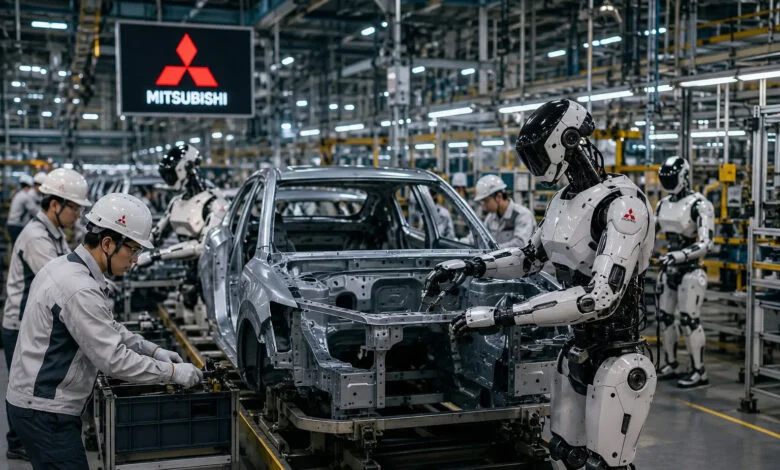
TOKYO — **Mitsubishi Motors** has announced a landmark **memorandum of understanding** to develop and manufacture AI-powered **humanoid robots** designed to work alongside human employees in its factories, addressing a severe **labor shortage** in Japan.
Under the new initiative, the Japanese automaker will not purchase pre-made robots from external suppliers. Instead, it is partnering with **Highlanders**, a technology startup spun off from the prestigious **University of Tokyo**. The robots will be manufactured directly within Mitsubishi’s own facilities under the supervision of its mechanical engineers.
### Re-equipping the Kyoto Plant
To accommodate this project, Mitsubishi will repurpose vacant buildings at its famous **Kyoto engine plant**, which currently produces internal combustion engines. The facility will be transformed into an integrated production line for humanoid robots, with actual manufacturing scheduled to begin in **early 2027**.
The automaker has set an ambitious production target of 1,000 humanoid robots per month.
Initially, these AI-equipped machines will be deployed to handle strenuous **logistics tasks**, such as moving and handling heavy automotive components. Subsequent phases will see the robots take over precise **welding** operations and complex **engine assembly** processes.
If the robots demonstrate sufficient mechanical efficiency and reliability on the assembly lines, Mitsubishi plans to expand the project into a commercial venture, exporting and selling the robotic units to other global automakers.
### Human-Robot Collaboration
Mitsubishi emphasized that this partnership represents the world’s first collaboration between an automotive brand and a robotics firm to establish a commercial, large-scale **mass production** line for humanoid robots. Management clarified that the initiative does not aim to replace human workers, but rather to foster an integrated **industrial environment** where humans and machines cooperate to maximize operational efficiency.
“Our collaboration with Highlanders represents a meaningful challenge to build a completely new industrial base where robots and humans work together in one work environment,” said **Takao Kato**, Chief Executive Officer of Mitsubishi Motors. “At the same time, this step gives Mitsubishi a golden opportunity to deepen our technological and commercial expertise in the humanoid robotics sector, and leverage existing **automotive supply chains** to support this development.”
### Background: Japan’s Industrial Automation Shift
Japan faces one of the world’s most acute demographic crises, characterized by a rapidly aging population and a shrinking domestic workforce. According to government data, more than one-quarter of the Japanese population is aged 65 or older, creating severe labor deficits across critical manufacturing sectors.
Automakers globally are increasingly turning to advanced automation to mitigate these labor constraints and lower production costs. While traditional industrial robotic arms have been a staple of car assembly lines for decades, the integration of AI-driven humanoid robots represents the next frontier. These machines are designed to navigate environments built for humans and perform highly dexterous tasks without requiring a complete redesign of existing factory layouts.