Google Open-Sources DeepMind AI Model to Accelerate 15-Day Hurricane Forecasting
The WeatherNext system predicts tropical cyclone trajectory and intensity simultaneously in under a minute.
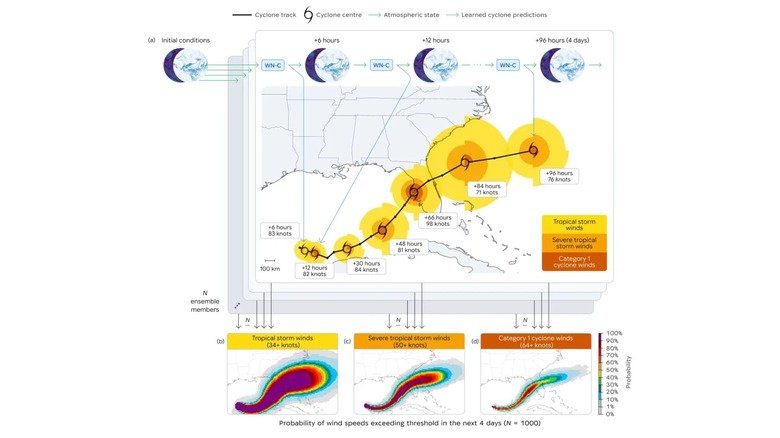
Google DeepMind and Google Research have made the code and model weights for WeatherNext publicly available on GitHub, introducing an artificial intelligence system that generates 15-day tropical cyclone track and intensity forecasts in less than a minute.
The system, detailed in a study published in the journal Nature, unifies two historically separate forecasting processes into a single computational framework. Meteorologists have traditionally relied on coarse global atmospheric models to project a storm’s trajectory, while using distinct, high-resolution localized models to calculate inner-core thermodynamics and wind intensity.
WeatherNext was trained on nearly 20 terabytes of global atmospheric data alongside historical cyclone records from the International Best Track Archive for Climate Stewardship. Running on specialized Google Tensor Processing Units (TPUs), the model dramatically reduces the time and computing power needed compared to traditional physics-based numerical weather prediction supercomputers.
“We can now generate a single 15-day forecast in less than a minute on a TPU, empowering forecasters to quickly evaluate the probability distribution of potentially devastating tail-risks,” the WeatherNext researchers wrote.
The project was developed in collaboration with major international forecasting authorities, including the National Hurricane Center, the UK Met Office, and the Cooperative Institute for Research in the Atmosphere. By releasing the underlying architecture open source, the technology can be implemented directly by public weather agencies and international researchers, including resource-constrained meteorological services that lack access to multi-million-dollar supercomputing infrastructure.
The public release represents the second generation of Google’s WeatherNext architecture, extending the company’s research into machine learning applications for severe weather events, which also includes predictive modeling for flash floods.