Global Stocks Rise as Trump Delays Iran Strikes and Oil Prices Stabilize
Equities surge in Europe and Asia after Donald Trump pauses U.S. strikes on Iran, cooling oil market volatility.

Global stock markets pushed higher on Tuesday as a sharp pullback in crude oil prices provided relief to equity investors following U.S. President Donald Trump’s announcement that he would hold off on new strikes against Iran.
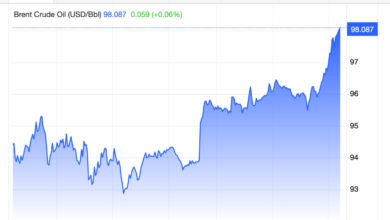
Energy markets stabilized following a steep drop of more than 5% in the previous session, with Brent crude edging up 98 cents to $84.75 a barrel while benchmark U.S. crude rose 15 cents to $80.49 a barrel. International crude prices had careened between $72 and $102 last month amid heightened anxiety over potential military conflict with Iran and uncertainty surrounding when oil tankers would be allowed to freely exit the Persian Gulf to deliver supplies globally.
The easing of geopolitical tensions in the Middle East helped ease broader concerns over energy-driven inflation, spurring gains across European equity indexes. Germany’s DAX surged 0.9% to 26,232.04, while France’s CAC 40 added 0.3% in early trading to 8,643.50. Britain’s FTSE 100 edged up nearly 0.4% to 10,897.75. U.S. equity futures also pointed to modest opening gains, with Dow futures up 0.1% at 53,409.00 and S&P 500 futures up 0.2% to 7,644.00.
Trading across Asia was similarly positive, led by South Korea’s Kospi, which gained 1.6% to 6,358.95. Australia’s S&P/ASX 200 added 1.4% to 9,145.80, and the Shanghai Composite gained 0.3% to 3,822.28. Bucking the regional trend, Hong Kong’s Hang Seng fell 0.6% to 25,852.92.
In Japan, the Nikkei 225 gained 0.3% to finish at 63,957.53, while financial markets continued to digest the effects of last week’s joint U.S.-Japan currency intervention. The coordinated central bank action was launched to support the Japanese yen after it plummeted to nearly 40-year lows near the 160-yen mark. On Tuesday, the U.S. dollar rose to 157.80 Japanese yen from 157.18 yen, while the euro cost $1.1513, inching down from $1.1514.
Although foreign exchange interventions rarely alter underlying economic fundamentals like interest rates and inflation differentials, joint actions involving the United States carry unique market significance. A report by BMI, a unit of Fitch Solutions, noted: “A U.S.-backed operation carries far more signaling weight than Tokyo acting alone, and the pledge of further action will give speculators pause. But any U.S. contribution will probably be constrained by size.”
Matthew Ryan, head of market strategy at global financial services firm Ebury, noted that the joint effort could exert lasting influence on market expectations. “This is an historic and meaningful development for the yen, which materially improves confidence in our mildly bullish call for the currency,” he said.