Extreme Heat Forces Airlines to Curb Passenger Loads as Flight Disruptions Rise
Rising temperatures and thinner air at key airports force carriers to shed fuel, bump passengers, and delay departures.
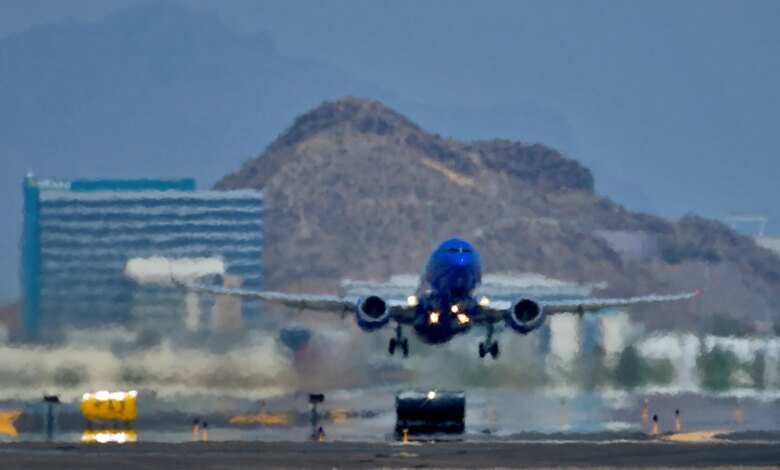
Surging summer temperatures across key North American and European air transit hubs are forcing commercial airlines to curb passenger loads and restrict fuel, as extreme heat increasingly undermines aircraft takeoff performance.
The operational strain was highlighted at Las Vegas’s Harry Reid International Airport, where American Airlines offered financial compensation to passengers willing to surrender their seats on a July 24 flight after ground temperatures reached 114 degrees Fahrenheit (47 degrees Celsius). The carrier cited standard industry weight-reduction protocols required to ensure safe departures in high heat.
The physical cause centers on density altitude: as ambient air warms, it expands and becomes less dense, diminishing both the aerodynamic lift generated by aircraft wings and the thrust produced by jet engines.
“There is a science behind all this,” said Ross Aimer, a retired United Airlines captain and chief executive officer of Aero Consulting Experts. “You can’t deny the science of flight and what it takes for an airplane to operate. Just like human beings, jet engines require lots of cool, dense air to perform well.”
Airlines and flight crews run preflight calculations factoring in total aircraft weight, ambient temperature, airport elevation, and runway length before every departure. High-altitude hubs such as Denver International Airport—sitting more than 5,000 feet above sea level—and airports with shorter runways, including New York’s LaGuardia and Washington’s Reagan National, face compounding operational restrictions when temperatures spike.
When calculated weight limits are exceeded, carriers are forced to reduce cargo, shed fuel and schedule intermediate refueling stops, delay flights until cooler hours, or bump passengers. Extreme conditions can render weight reductions insufficient entirely.
“At some point, the numbers just don’t make sense,” Aimer said. “You could roll down a runway as long as you want, and you still can’t take off.”
Weather station data underscores a steep rise in high-temperature operating days at major Southwest travel hubs. Phoenix Sky Harbor International Airport has averaged 43 days per year with temperatures reaching at least 110 degrees Fahrenheit since 2020—more than triple the mid-20th-century average, according to an analysis of weather station data by The Associated Press. Las Vegas has recorded an average of 18 such days annually since 2020, double its historical average, while Palm Springs International Airport averaged 55 days annually this decade, an 83% increase compared to the 2000s.
The Federal Aviation Administration does not set a single maximum temperature for takeoff, deferring instead to individual aircraft operating manuals, which vary by manufacturer, gross weight, and airport altitude. Certain regional aircraft models face maximum certified operating thresholds around 118 degrees Fahrenheit, triggering mandatory groundings regardless of load reductions.
Recent years reflect the expanding scope of heat-driven flight changes. American Airlines canceled dozens of regional flights out of Phoenix in June 2017 when temperatures climbed toward 120 degrees Fahrenheit, following similar cancellations in 2016. In July 2023, Delta Air Lines requested volunteer passengers to step off an aircraft in Las Vegas during an excessive heat warning due to weight restrictions, resulting in a flight cancellation after severe tarmac delays.
Research suggests operational disruptions will worsen. A study led by Columbia University, NASA’s Goddard Institute for Space Studies, and the Logistics Management Institute projected that mid-day weight restrictions could affect 10% to 30% of departing flights at vulnerable airports by midcentury if emissions continue rising. Separate research on European hubs estimated planes departing four major airports would need to shed payload equivalent to 10 passengers per flight by 2065.
Airport infrastructure actively compounds the thermal pressure. Jennifer Brady, a data scientist with Climate Central, noted that airfields experience severe urban heat island effects due to vast expanses of asphalt, minimal shade, continuous jet exhaust, and waste heat from ground operations, creating some of the hottest microclimates in urban centers.