Accenture Overhauls Five-Decade Operational Model as CEO Julie Sweet Pushes Enterprise AI Rewiring
Addressing geopolitical shifts and stagnant AI pilots, CEO Julie Sweet details a historic restructuring across the firm's 770,000-person workforce.

Accenture is executing the most comprehensive restructuring in its 50-year corporate history, dismantling internal divisions to create a unified operating structure capable of driving enterprise-level artificial intelligence deployments. The global consulting giant, which employs approximately 770,000 workers, is shifting away from traditional siloed business units to align its workforce with client demands for large-scale digital transformation.
Chief Executive Officer Julie Sweet, who has led the company since 2019, framed the organizational overhaul as an imperative for surviving and leading in the emerging artificial intelligence economy. According to Sweet, corporate attempts to layer generative AI onto legacy operational structures represent a fundamental miscalculation that frequently leads to failed initiatives.
The structural pivot comes at a critical juncture for the tech services industry. While enterprise spending on artificial intelligence continues to accelerate, market research indicates widespread friction in transitioning experimental projects into profitable operations. A study from the Massachusetts Institute of Technology found that up to 95 percent of enterprise generative AI pilot projects fail to yield measurable returns, underscoring the challenge legacy corporations face when integrating advanced algorithms into daily workflows.
Sweet countered widespread market skepticism regarding the commercial viability of AI, arguing that return on investment requires a strict alignment with financial fundamentals. She noted that enterprise leaders must tie AI deployment directly to balance sheets or established key performance indicators rather than relying on cross-functional steering committees, which she characterized as a sign of operational inefficiency.
Despite macroeconomic pressures—including fluctuating tariff regimes, shifting trade corridors across Southeast Asia and the Middle East, and supply chain realignments away from China—Accenture continues to secure significant enterprise commitments, logging roughly 30 client contracts valued at $100 million or more in single quarters.
Within its internal operations, Accenture has integrated agentic AI systems to automate complex tasks, reducing the development cycle of corporate strategy briefs from weeks to minutes and cutting creative turnaround times by up to 90 percent. The efficiency drive follows a broader operational lean-down: between fiscal year 2020 and the present, the firm lowered corporate overhead costs from 9 percent to 6 percent of total revenue, even as its global workforce expanded from 500,000 to nearly 800,000 employees.
Sweet’s management strategy has routinely challenged corporate norms at the Dublin-headquartered firm. Upon assuming the CEO position, she expanded the Global Management Committee from a small circle of direct reports to approximately 45 operational executives controlling revenue and costs. During the current corporate restructuring, she broke with traditional corporate protocol by eschewing written executive memos in favor of a direct video address, which was viewed by more than 500,000 employees.
Sweet’s path to the top of Accenture marks a distinct departure from traditional consulting leadership tracks. A former partner at prestigious law firm Cravath, Swaine & Moore, she joined Accenture at age 42 as general counsel under former CEO Bill Green. Lacking a technical background, she initiated an intensive 18-month technical mentorship under Bhaskar Ghosh—then head of Accenture’s India technology business and now Chief Strategy Officer—to master emerging software and cloud infrastructure.
In 2015, following a battle with breast cancer, Sweet was named Chief Executive Officer of Accenture’s North American business by then-Global CEO Pierre Nanterme. Her appointment in 2019 as Global CEO made her the first female chief executive in Accenture’s history, as well as the first leader who did not begin their career within the firm straight out of college.
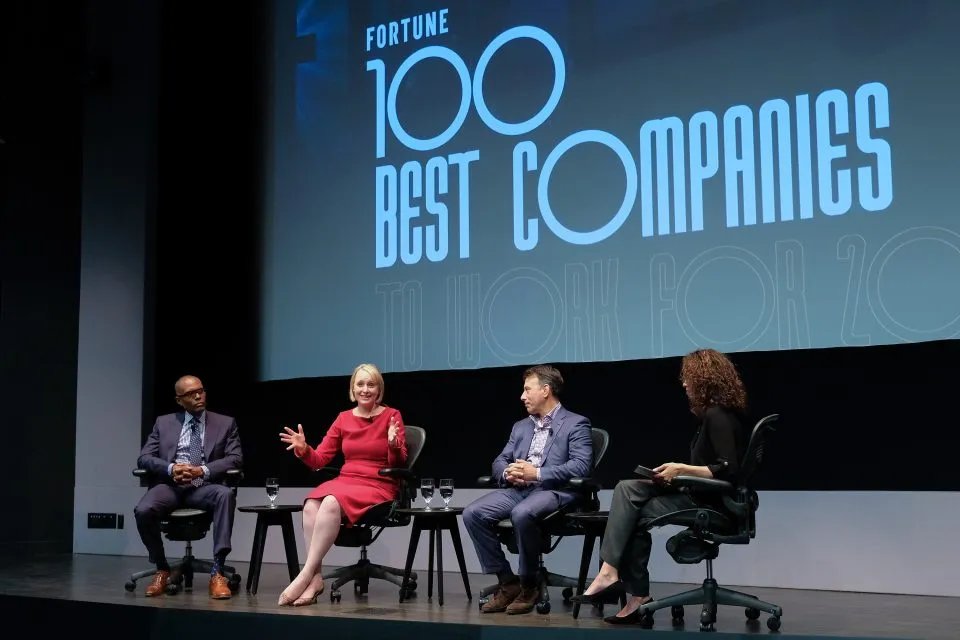
Looking toward technological horizons, Sweet projects that artificial general intelligence will materialize within the next decade. Rebuffing dire predictions regarding the potential collapse of Fortune 500 corporations under rapid technological change, she highlighted that contemporary chief executives are moving significantly faster to adopt AI than during previous technological shifts, such as early cloud migration.
Accenture tracks employee adaptation during organizational shifts using a proprietary performance tool known as Transformation GPS, benchmarking corporate change metrics against historical data to adjust internal communication strategies.