Strategy Pauses Bitcoin Purchases to Build $3.75 Billion Cash Buffer and Buy Back Preferred Stock
Corporate treasury pauses BTC buys for five weeks, issuing common stock to fund STRC buybacks and cash reserves.

Strategy has halted its aggressive Bitcoin acquisition campaign for five consecutive weeks—the company’s longest hiatus in two years—redirecting its capital pipeline toward stockpiling cash reserves and defending its distressed preferred shares.
Between July 20 and July 26, the corporate treasury giant raised $525 million by liquidating 5.4 million common shares (MSTR) through its at-the-market equity facility. The cash infusion boosted Strategy’s liquid reserves to $3.75 billion, creating a cash cushion sufficient to cover 2.1 years of its fixed annual capital obligations, which include $1.76 billion in preferred dividend distributions and debt service costs.
Rather than deploying the raised funds into digital assets, Strategy allocated $25 million to repurchase its STRC preferred stock. The move marks the initial buyback executed under a $1 billion authorization approved by its board on June 29. STRC shares have traded consistently below their $100 par value since mid-May, hitting record lows earlier this month and trading at roughly a 12% discount to their peg.
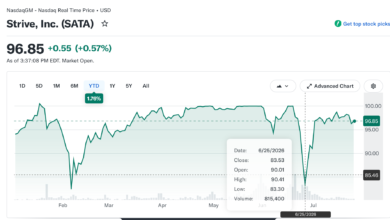
To execute this market defense, executive chairman Michael Saylor sold common equity trading roughly 80% below its historical peak to absorb discounted preferred stock. The tactical shift comes while Strategy’s balance sheet faces an $8.5 billion unrealized loss on its core crypto assets, with its 843,775 Bitcoin holdings valued below the $63.69 billion aggregate acquisition cost.
Ahead of its upcoming quarterly financial reporting, Strategy overhauled its core internal balance sheet metrics. The company established a “net Bitcoin per share” formula that subtracts $22.2 billion in outstanding debt and preferred claims. Simultaneously, it recalibrated its multiple of net asset value (mNAV) to 1.02x. In corporate treasury dynamics, an mNAV hovering near unity eliminates the accretive mathematical advantage of issuing fresh equity to acquire spot crypto assets, as new issuances near par fail to grow net asset concentration per share.
The treasury pause coincided with widespread market weakness across digital asset classes and international equity markets. Tech sector selloffs in memory semiconductor stocks and sharp drops in South Korean equities triggered liquidations across major cryptocurrencies.
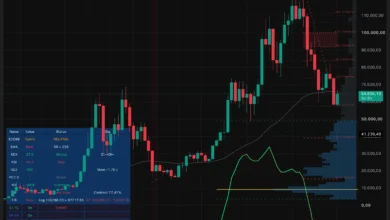
Bitcoin dropped nearly 3% to trade around $63,400, while Ethereum fell 4% to $1,875. Solana slipped 4% to $73.10, and Hyperliquid’s HYPE token logged a 9% decline to $54.45. Speculative digital assets experienced broader drawdowns, with major meme coins including Dogecoin, Shiba Inu, Pepe, and Bonk dropping between 4% and 8%.
Macroeconomic indicators reflected a fragmented global picture. Brent crude oil fell 2% to $81 per barrel, while gold eased 1% to $4,030. U.S. equity futures traded mixed, with Dow Jones futures gaining 0.7% on earnings reports, while the tech-heavy Nasdaq futures declined 0.9%.
On the legislative front in Washington, regulatory momentum slowed. The U.S. Senate formally deferred action on the CLARITY Act, setting aside the comprehensive crypto market-structure bill ahead of its upcoming recess. The delay guarantees the legislation will miss its projected August passage window despite weeks of last-minute negotiations.
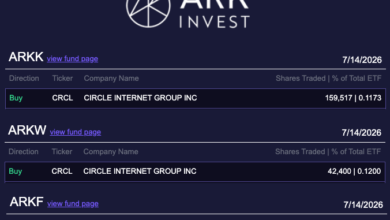
Despite legislative delays, institutional intellectual property expansion continued. Stablecoin provider Circle acquired nearly 1,000 blockchain patents from IBM, establishing an IP moat as market competition intensifies from traditional payment processors Visa and Stripe alongside rival issuers like Open USD.
In prediction markets, operators Kalshi and Polymarket secured a legal stay against Minnesota’s state-level prohibition. Concurrently, sports merchandise giant Fanatics acquired a regulated financial exchange to launch a direct prediction market platform alongside existing operators.
Exchange consolidation also continued as Kraken parent Payward acquired Magic Labs’ embedded wallet division, taking over an infrastructure system that has generated more than 60 million user wallets since 2018. Following the deal, Magic rebranded to Newton Labs to focus on onchain authorization technology.
In decentralized finance, Coinbase expanded its trading interface by introducing a “Launches” feature on its decentralized exchange platform, allowing immediate trading for newly deployed Base and Solana tokens as soon as they mint onchain.
Infrastructure pressure flared on alternative blockchains, where stablecoin-focused network Stable recorded a transaction volume spike exceeding 700% over two days. The surge filled remote procedure call (RPC) mempools to capacity while block production remained operational. Meanwhile, social trading application Fomo set new operational records, generating $1.79 million in weekly revenue and $1.96 million in protocol fees.