Anthropic Releases Claude Opus 5, Outperforming Flagship Models at Half the Cost
Artificial intelligence developer Anthropic officially released Claude Opus 5 on July 24, delivering a major performance upgrade across software engineering, enterprise automation, and complex problem-solving. Offered at $5 per million input tokens, the new flagship engine costs half as much to run as the company’s Claude Fable 5 while outpacing rival models from OpenAI on several major industry benchmarks.
The release repositions Anthropic’s product offerings for commercial subscribers, making Opus 5 the primary flagship model for both Claude Pro and Claude Max tiers. The shift comes after Fable 5 faced significant operational setbacks, including a brief temporary suspension in June due to emergency export controls from the U.S. government following a jailbreak discovery, after which Fable 5 was shifted to an unbundled, credits-only access structure.
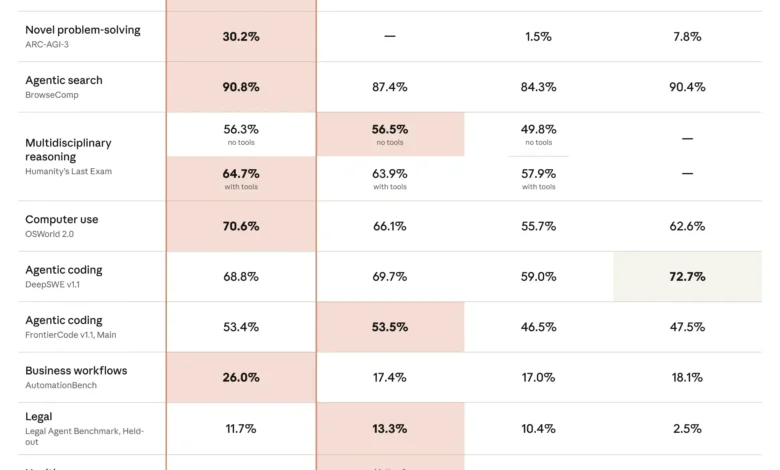
Benchmark results indicate substantial performance gains in high-complexity tasks. On ARC-AGI-3, a benchmark measuring abstract problem-solving capabilities on unmemorized puzzles, Opus 5 achieved a score of 30.2%, compared to 7.8% for OpenAI’s GPT-5.6 Sol. On the GDPval-AA v2 knowledge work evaluation, which uses Elo ratings to assess comparative performance on professional workloads, Opus 5 reached 1,861 points, surpassing Fable 5 at 1,747 and GPT-5.6 Sol at 1,736. Fable 5 retains a narrow lead over Opus 5 only in specialized legal and medical domains.
For developer workflows and software construction, Opus 5 scored 43.3% on Frontier-Bench v0.1, an evaluation focused on end-to-end agentic coding. By comparison, GPT-5.6 Sol recorded 34.4%, while Fable 5 scored 33.7%. Testing by developer platform Lovable demonstrated a 22% improvement over Opus 4.7 on difficult coding tasks, with Fabian Hedin noting marked consistency across execution runs. Enterprise workflow provider Zapier also reported a 100% completion rate on AutomationBench, where Opus 5 successfully performed a multi-stage churn prevention sequence using account health data—a task that previous model iterations failed to complete.
API access for Opus 5 is available at $5 per million input tokens and $25 per million output tokens, matching the pricing structure of its predecessor, Opus 4.8. Anthropic is also offering a high-speed Fast mode that operates at roughly 2.5 times standard speeds for $10 input and $50 output per million tokens. The pricing positions Opus 5 within Anthropic’s four-tiered structure—spanning Haiku, Sonnet, Opus, and the high-security Mythos class—as its premier operational workhorse.
In scientific research applications, DNA sequencing firm Ultima Genomics reported that the model demonstrates reliable statistical reasoning by independently validating analytical results and accounting for potential confounders during multi-step processes. The model’s launch follows recent international competitive shifts, coming one week after Beijing-based Moonshot AI released Kimi K3, a 2.8-trillion-parameter open-weight model backed by Alibaba that currently ranks third overall in global benchmark evaluations behind Fable 5 and GPT-5.6 Sol.