Canada Unveils $6.4 Billion Gordie Howe Bridge Amid Escalating U.S. Trade Tensions
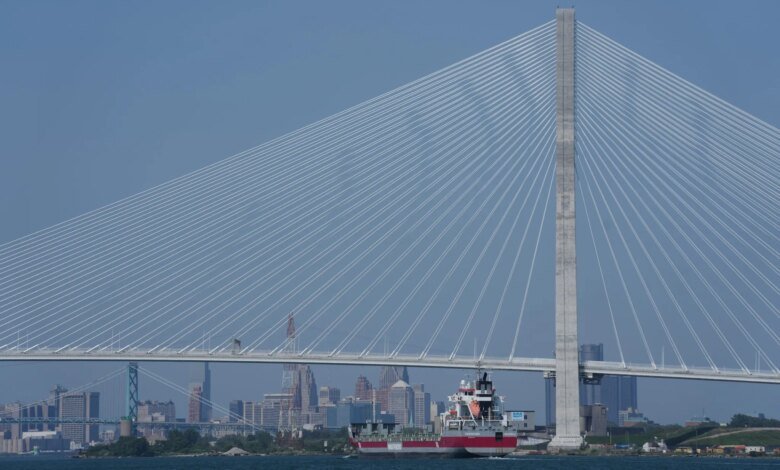
Canadian officials gathered in Windsor, Ontario, on Friday to celebrate the completion of the $6.4 billion Gordie Howe International Bridge, a massive six-lane span across the Detroit River that will officially open to vehicular traffic on Monday. However, the landmark event took place under an acute political shadow, as American representatives were absent following fresh trade disputes between Ottawa and Washington.
The planned joint ceremony was scaled back after U.S. President Donald Trump announced intentions to impose 50 percent tariffs on Canadian imports. In response to the sudden bilateral breach, event organizers performed only the Canadian national anthem, “O Canada,” while leaving American delegates off the official schedule. Windsor Mayor Drew Dilkens acknowledged the diplomatic tension prior to the event, calling the strained economic environment regretful while expressing hope for improved future relations.
Addressing attendees against the backdrop of the 1.5-mile cable-stayed bridge, Chuck Andary, interim chief executive officer of the Windsor-Detroit Bridge Authority, described the milestone as both the end of an extensive construction journey and the start of a transformative era for cross-border logistics. Cable-stayed bridge designs are routinely favored for major shipping corridors like the Detroit River because their high-clearing structures eliminate the need for mid-river support piers, ensuring unobstructed passage for Great Lakes commercial freighters.
The strategic importance of the new crossing to North American supply chains can hardly be overstated. According to the U.S. Department of Transportation, Detroit serves as the busiest port for commercial truck freight along the entire U.S.-Canada border, with more than 70 percent of Canada’s total exports bound for American markets. The Detroit-Windsor trade gateway alone facilitates more than $100 billion in cross-border goods annually, serving as a lifeline for integrated industries such as automotive manufacturing.
For nearly a century, commercial truck traffic moving across the Detroit River was restricted to a single point of entry: the privately owned Ambassador Bridge, which opened in 1929. The completion of the Gordie Howe International Bridge breaks that historic single-crossing bottleneck, introducing long-awaited competition and redundancy to the vital trade artery. Detroit Mayor Mary Sheffield emphasized the local economic impact of the project, noting that the new infrastructure will prove vital for regional financial growth.
Fully funded by the Canadian federal government, the 2.4-kilometer bridge stands 151 feet above the water at its highest point. Under a complex cross-border financial arrangement, Canada will share a portion of toll revenue with the U.S. federal government for 15 years. The state of Michigan is also slated to receive a share of toll proceeds, though those payments will only begin after Canada fully recovers its multi-billion-dollar construction costs—a milestone expected to take several decades.
Ground broke on the mega-project in 2018, though construction timelines experienced significant delays as global supply chains stalled during the COVID-19 pandemic. The structure honors hockey legend Gordie Howe, a Saskatchewan native who spent over two decades playing for the Detroit Red Wings, symbolizing the deep cultural ties uniting the border communities. Beyond commercial vehicles and passenger cars, the facility will feature a dedicated pathway for pedestrians and cyclists equipped with proper identification, set to open free of charge in the coming weeks.