U.S. Crypto Sector Projected to Generate $55 Billion in Economic Output as Employment Expands, Study Finds
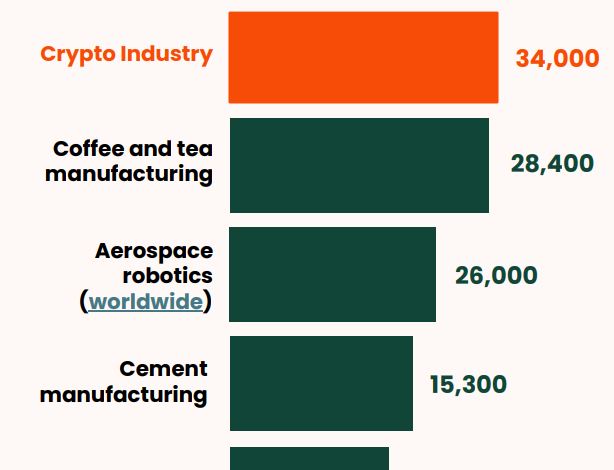
The United States digital asset industry is expected to inject $55 billion into the national economy this year, propelled by a combination of corporate payrolls, consumer spending, and secondary employment networks, according to a study commissioned by the National Cryptocurrency Association (NCA).
The report, prepared by the Pragmatic Policy Group, reveals that while direct employment within digital asset firms stands at roughly 34,000 workers, the broader economic ripple effect accounts for 232,000 jobs nationwide when accounting for direct, indirect, and induced labor. Figures from the U.S. Bureau of Labor Statistics indicate that direct headcounts in cryptocurrency now surpass the payroll numbers of domestic aerospace manufacturing as well as the coffee and tea production sectors.
Financial activities and real estate captured significant portions of this economic circulation. Investments in securities and commodity contracts generated $9.7 billion in overall impact, while residential real estate and housing markets derived a combined $4.8 billion from industry-supported wages and business expenditures. Economic multipliers naturally amplify corporate payrolls as employees re-inject capital into local service industries, mortgage markets, and retail ecosystems.
Geographically, established tech and finance centers lead in overall workforce size, with California, New York, Texas, Washington, and North Carolina capturing the highest concentrations of industry personnel. However, localized policy frameworks are reshaping the geographic distribution of blockchain infrastructure. The report notes that Colorado has seen accelerated activity due to state-level regulatory clarity, whereas North Dakota has converted tax incentives and low-cost energy policies into a commercial advantage. By utilizing excess flare gas from oil fields to power high-density computing rigs, North Dakota has increasingly established itself as an energy-integrated digital infrastructure destination.
The research reflects the outreach efforts of the NCA, an educational advocacy group launched in March 2025 with $50 million in seed funding from Ripple Labs. Led by Ripple chief legal officer Stuart Alderoty, the organization was created to quantify the sector’s tangible impact on domestic commercial activity and provide policy research to lawmakers.
Despite the macroeconomic totals cited in the report, the digital asset ecosystem continues to navigate severe commercial headwinds. Scale bottlenecks, elevated cloud infrastructure overhead, and shifting market dynamics led to notable venture shutdowns throughout 2026. New York-based start-up Entropy ended operations in January following a four-year run, while decentralized communication protocol Dmail closed in May under the pressure of unsustainable storage and bandwidth operational costs. Infrastructure platforms Tally and Balancer Labs similarly ceased activities in March, illustrating the ongoing divide between high-level macroeconomic footprint and the financial viability of individual early-stage projects.