The Offshore Evolution: Why the British Virgin Islands is Dominating Tokenized US Treasuries
As institutional capital demands legal and regulatory certainty, the Caribbean territory has quietly emerged as the world's second-largest hub for on-chain sovereign debt.
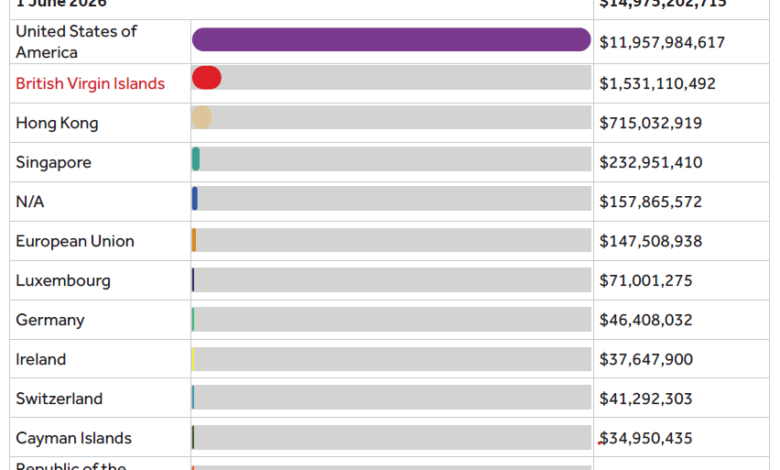
The landscape of global finance is undergoing a quiet but profound transformation. Today, more than $1 out of every $10 of the world’s tokenized US Treasuries is issued by a company incorporated in the British Virgin Islands (BVI). This remarkable statistic places the small Caribbean territory behind only the United States as a key jurisdiction for this rapidly growing asset class, according to BVI Finance, the voice of the territory’s financial services industry.
The scale of this shift is detailed in the agency’s Destination Digital report published in June. The study found that BVI-registered entities accounted for approximately $1.5 billion of the $14.98 billion global market for tokenized US Treasuries as of June 1. This milestone highlights how offshore financial centers are adapting to the rise of decentralized finance (DeFi) and the institutional migration toward blockchain-based market infrastructure.
This process, known as real-world asset tokenization, bridges traditional finance (TradFi) and digital asset networks by converting ownership rights of physical or financial assets into digital tokens on a blockchain. This mechanism unlocks fractional ownership, continuous trading, and instant settlement. In a high-interest-rate environment, tokenized US Treasuries have become the premier gateway for crypto-native institutions, decentralized autonomous organizations (DAOs), and international investors seeking low-risk, yield-bearing assets without exiting the blockchain ecosystem.
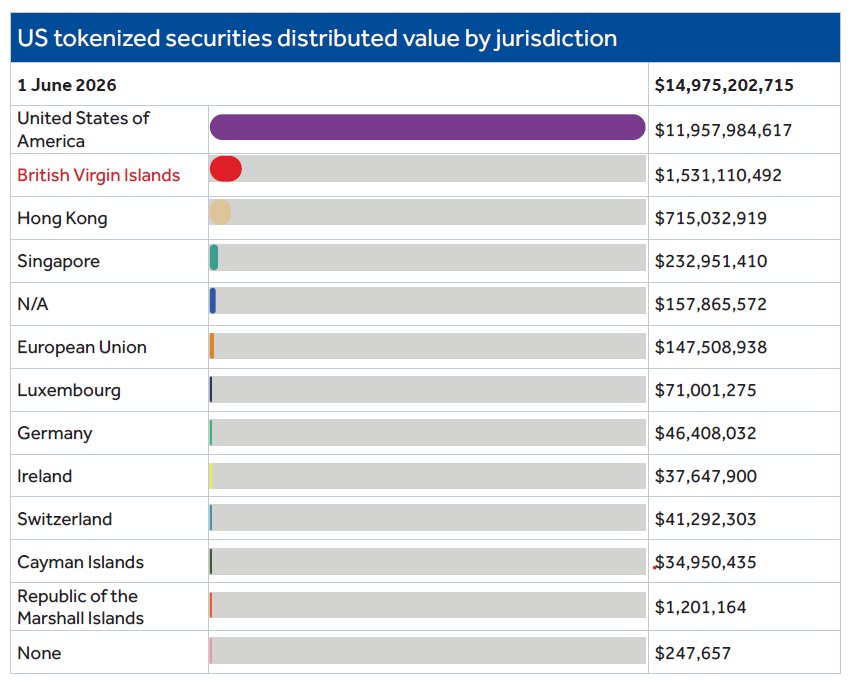
US tokenized securities distributed value by jurisdiction. Source: Destination Digital
A growing list of prominent digital asset firms now call the British Virgin Islands home. Among them are Payward (the parent company of major exchange Kraken), Bitstamp (which was recently acquired by Robinhood), decentralized exchange aggregator 1inch, and Bitfinex. Beyond treasury issuance, the territory boasts a stablecoin market cap of about $1.2 billion held in BVI-linked addresses, supported by roughly 28,000 stablecoin asset holders.
The regulatory footprint is equally substantial. More than 25 virtual asset service providers (VASPs) have been approved under the BVI’s regulatory framework. Furthermore, data compiled by Bernstein Research indicates that the Islands host 305 tokenized securities—representing the highest count for any single jurisdiction in the RWA.xyz dataset.
While these statistics suggest the Virgin Islands has become one of the world’s top crypto hotspots, the reality on the ground is more nuanced. Tokenized assets are inherently designed to be borderless, giving crypto projects wide latitude in choosing where to incorporate. In most cases, digital asset companies are not physically relocating their executive suites or engineering teams to the Caribbean; instead, they are utilizing the territory to incorporate specific legal entities, such as token issuers, treasury vehicles, holding companies, or special purpose vehicles (SPVs).
Moving Beyond the Legacy Tax Haven Narrative
Historically, offshore jurisdictions were associated almost exclusively with tax mitigation. However, the modern digital asset sector is driven by a different set of priorities. Andrew Jowett, a partner at Appleby (BVI) Ltd who advises digital asset businesses on corporate structuring, explained that clients researching the BVI typically compare several jurisdictions, including the Cayman Islands, the United Arab Emirates (UAE), Singapore, and Switzerland.
Despite long-held assumptions about offshore Caribbean tax havens, tax neutrality is no longer the primary driver for these companies.
“The overriding factor for choosing the BVI has been digital asset regulation and not tax,” Jowett said. While the British overseas territory maintains attractive tax policies—imposing no corporate income tax or capital gains tax on BVI companies—virtually all competing crypto hubs offer similar incentives. The Cayman Islands likewise imposes no corporate income tax or capital gains tax, while the UAE features zero personal income tax and zero federal corporate tax on qualifying free zone entities.
“Tax neutrality is table stakes,” said Saeed Al-Marri, chief executive of digital asset infrastructure firm Ethra, which is incorporated in the BVI. Al-Marri emphasized that the BVI’s true value proposition lies in its legal certainty and clarity—factors he believes will ultimately determine which jurisdictions survive the next wave of institutional adoption.
This sentiment is echoed by institutional infrastructure providers. LTP, a digital asset prime brokerage operating regulated entities in the BVI, Hong Kong, Australia, and the UAE, views regulatory compliance as a prerequisite for institutional integration. Jack Yang, founder and chief executive of LTP, noted that while favorable taxation remains relevant for cross-border corporate structures, it is secondary to legal and regulatory certainty as tokenization moves further into institutional finance.
“A tax-neutral structure that cannot pass review by banks, custodians, auditors, investment committees, or regulators has limited practical value,” Yang said.
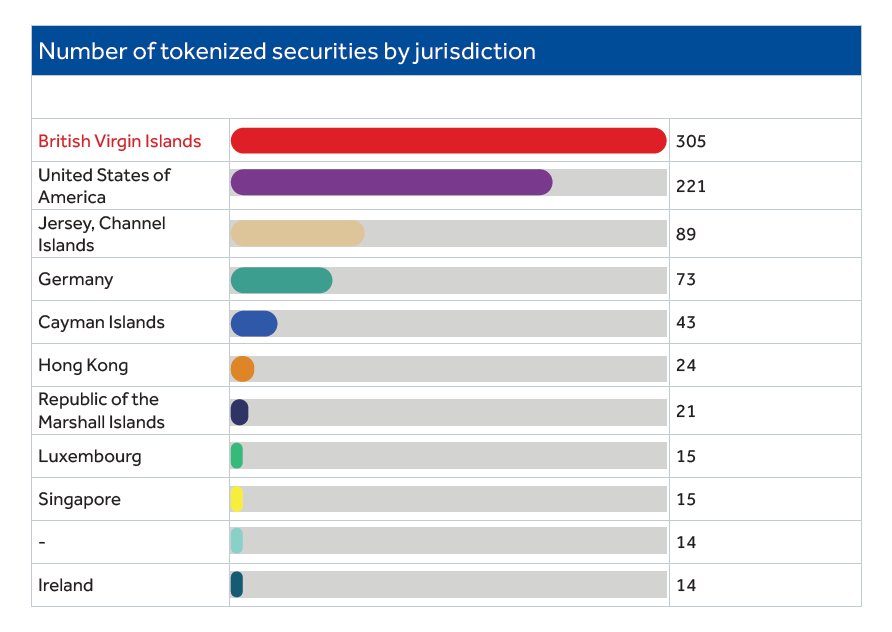
Number of tokenized securities by jurisdiction. Source: Destination Digital
Orest Gavryliak, chief legal officer at decentralized exchange aggregator 1inch, which is incorporated in the BVI, observed that decentralized finance (DeFi) protocols are increasingly prioritizing predictable legal environments over the lowest possible tax rates.
“Jurisdiction isn’t exactly becoming irrelevant, but its role is changing,” Gavryliak said. “Protocols are increasingly weighing factors such as regulations, institutional credibility and long-term sustainability.”
The Battle of Legal Infrastructures
As global competition intensifies, jurisdictions seeking to establish themselves as premier crypto hubs are competing on the sophistication of their legal frameworks. Singapore has leveraged its Payment Services Act, and Dubai has built a dedicated ecosystem under its Virtual Assets Regulatory Authority (VARA) rulebooks.
To keep pace, the BVI introduced the Virtual Assets Service Providers Act (VASP Act) in 2023, overseen by the BVI Financial Services Commission (FSC). Designed to balance robust oversight with commercial efficiency, the regime offers a relatively rapid turnaround. According to BVI Finance and FSC guidance, the regulator responds to VASP applications within six weeks and aims to complete the full review process within six months.
Jowett noted that alongside regulatory frameworks, clients prioritize “ease of launch” and efficient corporate structuring—long-standing pillars of the BVI’s corporate registry. Legal entities can be established quickly, corporate frameworks remain highly flexible, and ongoing reporting requirements are generally less burdensome than those found in onshore jurisdictions.
Historically, the BVI has also been favored for offering greater corporate confidentiality than larger onshore financial centers. While BVI companies must comply with strict anti-money laundering (AML) and know-your-customer (KYC) standards, beneficial ownership information is held securely by licensed registered agents rather than published on a public registry, reducing unnecessary exposure.
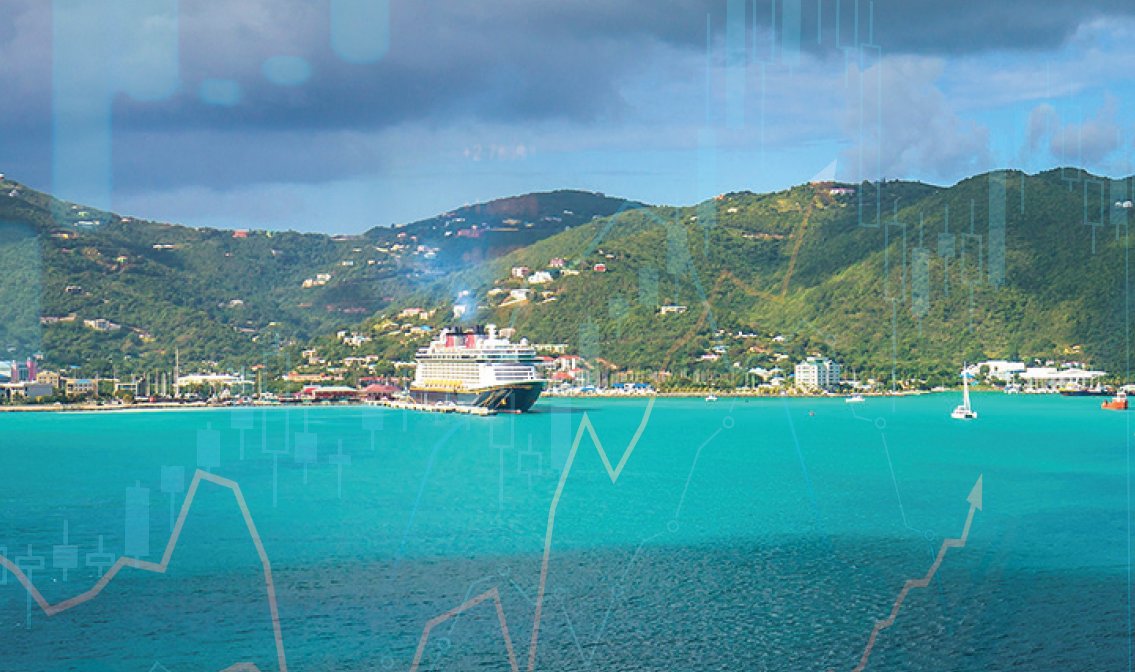
British Virgin Islands. Source: Destination Digital
Interestingly, none of the digital asset firms interviewed cited tax neutrality or corporate confidentiality as their primary motivation for choosing the BVI. Instead, they consistently pointed to legal predictability, regulatory clarity, and corporate flexibility as the deciding factors.
Incorporation Without Physical Footprints
The operational reality of these BVI entities highlights the decentralized, borderless nature of the modern digital asset industry. Yang confirmed that LTP does not maintain full-time staff “on the ground” in the BVI. Instead, the BVI entity is managed directly by its board of directors and supported operationally by personnel located across other offices in the LTP group.
This operational model is common across the industry. Payward, the corporate entity behind Kraken, is incorporated in the BVI, yet the exchange’s primary operations and workforce are based in the United States. Similarly, 1inch maintains its corporate registration in the BVI, but its development teams and operations are distributed globally across multiple jurisdictions.
The British Virgin Islands may not be winning the race to attract physical headquarters, executive offices, or large-scale engineering teams. However, by providing a robust, predictable, and highly efficient legal framework, the territory has successfully positioned itself as the corporate foundation for the rapidly growing real-world asset tokenization market. For offshore jurisdictions looking to secure a vital role in the future of global finance, that foundation is proving to be more than enough.