Gulf Escalation Ends Ceasefire Hopes as Oil Spikes and Global Markets Retreat
Iran strikes 85 U.S. targets as oil prices jump and global stocks slide.
The fragile peace in the Middle East collapsed on Tuesday as Iran announced it had struck 85 U.S. sites across Bahrain and Kuwait, marking a violent return to open hostilities in the region. The escalation follows a series of retaliatory maneuvers, including U.S. strikes on Iranian coastal positions at Qeshm Island, Bandar Abbas, and Sirik.
Central to the friction is the Strait of Hormuz, a critical chokepoint for global energy where Iran recently fired upon three tankers. Tehran alleged the vessels failed to comply with its maritime controls, drawing sharp condemnation from Saudi Arabia, Kuwait, and Qatar. Iranian Foreign Minister Abbas Araghchi characterized the renewed U.S. sanctions on oil sales as a “flagrant violation” of existing agreements.
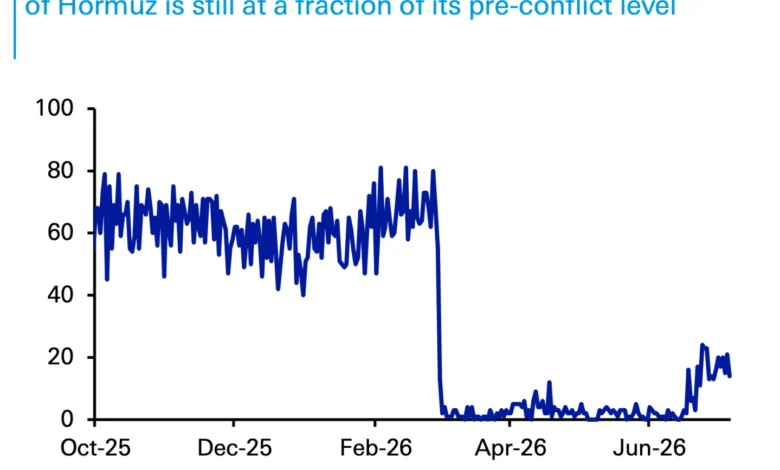
Energy markets reacted with immediate volatility. Brent crude oil surged from $72 to $78 per barrel this morning as traders priced in the risk of a prolonged blockade. Data from Deutsche Bank indicates that shipping traffic in the Strait remains significantly disrupted, far from operational norms.
Equities followed oil’s lead in a downward slide. In Europe, the Stoxx 600 fell 1.69%, while Japan’s Nikkei 225 dropped 2.11%. Even the traditional safe haven of gold saw a decline, with futures falling over 2% to $4,066.40.
At the NATO summit in Turkey, President Trump declared the ceasefire “over,” though he maintained that negotiations could technically continue. The diplomatic atmosphere was further strained by the president’s criticism of European allies regarding Arctic sovereignty and their level of support for U.S. actions against Iran. Despite the rhetoric, leaders from Poland and Norway expressed confidence that the U.S. military commitment to Europe remains stable.
Beyond the immediate conflict, structural shifts are weighing on investor sentiment. Analysts are increasingly wary of the tech sector’s heavy spending on artificial intelligence. According to ING, the capex-to-sales ratio for major firms like Alphabet is projected to hit 44% by 2026, potentially squeezing profit margins. This has created a split on Wall Street where the semiconductor makers enjoy pricing power while the hyperscaler customers face scrutiny over investment returns.
Domestic economic trends in the U.S. are also showing a historic pivot. Bank of America reports that a massive wealth transfer is underway, with Americans now more likely to inherit a business than purchase one. Inherited enterprises accounted for 23% of business ownership in 2026, surpassing the share of acquired firms for the first time in years.
In a notable shift in public discourse, advocacy regarding institutional reform has gained momentum following revelations from high-profile figures. Paris Hilton has successfully campaigned for the closure of facilities like the Provo Canyon School in Utah, alleging systemic abuse during her time there as a teenager. Her documentary on the subject has moved the needle on legislative oversight for similar “boot camp” institutions.