

Collagen Supplements: What 90 Days of Research Reveals About Skin, Joints, and Product Quality
Clinical data, third-party testing, and formulation details that determine whether collagen peptides deliver measurable results
Collagen supplements have moved from niche wellness aisles into mainstream drugstores and physician offices, with U.S. sales projected to exceed $2 billion annually. Yet consumers still face basic questions: Do these products deliver measurable benefits, or is the category built on marketing momentum?
A 2019 double-blind, placebo-controlled study published in the Journal of Drugs in Dermatology found that women taking 2.5 grams of specific bioactive collagen peptides daily for 90 days showed statistically significant improvements in skin elasticity, hydration, and wrinkle depth compared to placebo. The peptides used — Verisol®, a porcine-derived Type I and III hydrolyzed collagen — are among the few formulations with published clinical backing for skin outcomes.
“Not all collagen is created equal,” said Samantha McKinney, RD, CPT, a master trainer at Life Time who oversees the company’s supplement formulary. “The molecular weight, peptide profile, and source material determine whether the product survives digestion intact enough to signal fibroblasts in the skin.”


Hydrolyzed collagen peptides — also called collagen hydrolysate — typically range from 2,000 to 5,000 daltons, small enough for intestinal absorption. Larger, unhydrolyzed collagen molecules break down into individual amino acids during digestion, losing the specific peptide sequences that research suggests act as signaling molecules to stimulate endogenous collagen production.
Product format affects adherence more than bioavailability. Liquid shots, powders, capsules, and gummies all deliver hydrolyzed peptides if manufactured correctly. A 2023 consumer survey by the Council for Responsible Nutrition found that 68% of supplement users who switched from powder to liquid cited convenience as the primary driver, with taste and texture as secondary factors.
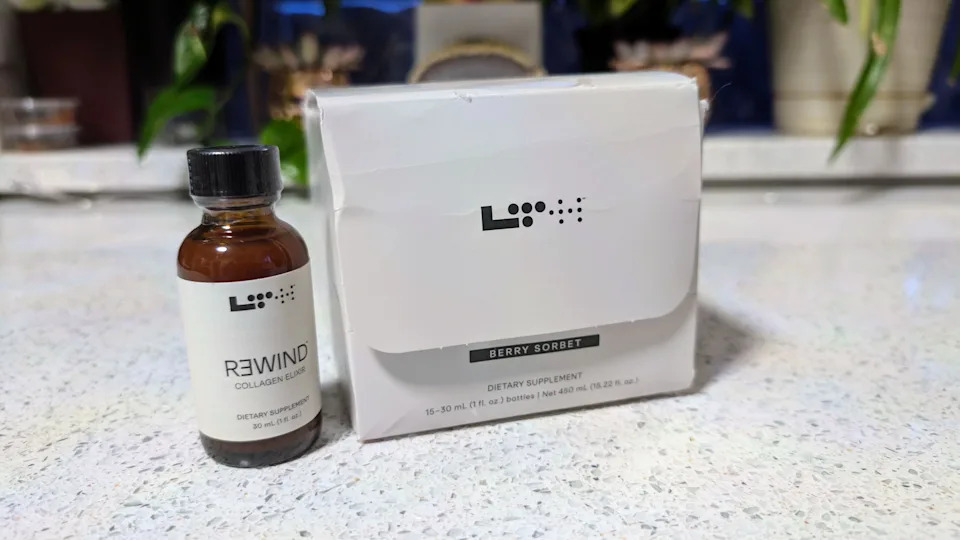
Third-party testing remains the critical quality differentiator. The FDA regulates supplements under DSHEA (1994), which does not require pre-market efficacy proof or mandatory contaminant screening. Brands that voluntarily submit to NSF Certified for Sport, USP Verified, or Informed Sport certification provide batch-level certificates of analysis for heavy metals, microbial contamination, and label accuracy. Life Time’s LTH line, including the Rewind Collagen Elixir tested in a 90-day informal trial, undergoes such testing.
The Rewind formulation combines 5 grams of Verisol® and Fortigel® (a bovine Type II collagen peptide studied for joint cartilage support) with 120 mg hyaluronic acid, 90 mg vitamin C, and Lutemax 2020® (lutein and zeaxanthin isomers). Vitamin C is a required cofactor for prolyl and lysyl hydroxylases, the enzymes that stabilize collagen’s triple helix structure — a detail many single-ingredient products omit.
Collagen is not a complete protein. It lacks tryptophan and is low in branched-chain amino acids, making it unsuitable as a primary protein source. The FDA’s Protein Digestibility-Corrected Amino Acid Score (PDCAAS) rates collagen at 0.08 versus 1.0 for whey or soy. Consumers replacing meals with collagen drinks risk essential amino acid deficiencies.
Source material matters for dietary restrictions and allergen profiles. Bovine collagen (Type I and III) dominates skin and bone research. Marine collagen (Type I) from fish skin and scales offers a lower molecular weight alternative but carries shellfish cross-contamination risks and sustainability concerns. Porcine collagen (Verisol® source) is less common in U.S. retail but well-studied in European dermatology literature. No vegan collagen exists; “plant-based collagen boosters” supply vitamin C, silica, glycine, proline, and copper to support endogenous synthesis.
Safety data from systematic reviews indicate mild gastrointestinal symptoms (bloating, fullness) in under 10% of users at doses up to 10 grams daily. Theoretical concerns about oxalate excretion from hydroxyproline metabolism remain unproven in humans at supplement levels. Patients with histamine intolerance should note that fermentation-derived collagen may contain trace histamine.
Cost per effective dose varies widely. Clinical studies typically use 2.5–10 grams daily. At retail, verified products range from $1.20 to $3.50 per 5-gram serving. Subscription models and club pricing (Life Time members receive 25% off LTH) can reduce per-serving cost below $1.
The evidence supports collagen peptide supplementation for skin hydration, elasticity, and nail growth at researched doses from quality-verified products. Joint benefits require Type II collagen (Fortigel®, UC-II®) at specific doses (40 mg undenatured or 5–10 grams hydrolyzed) with longer timelines — typically 12–24 weeks. Consumers should prioritize third-party certification, transparent peptide sourcing, and cofactor inclusion (vitamin C) over format or brand narrative.









