China’s Share of Global Container Exports Hits 40% Before Trump-Xi Summit
Trade diversion and intermediary routes have helped sustain Chinese shipments despite Western tariff barriers.
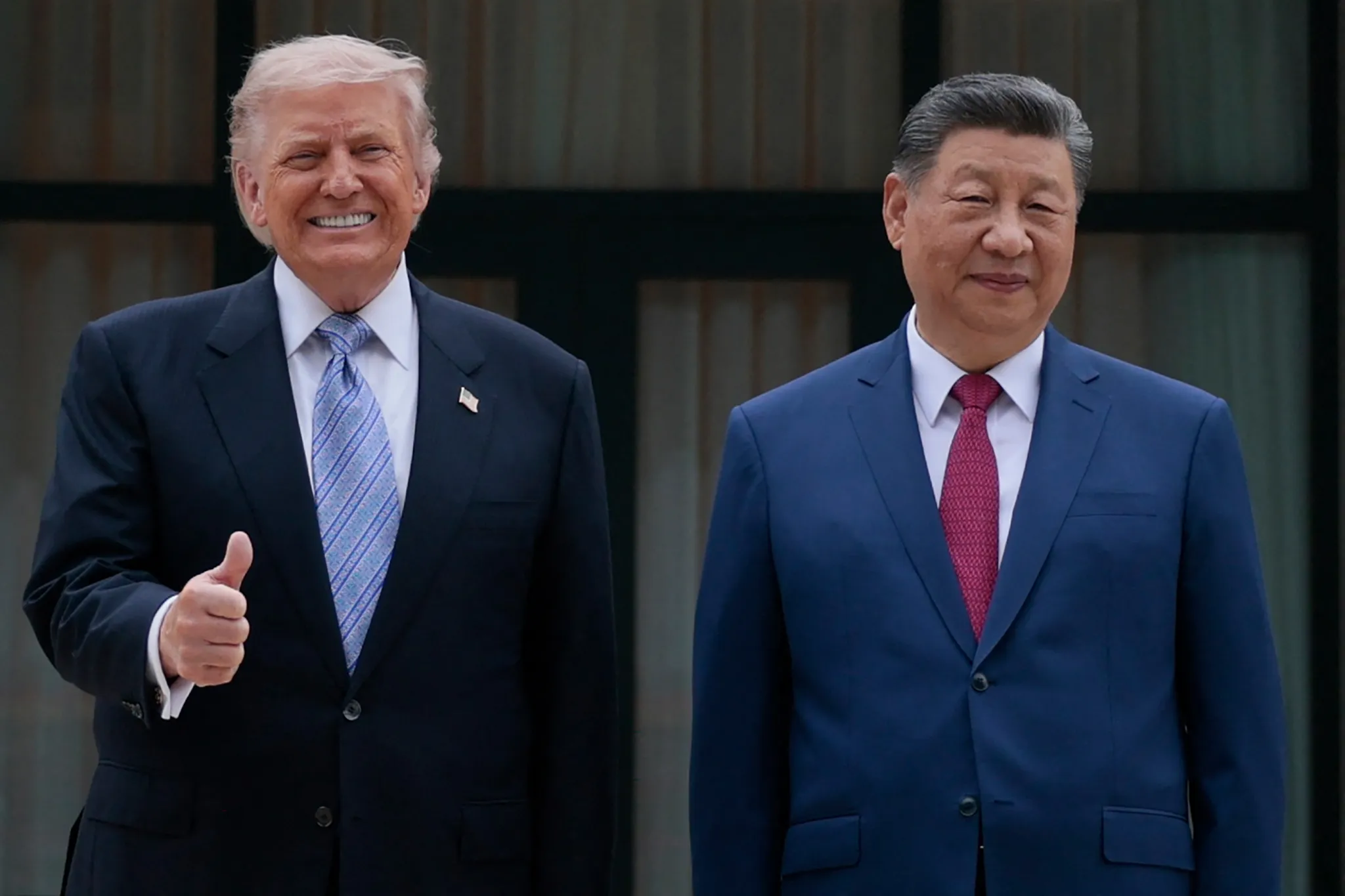
China now accounts for 40% of global container exports on a rolling three-month basis, a record reached on the eve of a two-day bilateral summit between Donald Trump and Chinese President Xi Jinping. The figure is 2.5 percentage points higher than nine months earlier, according to data disclosed by Jens Eskelund, president of the European Union Chamber of Commerce in China.
The increase comes after years of U.S. and European efforts to “de-risk” supply chains and reduce reliance on China. Rather than curbing Chinese industrial output, economists say tariff barriers have helped redirect trade routes, prompting exporters to diversify customers and send goods through intermediary countries.
That adjustment has carried costs for Chinese firms, said Andrew Greenland, a North Carolina State University economics professor who specializes in tariff policy. Routing goods through secondary nations adds transaction costs, shipping delays and administrative overhead, he said, making the increase in container shipments a sign of trade diversion and adaptation rather than a net expansion in genuine economic demand. Greenland described the changes as costly compromises, though they have also pushed Chinese companies to build deeper supply networks across Latin America, Africa and Southeast Asia.

A key mechanism is transshipment: Chinese manufacturers send intermediate components to countries with favorable U.S. or European trade agreements, where the goods are assembled and exported under local labels. The practice can avoid direct duties imposed under Section 301 of the U.S. Trade Act. Southeast Asian countries including Vietnam and Thailand, as well as Mexico, have benefited. Mexico officially surpassed China as the top exporter of goods to the United States in 2023, while Chinese foreign direct investment has helped fuel the shift, with Chinese firms building factories there to use tariff-free access under the United States-Mexico-Canada Agreement (USMCA).
A White House assessment estimated the U.S. government lost between $19 billion and $26 billion in customs revenue because of transshipments, identifying Chinese companies as the main drivers. U.S. trade authorities have broadened the legal definition of transshipment to cover goods linked to Chinese supply chains or containing significant Chinese components. Enforcing the expanded definition across global shipping networks remains a logistical challenge.
The scale of Chinese exports has intensified concerns in Washington and Brussels about a “China Shock 2.0.” The earlier shock followed China’s accession to the World Trade Organization (WTO) in December 2001, when an influx of low-cost manufactured goods damaged Western industrial sectors. Peer-reviewed research by economists David Autor, David Dorn and Gordon Hanson estimates that the first wave cost the United States roughly 2 million to 2.4 million manufacturing jobs between 1999 and 2011, leaving entire regions of the American Rust Belt economically depressed.
The current surge is concentrated less in low-tech goods such as textiles, furniture and toys than in high-value strategic and high-tech industries, economists warn. State subsidies support Beijing’s “new three” growth pillars—electric vehicles (EVs), lithium-ion batteries and solar panels—and Chinese manufacturers are producing more than domestic demand can absorb. That overcapacity has allowed Chinese firms to price exports up to 30% below Western competitors, threatening to constrain U.S. and European green-technology industries before they reach scale. Chinese exports are also expanding into artificial intelligence infrastructure, advanced semiconductors and telecommunications equipment.
The European Commission has warned that cheap Chinese imports are squeezing European manufacturers out of their home markets. The EU has responded with anti-subsidy investigations, most recently imposing definitive tariffs of up to 35.3% on Chinese-made electric vehicles, in addition to the standard 10% car import duty.
The United States has gone further. Building on duties introduced during Trump’s first administration, the Biden administration locked in increases under Section 301, including a 100% tariff on Chinese electric vehicles, 50% on semiconductors and solar cells, and 25% on lithium-ion batteries and critical minerals.
Jeremi Suri, a professor of public affairs and history at the University of Texas at Austin, called the tariff policies of the past two years an “unmitigated disaster.” He said they had compounded the vulnerabilities they were meant to address and eroded the United States’ standing as a stable, predictable trading partner, pushing neutral countries closer to China’s commercial orbit.