
BMW’s M2 CS Carbon Buckets: A Groin Divider Designed for Lap Times, Not Anatomy
The 543-horsepower M2 CS holds the driver in place with a carbon divider that does not yield.
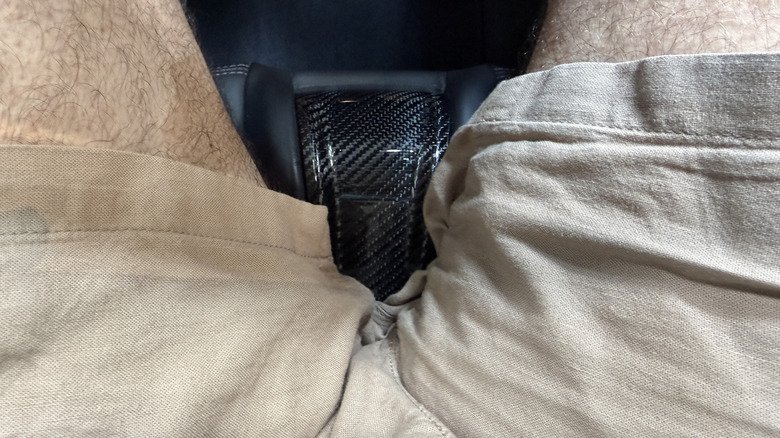
The M Carbon bucket seats in BMW’s M2 CS pressed a rigid, pronounced carbon-fiber divider against the inside of the driver’s thighs, directly against the groin, throughout the test drive. The divider is located dead center on the bottom cushion, extending upward as a fixed barrier between the legs. BMW designed the component primarily to accommodate multi-point racing harnesses, providing a sub-strap pass-through and enforcing a split-leg driving posture. The seats also reduce weight by approximately 21 pounds (9.6 kg) compared with standard M Sport seats.
The ultra-high, non-yielding carbon side bolsters clamped the driver’s torso and legs during cornering. On a public road, the bolsters required the driver to rotate the upper body sideways and drop into the seat at an angle, then repeat the process in reverse to exit. The M2 CS’s S58 3.0-liter twin-turbo inline-six engine produces 543 horsepower and 406 pound-feet of torque, routed through an eight-speed automatic transmission to the rear wheels. The track-focused tuning includes a stiffened adaptive suspension and aggressive weight-saving carbon fiber components, including the roof, hood, and front splitter.The seats held the driver in place under high lateral G-forces during a series of on-ramp sweepers. The carbon divider pressed harder into the inner thigh with each turn, shifting the driver’s seating position slightly off-center after repeated bends. BMW’s design rationale for the bucket seat geometry centers on extreme lateral restraint during track driving, where the combination of the S58’s power delivery and the stiffened chassis generates cornering forces that require the driver to remain fixed in position. The side bolsters on the M Carbon buckets rise higher than those on the standard M Sport seats, reaching above the hip bone on both sides. Entering the car, the driver’s left foot caught the bolster edge twice before clearing it. During a stop-and-go highway segment, the driver shifted weight every 90 seconds to relieve pressure from the center divider. The seat’s carbon-fiber structure does not flex under load, unlike foam-based performance seats in other BMW M models. The M2 CS’s adaptive suspension, set to its stiffest Sport Plus mode, transmitted every expansion joint and pavement crack through the seat base directly into the spine. The suspension can be softened to Comfort mode, which reduces vertical impact harshness but does not alter the seat’s rigid structure. BMW offers the M Carbon bucket seats as an optional upgrade on the M2 CS. The standard M Sport seats include adjustable lumbar support, power-adjustable side bolsters, and a flat cushion without a center divider. A sales representative at BMW of North America stated that the carbon buckets are the only seat option for customers who order the M Driver’s Package, which raises the top speed from 155 mph to 174 mph. The M2 CS’s curb weight, with the carbon buckets installed, is 3,647 pounds. The same car equipped with M Sport seats weighs 3,669 pounds. The 22-pound difference comes entirely from the seat structure and the removal of power-adjustment motors. A passenger who weighed approximately 180 pounds sat in the carbon bucket for 30 minutes and reported numbness in the left leg after 22 minutes. The driver experienced no numbness but noted a persistent red mark on the inner right thigh after the 90-minute test drive. The mark faded within 45 minutes of exiting the vehicle.