
The 11-Year-Old Alfa That Makes Modern Super-Sedans Look Overbuilt
A Ferrari-derived V6 and lightweight chassis keep Alfa’s aging Quadrifoglio ahead in the corners

The Alfa Romeo Giulia Quadrifoglio arrived in 2015, shortly after BMW introduced the F80-generation M3. Its Italian-built, Ferrari-derived V6 gave it more output than the BMW and put it into a fairer fight with the twin-turbo V8 in the Mercedes-AMG C 63 S of the era.
It also brought something the German competition never quite matched: a sense of passion in both its design and the way it drove. That brilliance never translated into M3 or C 63 sales, and the car now occupies an even stranger place in the market.
BMW has moved to the G80 M3, Mercedes-AMG has replaced the C 63’s V8 with a plug-in-hybrid four-cylinder, and Alfa Romeo is preparing future performance cars around Stellantis’s STLA Large platform, which is designed for fully electric and heavily electrified architectures. The Giulia Quadrifoglio was supposed to disappear last year, but Alfa granted it an eleventh-hour stay through next year. Its continued production turns the pure, non-hybrid, rear-wheel-drive sedan into an unexpected final internal-combustion swan song.

That is a very different proposition from the one it offered when new. We recently spent time with the 2026 model to see whether the flagship Giulia still makes sense or has become a relic that happens to be exceptionally good at going around corners.
Aside from a minor midlife facelift, very few updates have been made since the Giulia arrived. The Quadrifoglio still wears the same shapely carbon-fiber hood and uses the same 2.9-liter twin-turbocharged V6. Its age is obvious in the technology, but less so in the parts that determine how it feels on a road.
In Australia, the range-topping Giulia starts at AU$156,990 (US$112,000) before on-road costs and rises to a little over AU$170,000 (US$121,000) with all fees. The US market lost both the Giulia and Stelvio Quadrifoglio in mid-2024, leaving prospective American owners to search the used-car market. The price gap is wider than the production timeline suggests: an entry-level rear-wheel-drive BMW M3 costs at least AU$190,888 (US$136,300), while the M3 Competition xDrive costs AU$210,291 (US$150,200). The Mercedes-AMG C 63 S E Performance reaches AU$218,644 (US$156,100), including fees.
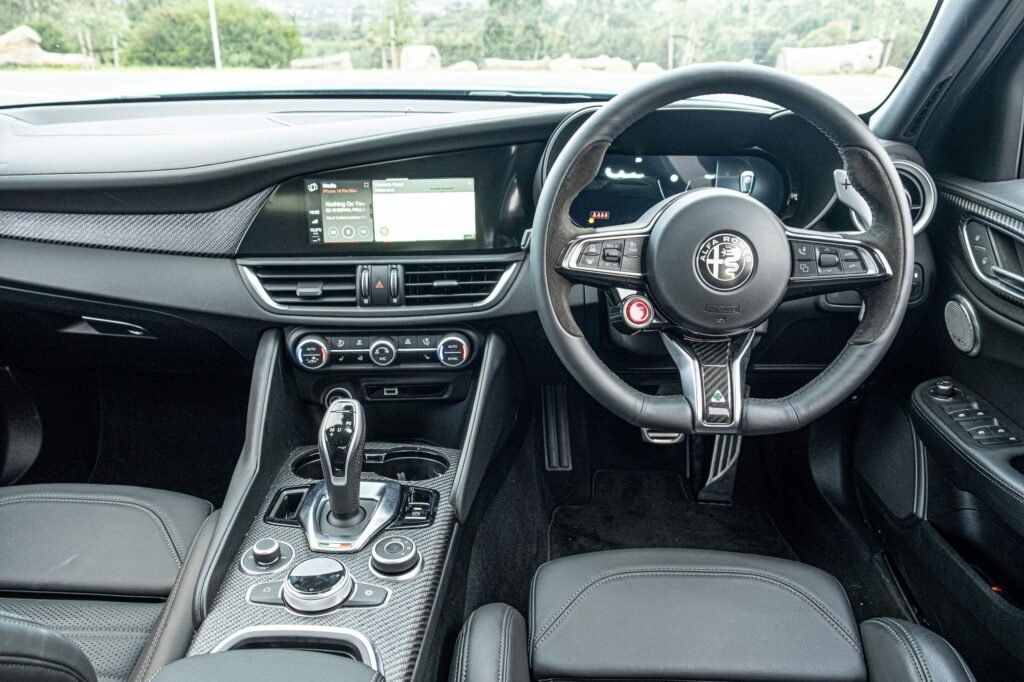
The Giulia’s lower price does not make its cabin feel newer. Visually, the layout remains attractive, and the driving position is excellent. The 12.3-inch instrument display sits inside a traditional binnacle that limits reflections, while the large column-mounted aluminum paddles and Alcantara-trimmed steering wheel provide the kind of tactile details the rest of the interior needs more of.
The cheap plastic climate-control dials and vents, basic gear selector, and physical infotainment controls belong in a much less expensive car. The 8.8-inch infotainment screen is clear and easy to navigate, but the software offers limited customization. Even the 12.3-inch display has only a handful of layouts that change with the drive mode.
My Montreal Green test car did not suffer from the audio problems I encountered a few years ago. Raw carbon fiber on the doors and transmission tunnel adds some welcome texture, and the cabin has enough comfort for daily use. It still feels closer to a budget compact from 2015 than a modern rival priced above AU$150,000.
That contradiction follows the Giulia everywhere. The same older architecture that leaves its cabin behind lets the chassis avoid the weight and complexity added to newer super-sedans.
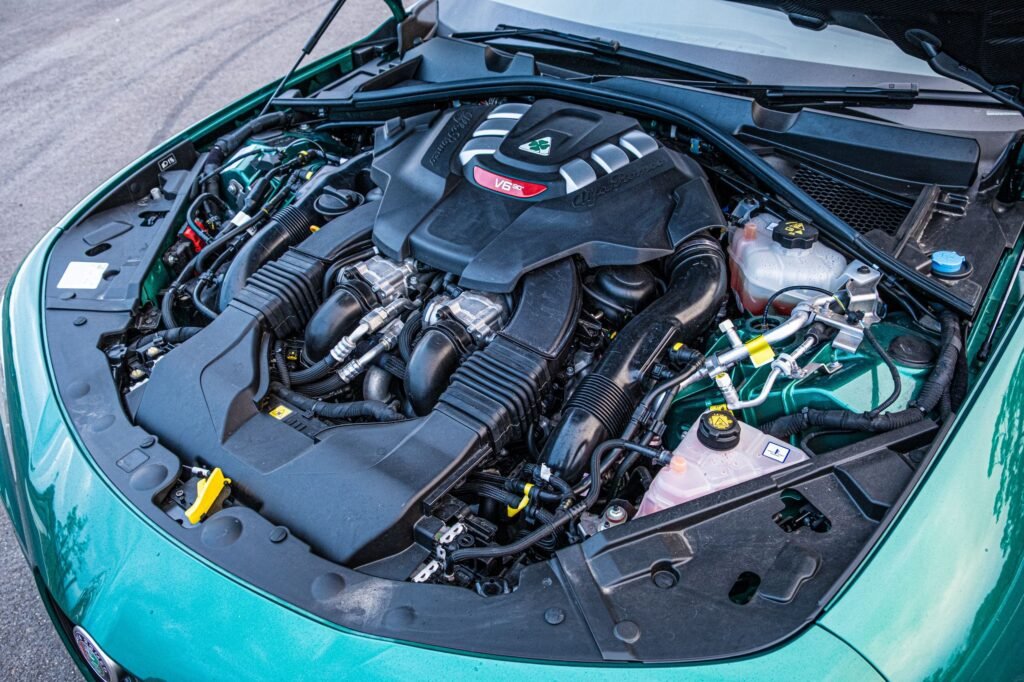
The 690T engine is not an off-the-shelf FCA block. Its 2.9-liter 90-degree twin-turbo V6 is technically derived from Ferrari’s F154 twin-turbo V8, developed under former Ferrari chief engineer Gianluca Pivetti. It uses an all-aluminum construction, a 90-degree bank angle, and cylinder deactivation. With 375 kW (503 hp) and 443 lb-ft (600 Nm), it remains more evocative than the C 63’s turbo-four and more characterful than the M3’s inline-six.
The engine drives the rear wheels through an eight-speed automatic transmission. Alfa Romeo quotes a 0-100 km/h (62 mph) time of 3.9 seconds, and there is little reason to doubt that figure on sufficiently grippy pavement. The transmission changes gear quickly when asked, although it can become rough and jerky when selecting first gear or shifting at low speeds in manual mode. Automatic mode is smoother.
Race mode leaves the exhaust valves open, but it also disables both traction and stability control. With Pirelli P Zero Corsa tires, the full 503 hp can be difficult to manage in winter. The tires sometimes bite hard enough to fire the car forward, then struggle to put the power down through first and second gear. The previous Giulia Quadrifoglio I tested wore Michelin Pilot Super Sports and felt more reassuring.
An all-wheel-drive M3 will walk away from the Alfa in a straight line. The Giulia’s response is found in the corners, where its rear-drive layout and low mass still feel unusually direct.
The bespoke Giorgio architecture was developed through a multibillion-dollar program initiated under late Fiat Chrysler CEO Sergio Marchionne. It uses a standard carbon-fiber driveshaft and aluminum suspension subframes, helping keep the Giulia’s curb weight around 3,600–3,700 pounds. That is roughly 200–300 pounds less than a current G80 M3 and nearly 1,000 pounds less than the hybrid Mercedes-AMG C 63 S E Performance.
That weight advantage is present in the steering, too. The rack has an ultra-quick 11.8:1 ratio and takes only 2.3 turns from lock to lock. Small inputs create large changes in direction, which is useful on a mountain road and requires constant restraint on a highway. Steering feedback can feel vague, but the front and rear axles offer superb grip, while the neutral balance and lightweight responses remain difficult for the heavier competition to replicate.
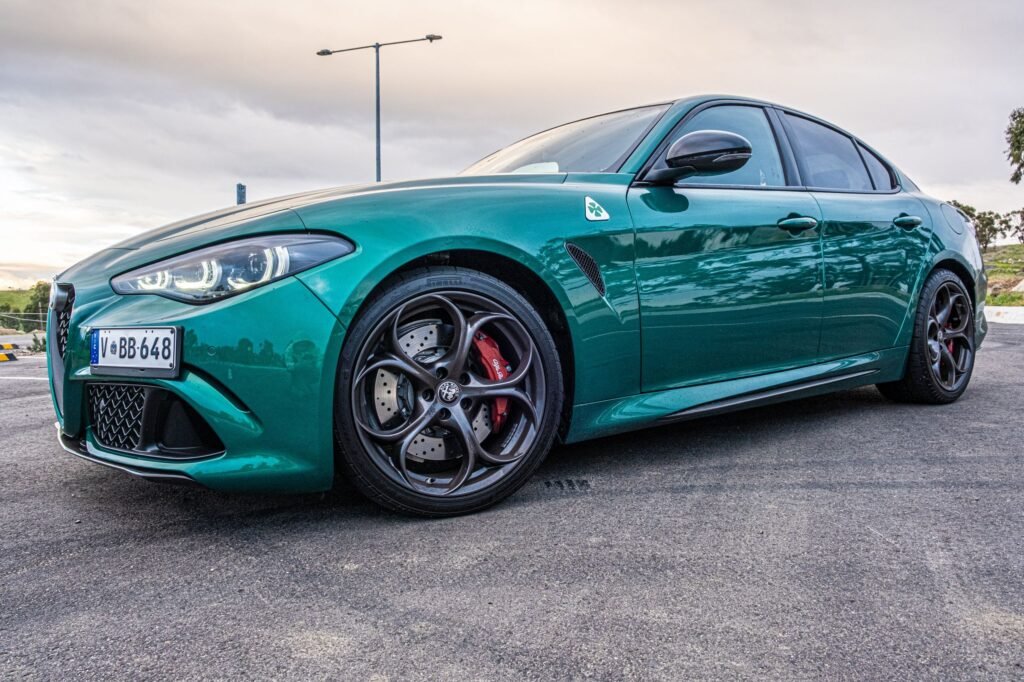
The brakes have immense initial bite and showed no signs of stress during hard driving. They also squealed frequently at low speeds, despite having plenty of pad material left. Active dampers provide different comfort levels in Normal, Dynamic, and Race modes, and even the firmest setting remains compliant enough for daily use.
The Giulia’s mechanical simplicity is becoming a commercial liability as Alfa Romeo and Stellantis move toward STLA Large and the eventual sunsetting of internal-combustion sports sedans. The car’s US disappearance has already narrowed its audience, while the cheap switchgear, limited software, and uncertain reliability make it difficult to recommend rationally.
The G80 M3 remains the stronger high-end sports sedan. Its superior cabin, greater build quality, and proven reliability justify much of its higher price. The Giulia is not Alfa Romeo’s best choice for every buyer, but its engine, rear-drive balance, and lighter Giorgio chassis preserve a level of involvement that the newer cars have not replaced.
Alfa Romeo’s continued production of the non-hybrid Quadrifoglio gives buyers one more year to purchase an Italian performance sedan whose strongest arguments are also the parts modern competitors are leaving behind. In the United States, those buyers will have to look at used examples.