

Underwear, Kissing and Snake Bites Take Center Stage at Zurich’s Ig Nobel Ceremony
Nobel laureates, buried underwear and venomous snakes feature at the first Ig Nobel ceremony outside the U.S.
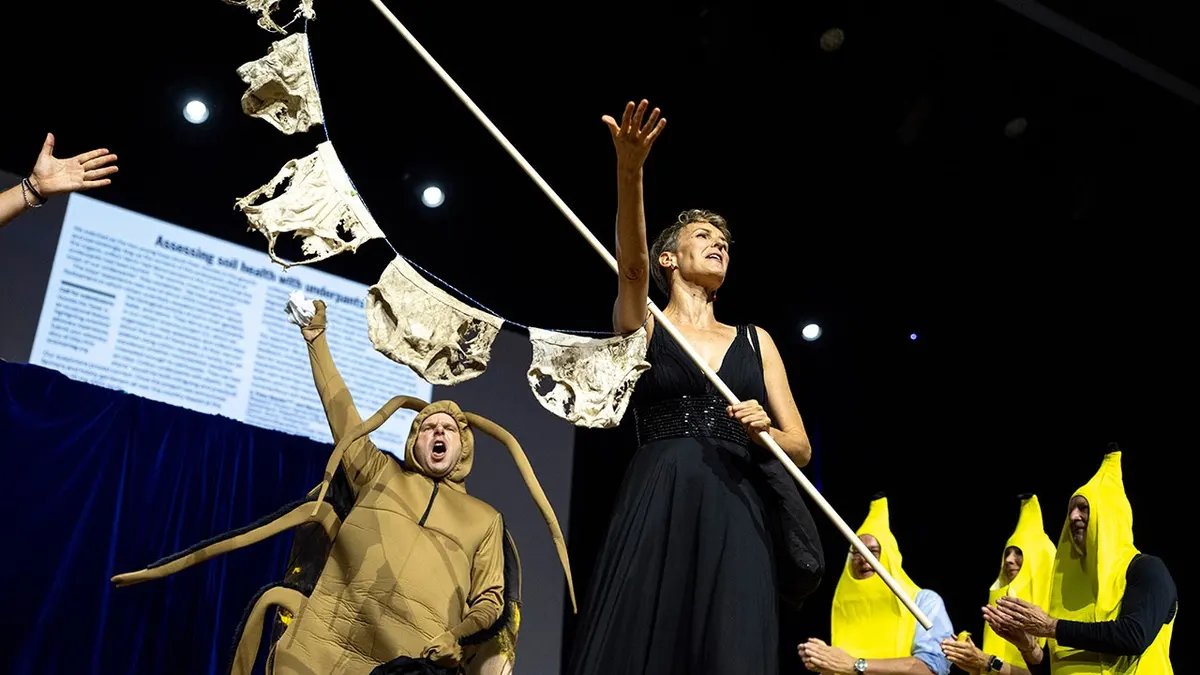
Esther Duflo, Abhijit Banerjee, Michel Mayor and Sir Tim Hunt examined a pair of underwear onstage Thursday at the Ig Nobel Prize ceremony in Zurich.
The underwear was connected to the Soil Science Prize, awarded to researchers behind “Proof by Underpants,” a project that used standard cotton briefs buried by thousands of citizen scientists to measure microbial decomposition rates in soil.
The awards were presented at the Zurich Convention Center by the Annals of Improbable Research, the digital magazine associated with the ceremony.


Marc Abrahams, who organizes the Ig Nobels, established the event around the criterion that its honors should “make people laugh, then make them think.” The awards recognize real studies, including research into cockroach milk, the evolutionary history of kissing and soil health.
The ceremony was held outside the United States for the first time this year. For more than three decades, it had been associated with Harvard University and the Massachusetts Institute of Technology in Cambridge, Massachusetts. Organizers cited tightening international travel restrictions and bureaucratic visa delays affecting researchers who might not have been able to attend in the United States.
The four Nobel laureates onstage have been part of the ceremony’s presentation tradition. Duflo and Banerjee won the 2019 Nobel Memorial Prize in Economic Sciences, Mayor won the 2019 Nobel Prize in Physics, and Hunt won the 2001 Nobel Prize in Physiology or Medicine.

Researchers studying snakes received recognition for experiments involving venomous pit vipers in Brazil. The team used specialized foam-padded boots and gently stepped on the snakes to record what provoked them to bite.
Another group studied whether upper-class people were more likely to engage in unethical behavior. The research included experiments involving the theft of candy from a baby.
Dr. Paul Piff, a social psychologist at the University of California, Irvine, told the Guardian that the research found that “with wealth and rising power, you become less engaged with the needs of others and less burdened by the needs of social relationships.”
“Taking candy from children might be the least of our worries, but it’s emblematic of the tendency to prioritize one’s own needs over those of others,” Piff said, according to the Guardian.
A study on proper nose-blowing also received an award. Other honorees examined attempts to design a splash-free urinal, the use of dead mosquitos for 3D printing, the power of having mutual enemies and whether parents prefer the smell of newborn babies to the smell of teenage children.
The kissing research defined a kiss as “a non-agonistic interaction involving directed, intraspecific, oral-oral contact with some movement of the lips/mouthparts and no food transfer.”
Matilda Brindle, an evolutionary biologist at the University of Oxford, told NPR that kissing is a “21.5 million-year-old tradition” and said her team believes Neanderthals kissed one another and may also have kissed early humans.

The ceremony’s trophies resemble a combination of a mushroom and a human foot. Audience members throw paper airplanes at the honorees during the event.
The Ig Nobel Prizes have been awarded since 1991 and are unrelated to the Nobel Prize. The Nobel committees are scheduled to announce their 2026 laureates in October.