Amazon Suspends 21 Air Contract After Deadly Miami Freighter Crash
NTSB Examines Speed, Deceleration Systems and Fleet Age After Miami Overrun
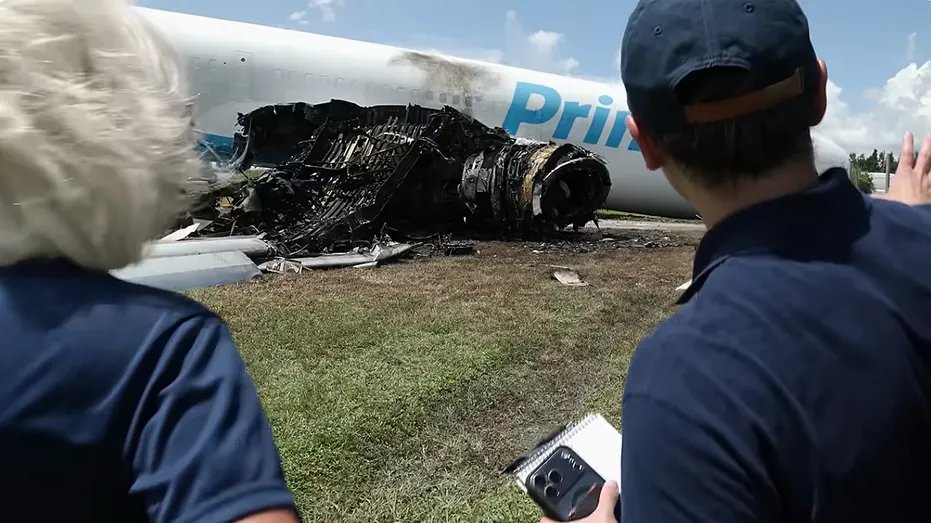
The aircraft involved in the Miami runway overrun was a 32-year-old Boeing 767-300. Air cargo operators frequently use older, retired passenger aircraft that have undergone Passenger-to-Freighter (P2F) conversions. Although these conversions are heavily regulated and approved by the FAA, aviation safety advocates continue to focus on the age of cargo fleets, noting that freighter fleets typically have a higher operational age than passenger fleets.
The incident occurred when Flight 7598, a Boeing 767-300 freighter operated by 21 Air on behalf of Amazon Air, arrived at Miami International Airport after a flight from San Juan, Puerto Rico. According to preliminary data released by the National Transportation Safety Board (NTSB), the aircraft overran the runway during landing, traveled approximately 1,300 feet beyond the designated pavement, and collided with multiple ground vehicles.


The crash killed five people and injured five others, bringing renewed scrutiny to cargo aviation safety, major e-commerce platforms’ reliance on third-party air carriers, and the operational standards of converted wide-body freighter fleets. Preliminary flight recorder evidence analyzed by federal investigators indicated that the flight crew had expressed concerns about the aircraft’s speed during the final landing sequence.
Amazon spokesperson Kelly Nantel confirmed that the company had paused operations with the cargo carrier. She said Amazon had focused on supporting the federal investigation and evaluating the operational circumstances surrounding the event. Telemetry data recovered from the flight data recorder showed no indication that the aircraft’s speed brakes or thrust reversers—critical deceleration systems used to slow heavy jets upon touchdown—were deployed before the overrun.
Amazon established Amazon Air in 2015 to reduce its dependency on traditional commercial delivery networks such as FedEx and UPS. The Seattle-based e-commerce giant does not operate its own fleet directly. Instead, Amazon uses an Aircraft, Crew, Maintenance, and Insurance (ACMI) leasing model, contracting the flight operations of its branded aircraft to regional and national cargo carriers.
The Miami crash was the first fatal accident within Amazon’s logistics flight network since February 23, 2019. On that date, Atlas Air Flight 3591, also a Boeing 767-300 freighter operating on behalf of Amazon, crashed into Trinity Bay near Anahuac, Texas, during its approach to Houston. All three crew members on board were killed.

The subsequent NTSB investigation into the 2019 crash identified pilot spatial disorientation and systemic gaps in pilot background tracking. Those findings later prompted federal reforms in aviation hiring databases. In the wake of the Miami crash, both Amazon and 21 Air have been named in multiple negligence lawsuits filed in Florida state courts.
Greensboro, North Carolina-based 21 Air began operating Boeing 767 cargo aircraft for Amazon Air in 2024. Responding to the suspension and legal actions, 21 Air Chief Executive Officer Keith Winters expressed condolences to the families of those killed and said the airline was fully cooperating with the NTSB, the Federal Aviation Administration (FAA), and local first responders.
The carrier defended its operational standards, asserting confidence in its pilot training, maintenance protocols, and overall safety management systems. The NTSB’s investigation into the structural, mechanical, and human factors involved in the Miami crash remains active. A final determination of probable cause is expected to take up to a year or more as investigators review maintenance logs, air traffic control transcripts, and cockpit voice recordings.
Amazon’s decision to suspend its logistics contract with 21 Air followed the fatal runway overshoot at Miami International Airport involving an Amazon-branded freighter on September 6, 2026.