Trump Gas Prices Passed Biden’s by $0.001. The First Diesel Shipment Is 14 Hours of Supply
The $0.001 crossover is a term average, not a price record, and the diesel fixes are smaller and later than they sound: hours of supply, cents against a $2.67 rise, and farm rates not set until November.

The first Russian diesel shipment promised for American pumps amounts to about 14 hours of national demand. The initial tranche is 2.24 million barrels. The Energy Information Administration put US distillate use at 3.732 million barrels a day in the week ended October 16, which divides to roughly 14 hours. The full announced schedule, 2.2 million barrels this month, 3.7 million in November and 7.5 million shortly after, totals about 13.4 million barrels, or roughly three and a half days of that same demand. A tanker tracked toward New York, estimated by the Associated Press at about 300,000 barrels, works out to under two hours on its own. Its estimated arrival is November 6 to 7, after the November 3 election. The link is unconfirmed. Its connection to the announced schedule has not been established, with the buyer and seller unidentified and the route still changeable.
AAA’s daily figures, released Monday, put Trump gas prices at a term average of $3.472 a gallon for regular gasoline, against $3.471 under Joe Biden. That gap is a tenth of a cent, or about 0.03%. Diesel tells a different story on the same measure, averaging $4.343 under Trump against $4.078 under Biden. The diesel gap is 26.5 cents, or about 6.5%. Today’s prices sit far above both averages. Gasoline is at $4.29, about 82 cents or 24% above the Trump term average, and diesel is at roughly $6.30, about $1.96 or 45% above its term average. The crossover is a record for the average, not for the pump price itself. Biden still holds the single-day national gasoline record at $5.02 in June 2022, while AAA and Bloomberg report Americans have never paid this much for fuel this late in the year.
Gasoline has climbed about 44% since late February, from roughly $2.98 a gallon before the US-Israeli war with Iran began to $4.29 now. Diesel hit a record $6.523 on September 22. The war disrupted Middle East refining and product exports, with Rystad Energy putting the missing Middle East gasoline exports at about 400,000 barrels a day, and American refineries already running at full stretch. Middle East oil exports, including Hormuz, Gulf of Oman and Red Sea shipments, reached 24.6 million barrels a day in the week to October 18 according to Kpler data. That is the highest since the war began and above pre-war levels, which leaves the pressure concentrated in refining and product supply rather than in crude leaving the Gulf.
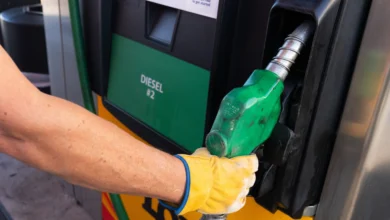
An October 5 executive order deferred collection of the federal excise tax on red-dyed diesel through the end of the year, opening a fuel normally reserved for off-road machinery and farm equipment to wider use. The White House puts the saving at 24.4 cents a gallon, or $61 on a 250-gallon fill. Diesel costs about $2.67 a gallon more than a year earlier, when it was $3.63, so the same 250-gallon fill costs $667.50 more than it did then. The tax saving covers about 9% of that increase. Energy fellow Ed Hirs at the University of Houston, asked what the measures would do, answered with a single word. He has argued separately that wider red-dye use increases competition for limited fuel and could push farmers’ own prices up rather than down.
The Agriculture Department announced the $8 billion Harvest Fuel Relief program at a Kansas rally on October 19, as one-time payments to farmers during harvest. The department says the payments cover only a portion of modeled losses for the 2026 crop year. The rates come in November. The American Farm Bureau Federation puts farm fuel expenses at $22 billion in 2026, up 29% from roughly $17.1 billion in 2025, an increase of about $4.9 billion. The $8 billion pot equals about 36% of the year’s total farm fuel bill without cutting the price of a gallon. It is also the year’s second major farm payment, after the $12 billion Farmer Bridge Assistance paid to more than 560,000 farmers earlier in 2026.
A Politico poll published October 10 found that most respondents would not switch to Republicans even if gasoline fell $1 a gallon. A Reuters/Ipsos poll published October 19 put Trump’s overall approval at 31%, the lowest of either of his terms, with 23% approving of his handling of the economy. A later Reuters/Ipsos poll that closed October 26 put approval at 32% and Democrats ahead of Republicans 47% to 36% on the generic ballot, or 50% to 41% once leaning voters were counted. Trump has told voters that oil prices will fall after the election. He predicted gasoline could reach $1.85 once the conflict ends, while at a rally in Rome, Georgia, he told supporters they were still paying less than under Biden and Barack Obama, a claim the AAA term averages do not support.
A White House release dated October 25 claims deals with other countries to release more than 130 million barrels of diesel from their stockpiles. Against world diesel use of nearly 30 million barrels a day, that amounts to about four days of world supply, and it is a claim about other countries’ stockpiles, not an American one. The Treasury’s Office of Foreign Assets Control issued General License 135 on October 9, authorizing specified transactions in Russian-origin diesel, including imports to the United States. The licence runs to April 2027. The legal channel for the Russian fuel therefore runs months past the midterm while no confirmed cargo is scheduled to arrive before it.
Distillate stocks sit 12% below their five-year average for this time of year, and down more than 12% from a year earlier. Four-week distillate demand averaged 4.0 million barrels a day.