SpaceX Secures $40B in Debt to Fund AI Chips as Musk Warns Rivals
Elon Musk says tightening credit markets threaten hundreds of AI-focused neocloud companies lacking independent revenue.

Elon Musk said SpaceX has closed $40 billion in debt financing to purchase graphics processing units for its artificial intelligence operations, highlighting the enormous sums being spent in the race to build AI computing capacity.
Musk announced the financing on Sunday, saying SpaceX was able to secure the money because of its investment-grade status and revenue generated outside AI through its Starlink satellite internet and rocket launch businesses. The ability to access capital at this scale reflects SpaceX’s position as one of the few private companies with credit metrics comparable to major publicly traded defense and technology firms.
“SpaceX closed $40B of debt for GPUs, but we’re investment grade and have Starlink & launch revenue,” Musk said.


Graphics processing units, or GPUs, are advanced chips that provide the computing power needed to train and operate AI systems. Nvidia currently dominates the market for these processors, which have become the essential building blocks for large-scale machine learning models across the technology sector.

Reuters previously reported that SpaceX was in talks with banks and asset managers to raise $40 billion to purchase Nvidia AI chips.
“This is primarily callable debt for GPU purchases that will arrive in Q1 and Q2,” Musk said in a follow-up post on X, confirming that the GPUs are expected to arrive in the first half of 2027. “Not a major factor this quarter.” Callable debt allows the borrower to repay the principal before maturity, giving SpaceX flexibility if chip prices fall or alternative hardware emerges.
It was not immediately clear whether investors had agreed to the debt’s pricing terms.
The funding underscores the cost of the AI race, as companies spend heavily on advanced chips and other computing infrastructure. Hyperscalers such as Microsoft, Amazon, and Alphabet have each committed tens of billions of dollars annually to expand their own data center footprints to keep pace with surging demand for generative AI services.
SpaceX Chief Financial Officer Bret Johnsen said the company expects to spend $35 billion to $40 billion on capital expenditures in the fourth quarter alone, according to Reuters.
Musk also said borrowing conditions have deteriorated significantly for companies that rely heavily on AI infrastructure.
“As of the past few weeks, debt markets have almost entirely shut off access to money for any company that doesn’t have substantial revenue independent of AI data centers,” he said.
Musk warned that many of those companies could struggle to survive.

“That means the 200+ neoclouds are going to see guppy-level death and consolidation,” Musk said, referring to companies that rent out computing power built primarily for AI customers. “Some will make it through, but not many.” Neocloud providers emerged rapidly over the past three years to offer specialized GPU hosting, but rising interest rates and tightening credit standards have exposed their reliance on continuous outside funding.
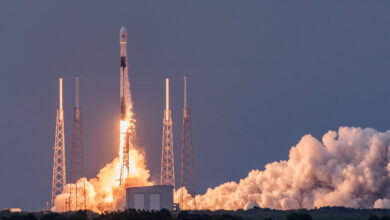
SpaceX’s established businesses, including Starlink and rocket launches, provide revenue streams outside its AI operations. Starlink alone serves millions of subscribers globally, generating recurring cash flow that insulates the company from the volatility affecting pure-play AI startups.
SpaceX’s third-quarter revenue climbed 161% from a year earlier to $14.58 billion, according to Reuters.
Musk suggested last week that a potential merger of Tesla and SpaceX would be “a good idea.” Such a combination would unite the world’s most valuable automaker with its preeminent commercial spaceflight company, creating an industrial conglomerate with unmatched reach in transportation, energy, and orbital infrastructure.
He also said both companies have formed special committees of independent directors to explore a potential deal, though Musk stressed that a merger is not certain.