

AI Chatbots Are Becoming News’ Biggest Threat to Factual Reporting
Neurosymbolic AI systems are eliminating the hallucinations that protected newsrooms, threatening the century-old bundle model of journalism.
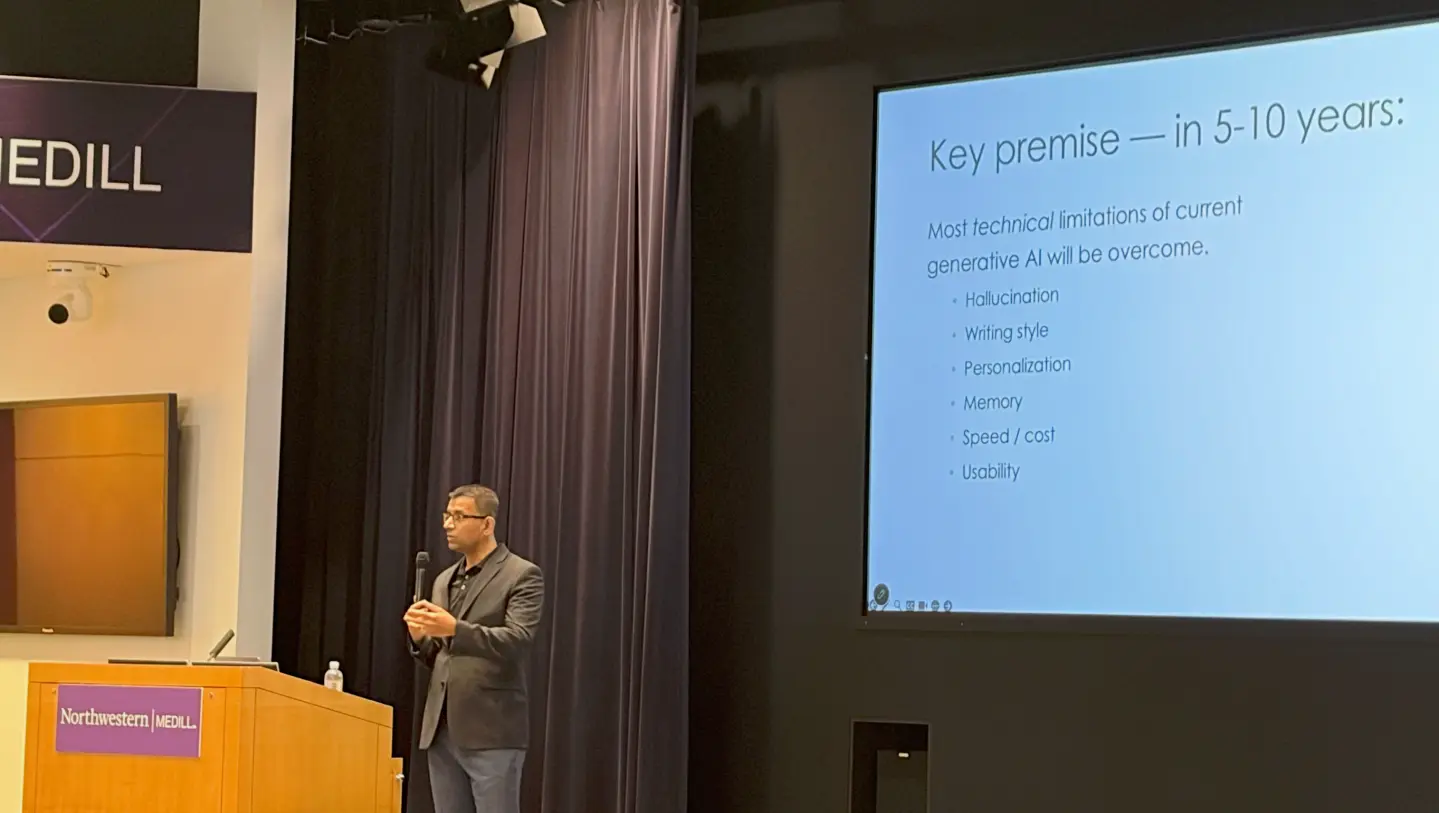
The traditional newsroom is losing its most basic function — answering straightforward factual questions — to artificial intelligence systems that are rapidly shedding the errors and stylistic tells that once made them easy to dismiss.
Princeton computer scientist Arvind Narayanan warned journalists this week that the industry is preparing for the wrong version of AI. Speaking at Northwestern University’s Computation + Journalism Symposium, Narayanan argued that news organizations are reacting to today’s flawed chatbots rather than the neurosymbolic systems emerging over the next decade. These newer architectures combine large language models with web search, document retrieval, and data analysis tools, effectively eliminating the hallucinations and logical failures that plagued earlier iterations.
A Pew Research Center survey conducted this year found that 10% of Americans already treat AI as a primary source for factual information. Narayanan projects that within roughly a decade, virtually all uncontested queries — such as identifying political candidates or verifying historical dates — will migrate entirely to chatbots. The shift mirrors Wikipedia’s trajectory from a widely mocked reference tool in the early 2000s to an accepted baseline for general knowledge.


This migration threatens what economists call the “bundle” model of journalism. Since the ad-supported penny press emerged in the 1830s, newspapers aggregated reporting, fact-checking, analysis, and distribution into a single commercial product. Objectivity itself was a later invention, developed largely as a professional standard following World War I propaganda campaigns. Paid reporters were once viewed with suspicion; the term “hired reporter” carried the same stigma as “hired gun.” The institutional newsroom, Narayanan noted, is a historically contingent structure, not an inevitable one.
As AI democratizes production — just as the internet previously democratized distribution — the bundle is unraveling. One- or two-person operations can now generate first-rate journalistic content across multiple formats. The result is not necessarily a decline in journalism but a migration of its functions away from legacy institutions toward independent analysts, newsletters, and niche outlets. An analyst’s authority increasingly derives from a verifiable body of work rather than a masthead.
Narayanan, who directs Princeton’s Center for Information Technology Policy and co-authored “AI Snake Oil” with Sayash Kapoor, identified a structural gap in how newsrooms handle information. Citing economics writer Noah Smith, he argued that journalism has long treated the boundary between fact and opinion as binary, leaving no institutional home for analysis — the critical layer between verified data and subjective commentary. Determining whether the current AI investment cycle constitutes a bubble, for example, requires analytical frameworks that straight reporting cannot provide.
The power dynamics driving this transition heavily favor technology companies. Publishers require chatbot distribution far more than any individual AI firm requires a specific outlet’s content. This asymmetry depresses licensing revenues for news organizations. Narayanan compared the current dynamic to Facebook’s mid-2010s algorithm changes that forced publishers into a costly and ultimately futile “pivot to video,” destroying newsroom budgets to satisfy a platform metric that was later abandoned.
Detecting AI-generated text offers little protection for publishers. Models can now be trained to replicate individual writers with near-perfect accuracy, making automated detection unreliable. The remaining technical barriers are primarily questions of compute cost rather than fundamental capability.
To counter these structural disadvantages, Narayanan proposed that journalists form a broad, nonpartisan political movement encompassing independent creators and legacy outlets alike. He suggested exploring mechanisms similar to Meta’s Oversight Board, giving news professionals direct input into how AI companies tune their algorithms, alongside potential taxation on AI and social media platforms to fund public-interest reporting.
Some scholars have cautioned against treating AI neutrality as inherently safer than human judgment. Daniel Trielli of the University of Maryland raised concerns during the symposium that chatbots risk replicating what New York University press critic Jay Rosen famously termed the “view from nowhere” — a false equivalence that obscures reality under the guise of balance. Narayanan acknowledged the danger, framing it as an unresolved challenge for both technologists and editors.
Narayanan previously described the productivity paradox of AI adoption as a “skinny hamburger, fat bun” problem: the execution phase shrinks dramatically while the deliberation and decision-making phases expand, generating anxiety without proportional output gains. His newsletter, AI as Normal Technology, currently reaches more than 87,000 subscribers. He has never worked inside a newsroom.









