Nordic Curls: The Knee-Stabilizing Exercise for Men Over 40
Eccentric hamstring training builds longer muscle fascicles and protects aging knee joints without heavy barbells.
Hamstring strains account for a disproportionate share of lower-body injuries in aging athletes, yet the most effective preventative tool requires no equipment beyond a padded floor and an anchor point. For men over 40 transitioning away from heavy barbell training, the Nordic hamstring curl delivers targeted tendon reinforcement that traditional gym machines cannot replicate.
Decades of heavy squats and deadlifts build bone mineral density but simultaneously compress articular cartilage in the knees and hips. As maximal strength peaks typically occur in a lifter’s late twenties or early thirties, continuing to chase one-rep maxes into middle age accelerates joint degradation. Sports medicine professionals increasingly recommend eccentric bodyweight movements as a bridge between heavy resistance training and sustainable longevity programming.
The Nordic curl operates almost entirely in the eccentric phase—the lengthening portion of a muscle contraction. Biomechanical research demonstrates that this specific loading pattern increases fascicle length in the biceps femoris, the largest of the three hamstring muscles. Longer muscle fascicles absorb force more efficiently during sudden deceleration, directly reducing the mechanical circumstances that cause tears.


A landmark cluster-randomized controlled trial involving professional soccer teams found that incorporating the Nordic curl reduced new hamstring injuries by 60 percent and recurrent injuries by 85 percent. While those subjects were elite athletes, the physiological mechanisms protecting the knee joint apply identically to recreational lifters managing age-related connective tissue changes.
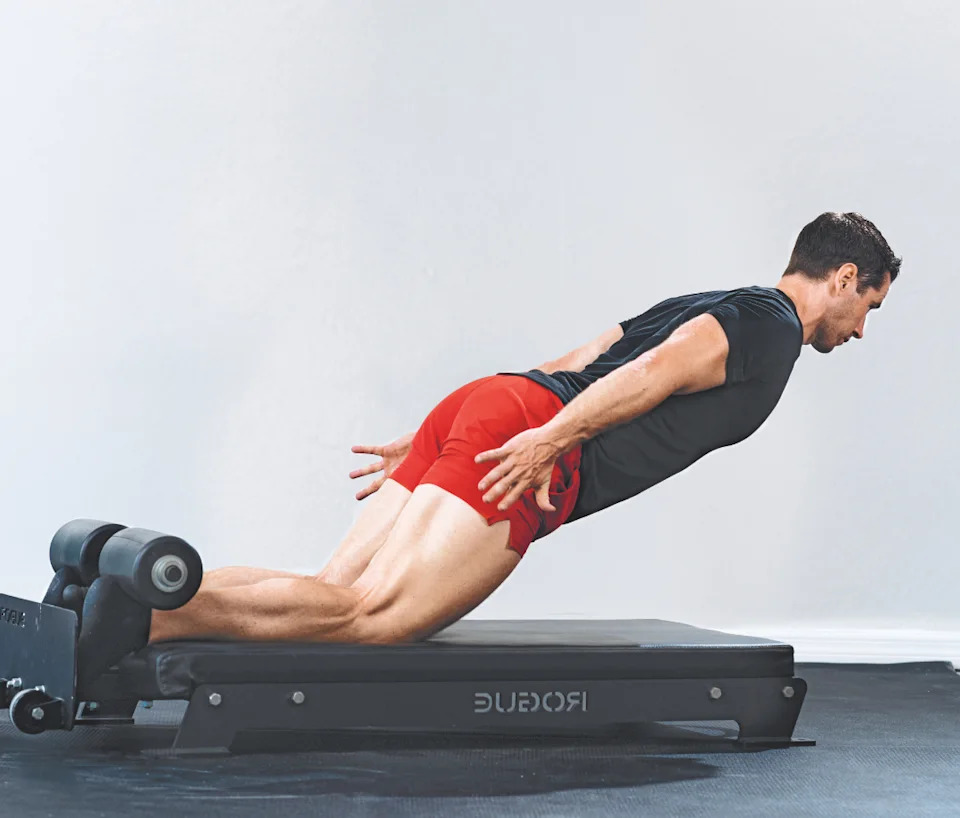
Execution demands strict control rather than speed. Kneel on a thick pad with ankles secured beneath a loaded barbell, a heavy piece of furniture, or held firmly by a training partner. Lock the hips in full extension so the torso forms a single rigid line from knees to shoulders. Engage the core before initiating movement.
Lower the body toward the floor as slowly as possible. The objective is to resist gravity using only the hamstrings, maintaining tight glutes throughout the descent. Most trainees will reach a breaking point where the muscles can no longer control the fall; catch yourself with outstretched hands in a push-up position at that threshold. Push off the floor lightly to return to the starting position if concentric strength is insufficient for a full repetition.
Volume should remain low. Three sets of four to six repetitions performed twice weekly provide sufficient stimulus for tendon adaptation without inducing excessive delayed-onset muscle soreness, which tends to be more severe with novel eccentric loading in older populations.
Unlike leg curl machines that isolate the muscle belly through a fixed range of motion, the Nordic curl forces the hamstrings to stabilize the knee joint under progressively increasing leverage. This mimics the real-world demands placed on the posterior chain during running, jumping, and directional changes.
Physical therapists frequently pair this movement with heavy slow resistance protocols to manage patellar tendinopathy, leveraging the principle that tendons respond optimally to high-magnitude, controlled mechanical stress rather than rapid, repetitive loading.