California’s Insurance Rules Reward Roseville While Paradise Struggles
Roseville gains policies as Paradise and the FAIR Plan face mounting pressure
California’s property insurance market is producing stark geographic and economic disparities. Rules intended to encourage insurers to write policies in distressed areas are allowing private companies to claim lucrative rate credits in rapidly growing, low-risk suburbs, while disaster-stricken communities remain stranded and lower-income inland towns financially subsidize wealthy coastal enclaves.
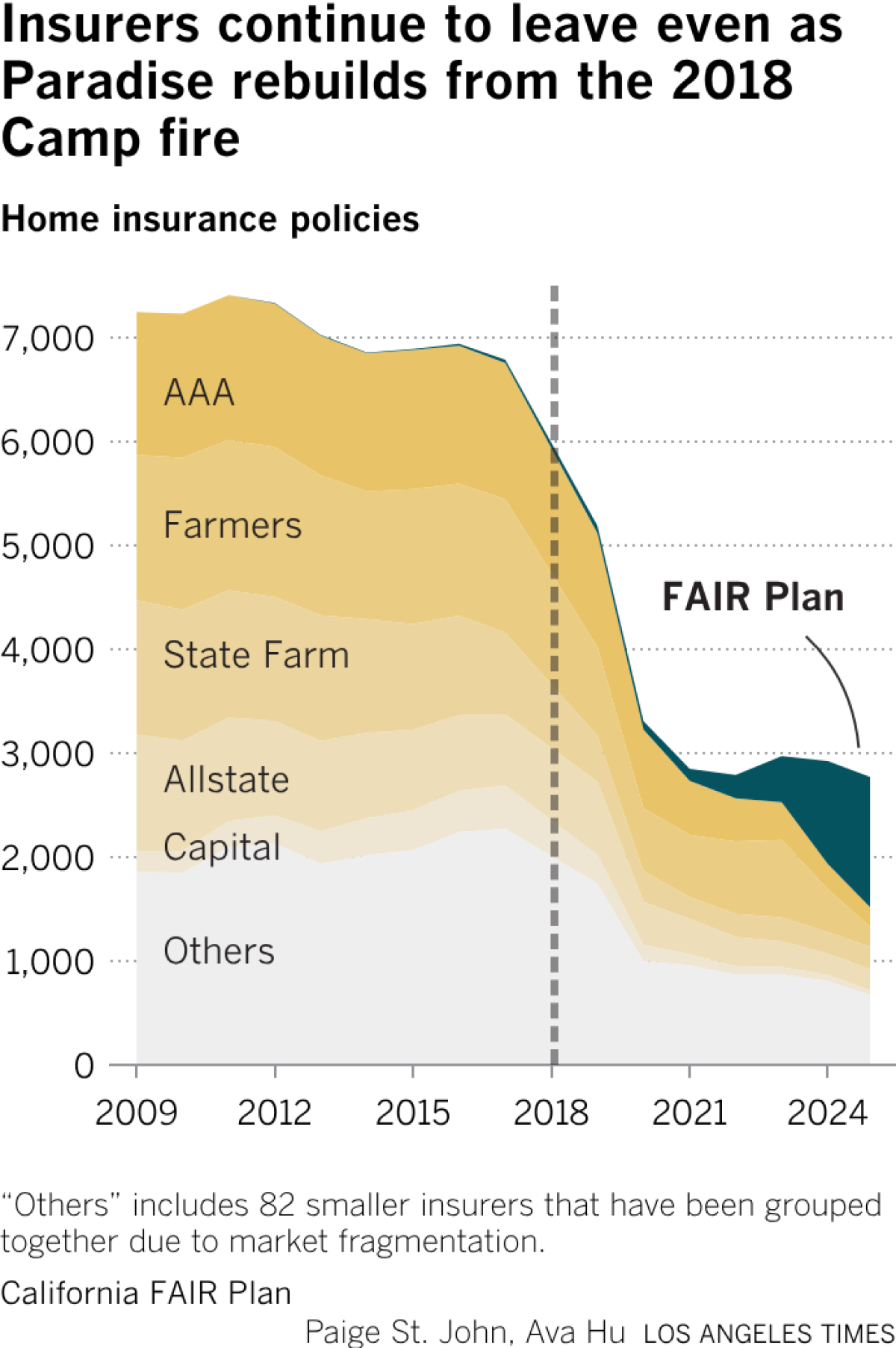
The imbalance is especially visible in northern California. Paradise, which the 2018 Camp Fire virtually erased, is still being abandoned by regulated insurance carriers even as residents rebuild. The fire killed 85 people and destroyed nearly 19,000 structures, making it the deadliest and most destructive wildfire in California history.
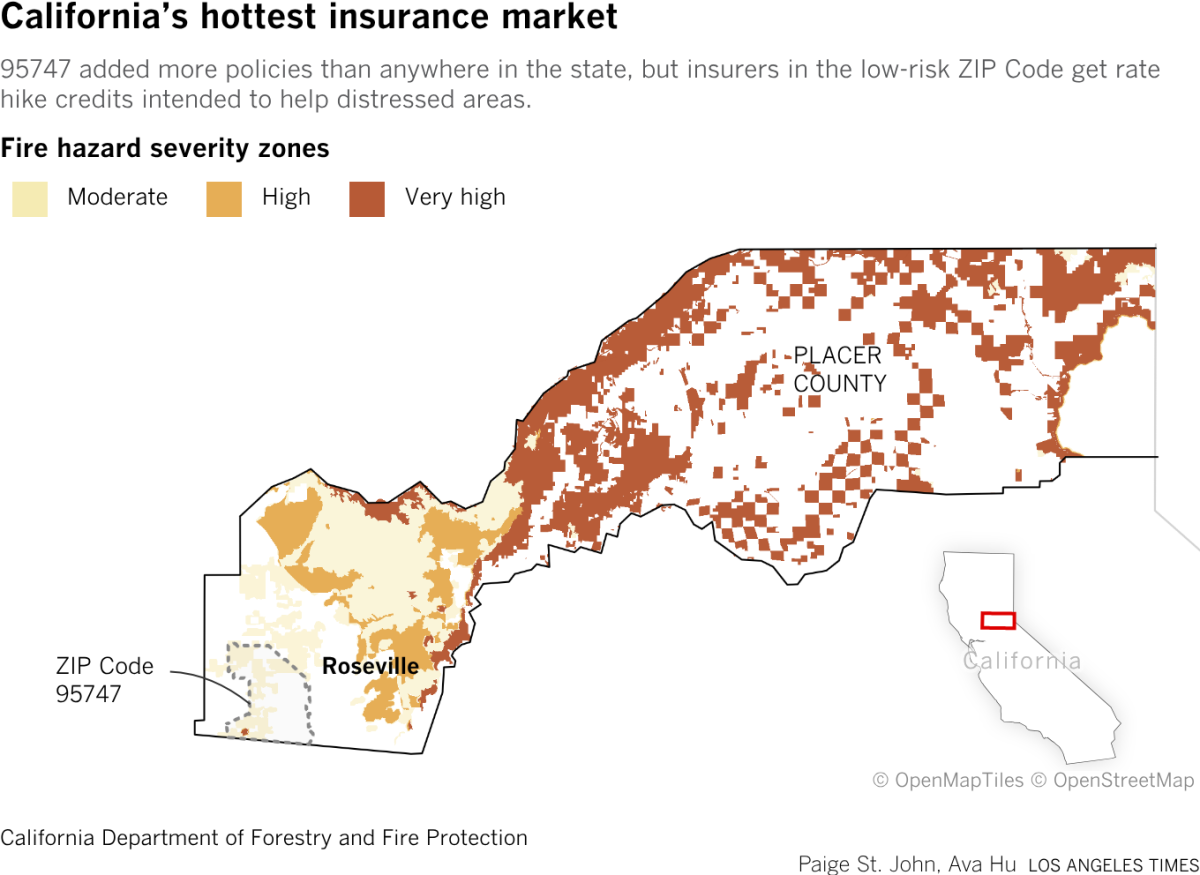
Meanwhile, private insurers have written more than 6,500 new policies in Roseville’s 95747 ZIP code since 2019. Only 76 homeowners in that area were forced to use the state’s insurer of last resort during the same period. State agency data identify the ZIP code as California’s fastest-growing insurance market.


The Roseville development zone consists of luxury housing developments that cater heavily to transplants from Sacramento and San Francisco. Under rules established by the California Department of Insurance, carriers fleeing communities such as Paradise can still obtain expedited rate increases by writing policies in another area designated as “distressed.”
Roseville’s zone was placed on the state’s distressed market list because it is located within Placer County. The county stretches 65 miles eastward into the severe fire hazards of the rugged Sierra Nevada mountains, although Roseville’s suburban plains face little to no wildland fire risk.
Six years after the Camp Fire, Paradise homeowners have been forced to rely almost entirely on the state’s high-risk insurance pool. Insurers writing in 95747, by contrast, can qualify for regulatory benefits intended for high-risk areas while taking on very little actual risk.
The broader imbalance has also drawn attention from Nancy Wallace, director of the real estate and financial markets laboratory at the University of California, Berkeley. A study she published this year concluded that political pressures, including caps on rate hikes, have severely unbalanced California’s risk pool.
Wallace found that residents in lower-risk, often lower-income inland communities are effectively subsidizing insurance liabilities tied to multi-million-dollar estates in wealthy coastal and mountain enclaves. In Coalinga, Mayor Nathan Vosburg described the local frustration during a City Council meeting with a state insurance department representative: “We have no risk and we’re the ones paying.”
The concentration of risk became highly visible in January 2025, when a disastrous firestorm swept through luxury homes in Los Angeles and heavily impacted areas such as Pacific Palisades. The catastrophic losses forced a major regulatory pivot.
After the firestorm, California Insurance Commissioner Ricardo Lara issued a significant concession to private insurers facing the prospect of massive financial assessments. He capped the wildfire-related liabilities covered by the state’s insurer of last resort. Under the new rule, collective payouts for wildfire claims under the plan are capped, leaving individual policyholders responsible for losses exceeding $500 million.
The change followed years of decisions that expanded the program’s liabilities. Lara had ordered the state pool to raise its policy limits on individual residential properties to $3 million and to insure commercial condominium associations for up to $100 million. Experts said those moves drastically increased the financial exposure of the plan and the private companies backing it.
The safety net at the center of the crisis is the California Fair Access to Insurance Requirements, or FAIR, Plan. The California Legislature created it in July 1968 as a temporary, bare-bones option for property owners unable to obtain coverage on the open market.
The plan’s creation followed the August 1965 Watts riots in Los Angeles and was intended to prevent banks and insurers from redlining minority neighborhoods. Historical records also tie its legislative origins to the November 1961 Bel-Air fire, which destroyed nearly 500 homes in the Santa Monica Mountains, including the homes of several prominent Hollywood figures.
By mid-1968, thousands of high-risk homeowners faced cancellation of their brush-fire coverage, prompting lawmakers to rush emergency legislation that formed the California FAIR Plan Association. Every private insurance company licensed to operate in California must participate in the syndicate, sharing its profits and losses in proportion to market share.
FAIR Plan coverage is strictly limited to basic fire protection. It excludes standard property coverages such as theft, liability, and water damage.
For decades, the FAIR Plan remained a small and quiet segment of the overall market. In early 2022, however, dominant private carriers including State Farm, Allstate, and Farmers began shedding hundreds of thousands of policies across California because of severe wildfire seasons, rising construction inflation, and the soaring cost of global reinsurance.
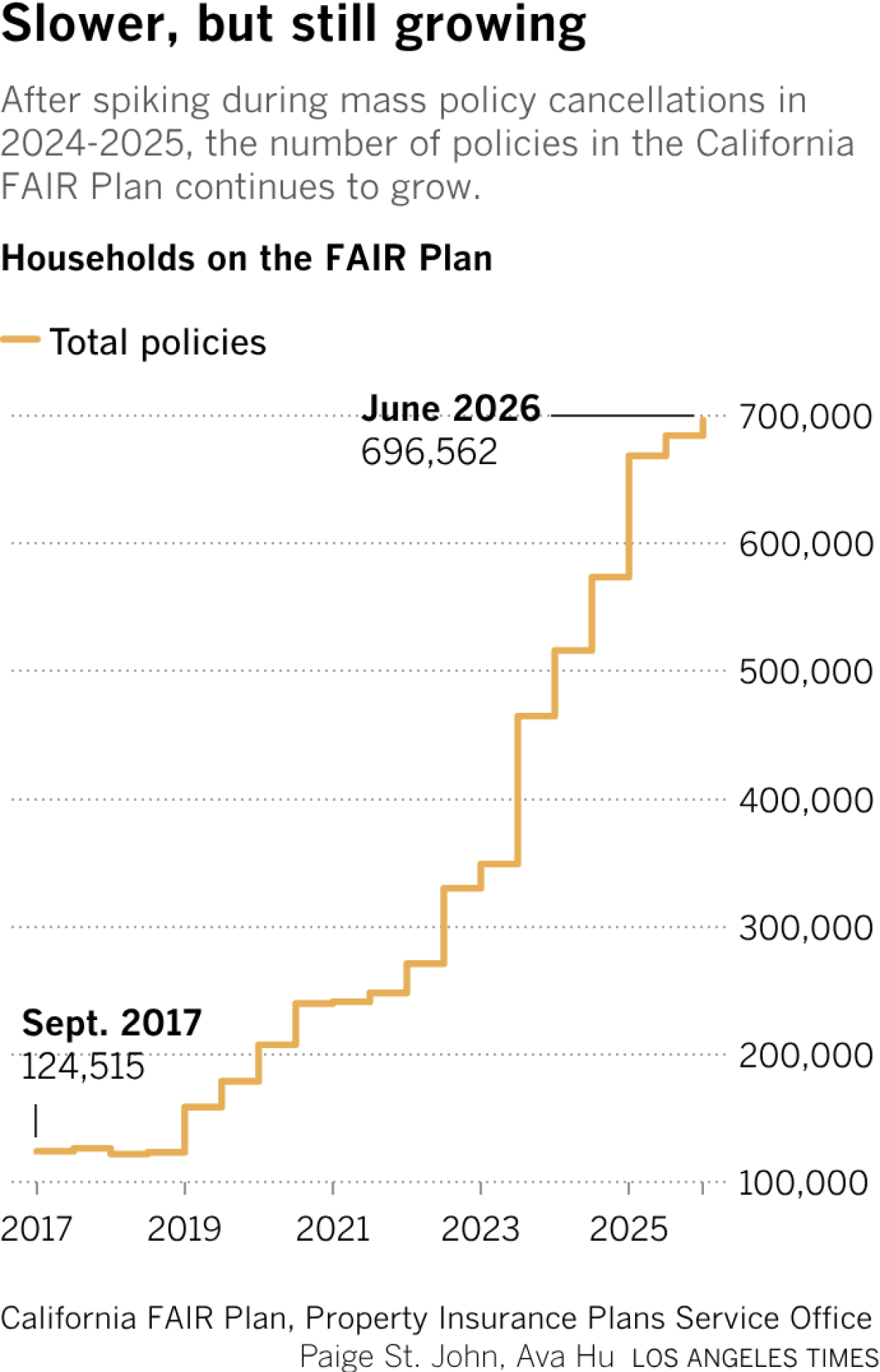
The flight from the private market sent an unprecedented volume of properties into the state pool. As of June 30, the FAIR Plan had 696,000 insured properties, representing potential loss exposure of $788 billion.
Dan Dunmoyer, a building industry representative and former insurance lobbyist, warned that the arrangement risks a “death spiral.” As private insurers move more high-risk policies into the FAIR Plan, the likelihood of a massive financial shortfall rises; those insurers would legally be required to bail out the plan, potentially driving more companies out of California entirely.
Cedric Snow, a retired insurance executive with CSAA and former member of the FAIR Plan’s executive committee, said the plan’s liabilities have outgrown the capacity of the domestic market. “You could see that the potential for a $4- or $5-billion industry assessment was not remote any longer,” Snow said. “What was once a 1-in-500 or 1-in-1,000 chance, it was now a 1-in-100 or a 1-in-75 chance.”
Snow said the FAIR Plan can no longer rely solely on California’s private insurance market to cover catastrophic losses, while obtaining adequate reinsurance on the international market remains a severe challenge. Experts also suggest the plan has become too large to contract back to its original size without triggering significant market disruptions.