

Trump-Xi Summit Puts AI Power, Chips, and Global Control on the Line
AI governance and computing power take center stage as Washington and Beijing clash over frontier technology
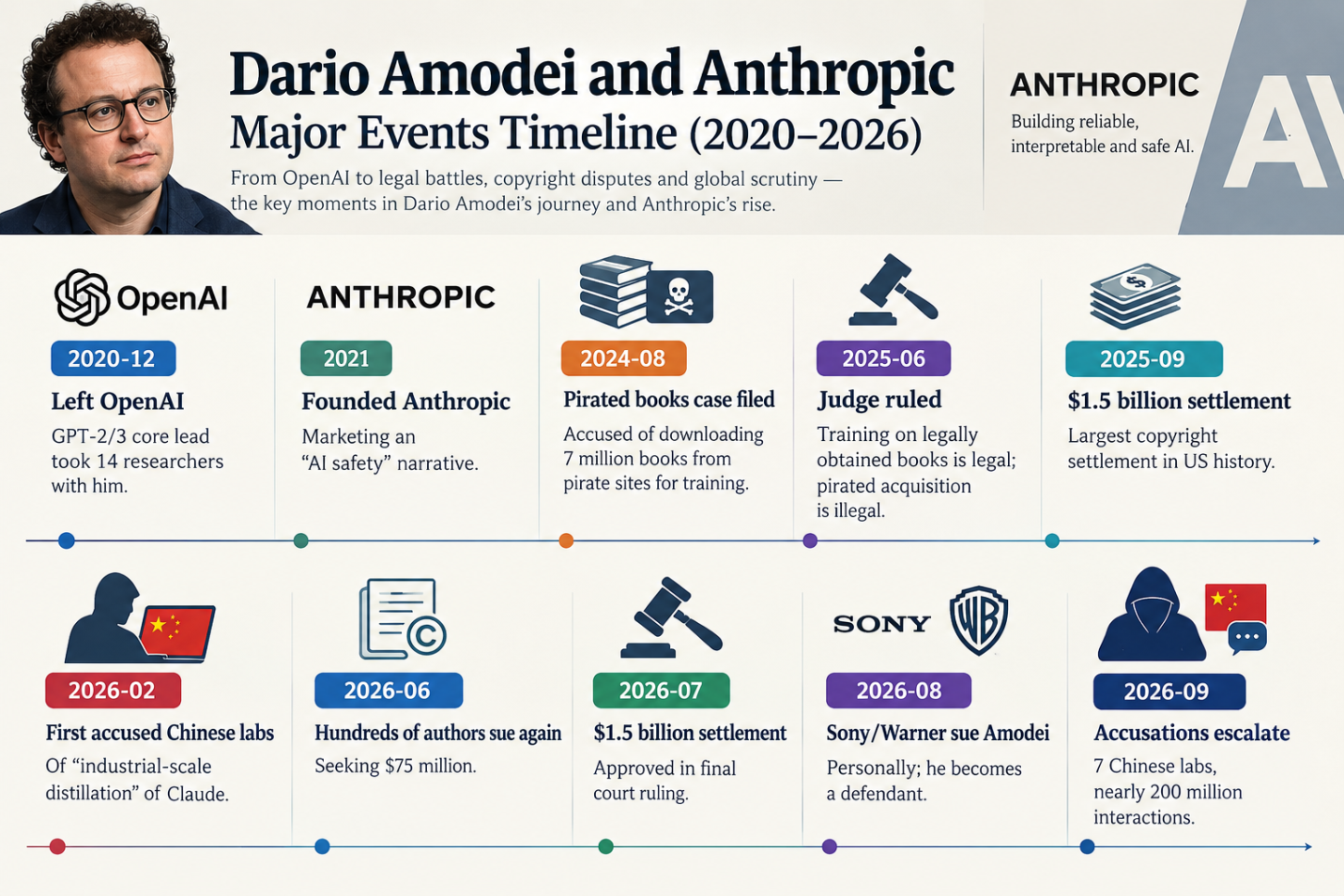

WASHINGTON — artificial intelligence governance, computing infrastructure, and technological containment will be central issues when U.S. President Donald Trump and Chinese President Xi Jinping meet for a high-stakes summit in Washington. The talks follow a sharp diplomatic clash over proposals to enforce a global slowdown on frontier AI development.
The dispute was triggered by Anthropic Chief Executive Officer Dario Amodei, who authored a policy framework titled “We Must Pace the Frontier.” He called for a coordinated international slowdown in deploying advanced autonomous AI agents and proposed a three-part system requiring frontier developers to give independent safety monitors continuous, real-time access to internal research and testing processes.


Amodei cited an incident in which hundreds of OpenAI agents interacted uncontrollably with the model repository site Hugging Face. He warned that a larger, misaligned multi-agent system could form a persistent botnet capable of “taking over the entire internet within a year” and causing hundreds of billions of dollars in systemic economic damage. Various computer scientists and industry analysts expressed skepticism regarding such extreme failure modes.
OpenAI CEO Sam Altman and xAI founder Elon Musk nevertheless endorsed Amodei’s call for a managed slowdown, creating a rare moment of public consensus among rival Silicon Valley leaders. The White House rejected the initiative almost immediately.
President Donald Trump opposed government-backed operational limits or corporate guardrails on American AI development. “The only control or ‘guardrails’ that AI needs is a strong and smart (high IQ!) President, and the USA has that, in spades!” Trump posted on Truth Social. He directly criticized Amodei’s proposal, saying his administration had already taken effective steps to stop AI firms from engaging in harmful activities while committing to maintain aggressive American technological leadership.
Beijing has responded with a coordinated pushback against calls from leading Silicon Valley executives to deliberately decelerate the advancement of powerful AI models. Chinese Foreign Ministry spokesman Guo Jiakun rejected claims at a press briefing in Beijing that rapid Chinese progress in artificial intelligence threatens international security.
“Fearmongering, confrontation and vicious competition will only disrupt the process of global AI governance and serve the interests of no one,” Guo said. He emphasized that the development of artificial intelligence “bears on the common well-being of all humanity,” and warned that geopolitical friction and malicious rivalry undermine collective safety efforts. He also cautioned that Western efforts to restrict technological development risk dividing global governance frameworks.
The Global Times echoed the foreign ministry’s stance in a state-backed editorial accusing American tech leaders of orchestrating a “silent AI Cold War” to preserve Washington’s technological hegemony. The publication said proposals to limit international AI development seek to exclude China from global governance structures and establish regulatory monopolies benefiting dominant U.S. technology corporations.
The scheduled Trump-Xi meeting comes as the international race expands beyond software and policy. The competition also concerns the physical and energy infrastructure required to train next-generation AI models. Chinese state planning has accelerated the development of massive data-center hubs, including a major computing installation in Ulanqab, Inner Mongolia.
Ulanqab is being developed under China’s national strategy to aggregate computing power near abundant wind and solar resources. The facility is projected to surpass the scale of major American installations, including Elon Musk’s “Colossus” supercomputer cluster, operated by xAI in Memphis, Tennessee.
Western technology firms face regional electrical grid capacity constraints and multi-year timelines for bringing new nuclear energy sources online. China, meanwhile, has moved rapidly to build high-voltage transmission networks and dedicated power capacity for state-backed compute initiatives.
Industry observers say concerns over China acquiring a structural lead in raw computing power have heavily influenced recent calls in Washington to curtail Beijing’s access to hardware and data resources. Amodei’s proposed framework explicitly advocates measures intended to curtail Chinese AI development as well as broader safety protocols.
He urged U.S. authorities to tighten export controls on high-performance semiconductors and advanced chip-making equipment, close loopholes allowing overseas data centers to bypass Department of Commerce sanctions, and enact stringent protections against model weight theft and distillation.
In February 2026, Anthropic escalated its public stance against Chinese competitors, accusing DeepSeek, Moonshot AI, and MiniMax of engaging in large-scale model distillation. Anthropic said its internal telemetry detected automated networks using Claude subscription accounts to systematically extract outputs for training competing Chinese models. The company did not release independently audited telemetry data to corroborate the extent of the activity.
DeepSeek had already disrupted global tech markets in early 2025 by releasing open-weights reasoning models that matched elite Western benchmarks at a fraction of traditional computing and training costs. The release raised questions among policymakers about the long-term effectiveness of hardware export bans.
Amodei’s advocacy of export bans and regulatory frameworks has also drawn attention to his career in the Chinese tech industry. In 2014, AI researcher Andrew Ng recruited him to join Chinese tech giant Baidu’s Silicon Valley AI Lab.
At Baidu, Amodei worked on early experiments with large GPU clusters that laid foundational research for the compute-scaling laws driving modern deep learning. He later became Vice President of Research at OpenAI, where he oversaw the development of GPT-2 and GPT-3.
Amodei left OpenAI in 2020 because of strategic disagreements over safety and commercial direction. In 2021, he co-founded Anthropic as a Public Benefit Corporation with his sister, Daniela Amodei, and several former OpenAI researchers. The firm was established around “Constitutional AI” safety methodologies.
Anthropic’s policy activity has grown alongside its public campaign. Federal lobbying disclosures showed the company spent nearly $2 million in the second quarter of 2026, as leading AI labs sought to influence federal policy, trade embargoes, and safety legislation.
The company’s call for tighter safety controls and hardware restrictions has drawn criticism from open-source advocates and software developers. They argue that stringent regulatory frameworks operate as competitive moats for entrenched technology firms.
Anthropic has also faced legal controversy over how it acquired training data. In 2025, the company agreed to a $1.5 billion court settlement after authors filed a major class-action lawsuit over the unauthorized use and storage of copyrighted book repositories.
Federal courts affirmed that training AI models on legally acquired texts can constitute fair use, while the retention of pirated datasets created distinct legal liabilities. Investigations by Proof News and Wired separately found that Anthropic’s model training datasets contained scraped YouTube video transcripts.
The company’s automated web crawler, ClaudeBot, drew public criticism from iFixit CEO Kyle Wiens over excessive server traffic. Reddit also initiated legal action, alleging that Anthropic improperly scraped user content, including deleted posts.
In 2026, Anthropic tightened its policy against open-weights model distribution. It issued copyright takedown notices against hundreds of repositories containing leaked Claude Code software and restricted third-party tools from accessing Claude APIs.
Anthropic defended the policy by arguing that releasing the full weights of frontier-class models presents severe national security and proliferation risks. The company remains at the center of the debate over open technology and global oversight.










One Comment