Ethiopia’s Su-35 Deal Is Aimed at Its Neighbours: The S-400s Make It Stick
Twelve jets were announced, two were handed over, and the batteries nobody has dated are the part that changes Ethiopia's standing with its neighbours.
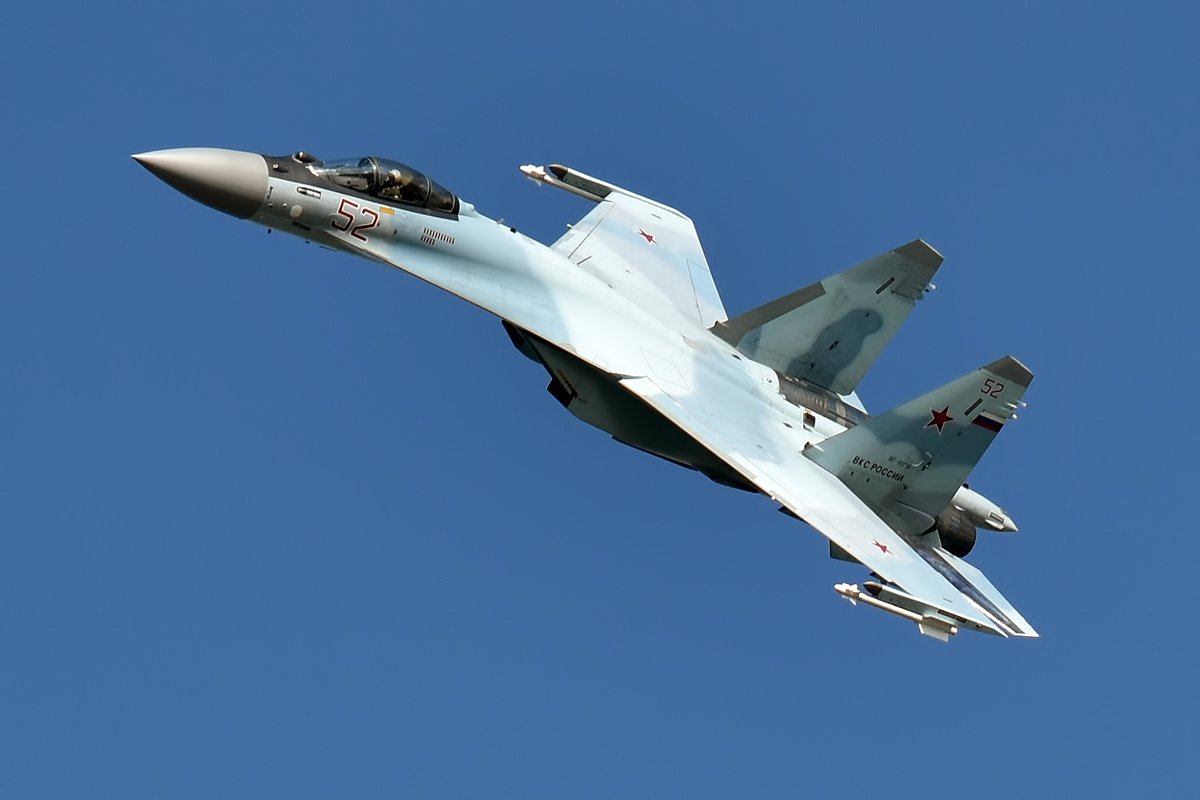
At Zhukovsky airport outside Moscow, Abiy Ahmed posed beside two fighter jets with Russian and Ethiopian officials, holding a framed certificate, and was shown the Su-57 stealth fighter as well. The photographs went up on his X account on October 28, during the third Russia-Africa Summit, with an announcement that Ethiopia had “taken delivery of the first twelve Su-35 4++ Generation fighter jets” under a prior agreement with Moscow, and would also receive four S-400 air defence batteries. The jets had arrived a year ahead of schedule, he said, thanking his friend Vladimir Putin for speeding the delivery, and the new equipment would strengthen Ethiopia’s ability to “preemptively deter aggression”. In a second post that day he described the jets as newly deployed to defend Ethiopian airspace.
Two jets changed hands at Zhukovsky, according to Russia’s state arms exporter, Rosoboronexport, which told Reuters that the first batch of two aircraft had been delivered to the Ethiopian Air Force that day. Only two arrived. The other ten carry no announced delivery date, and Abiy disclosed no cost for the deal and no basing for the aircraft. His wording matters here. “First twelve” implies more may follow, and twelve is double the only prior record of the order: internal Rostec files published by the hacker group Black Mirror in October 2025 listed Ethiopia under customer code 231 with an order for six Su-35s, and tasked Rostec’s electronics subsidiary KRET with building display and control systems for six airframes. Neither Rostec nor the Ethiopian government commented at the time.
On October 4, government troops entered Mekelle, the Tigray regional capital, after fighters of the Tigray People’s Liberation Front withdrew, and Addis Ababa installed a six-month caretaker administration. Fighting has continued anyway, with a TPLF commander calling for continued resistance in a television broadcast last week and the group claiming attacks in northwestern Tigray on October 28, while federal troops are also battling Fano, an Amhara armed group fighting since 2023. Researchers at Belgium’s Ghent University estimate the 2020-2022 war killed about 500,000 civilians. Neither flies combat aircraft, and the wars Ethiopia is fighting now are ground wars of infantry, artillery and drones. An air-superiority fighter answers a different kind of threat from the ones killing people in Tigray and Amhara.

Ethiopian troops have pushed right up to the Eritrean border in recent weeks, after repelling an advance by Eritrea-backed rebels in northern Tigray, and the two countries broke diplomatic ties this month. Both Abiy and Eritrean President Isaias Afwerki attended the Moscow summit, which drew delegations from 48 African nations, and Russia’s foreign minister, Sergei Lavrov, said on Tuesday that the summit could be a forum for the two neighbours to talk. “We are interested in Ethiopia and Eritrea normalising their relations,” Lavrov said, adding that Moscow would “provide every opportunity for arranging contact”. Asmara’s worry, reported for years, is that landlocked Ethiopia will invade to seize access to the Red Sea. A dozen of Russia’s most capable export fighters landing in Ethiopian hands is a fact Asmara has to price in whether or not a shot is ever fired.
Egypt’s air force counts 54 Rafale fighters, and it has been adding aerial refuelling capacity that defence analysts writing this week say would bring the Grand Ethiopian Renaissance Dam, inaugurated in September 2025, within practical striking range. Against that, Ethiopia’s ground-based air defences have long rested on Soviet-era S-75 and S-125 systems. A battery of S-400s, whose 40N6 missile is credited with a reach of up to 400 kilometres, would complicate any strike plan far more than the jets alone, and that reading, not the announcement’s language about collective security, is what gives the second half of Abiy’s post its weight, and Cairo has said nothing in public about the delivery.
Turkey signed for the same system in December 2017, in a contract reported at $2.5 billion, and the first components arrived at Mürted air base near Ankara on July 12, 2019. Five days later the United States announced that Turkey’s participation in the F-35 programme was over, saying the jet could not coexist with a Russian intelligence collection platform, and in December 2020 Washington imposed CAATSA sanctions on Turkey’s defence procurement agency, the first time the law had been turned on a NATO ally. A US defence law then barred any F-35 transfer while Turkey holds the S-400, and the six jets Turkey had paid for, reported at $1.4 billion, stayed mothballed on American soil. Washington has used the same law against China over its own Su-35 and S-400 purchases, so the question of whether it acts against Ethiopia now depends on a separate US determination. That determination has not been made.
In July 2026, President Donald Trump said in Ankara that he would lift the sanctions and consider reversing the F-35 ban, but the State Department told Congress on July 22, 2026, that Turkey has not yet met the conditions for readmission. The Kremlin has since confirmed that Moscow is discussing the future of Turkey’s S-400s, after reports that Ankara could transfer them to another country. The system Ethiopia is buying is one its most famous owner is trying to offload, and the price of membership so far is measured in a lost fighter programme, not in the purchase price of the batteries.
In 2018 Egypt ordered 24 of the same jets, and that transfer fell through under the threat of US sanctions and a teased offer of F-15s, after which airframes built for Cairo were later reported offered to other clients, with Algeria receiving its first units in March 2025 and Iran reported to have sought them. The War Zone notes that Ethiopia’s twelve could also have been left over from the abandoned Egyptian deal, a possibility rather than an established fact, and one that would make Ethiopia the third customer for a batch built for somebody else. The jets themselves are a heavily upgraded derivative of the Soviet-era Su-27, with thrust-vectoring engines and longer-range air-to-air missiles, and they join an air force that has flown Russian Sukhois for more than 25 years.
Russia’s arms exports fell 64% between the two five-year periods in SIPRI’s March 2026 fact sheet, and its share of global exports dropped from 21% to 6.8%, with the institute attributing the fall substantially to lost sales to Algeria, China and Egypt. Africa’s imports of major arms fell 41% over the same comparison, and in sub-Saharan Africa, where imports rose 13%, China supplied 22% across 23 states against Russia’s 12%, while the region’s largest buyers were Nigeria, Senegal and Mali. Ethiopia does not appear among them. The fleet it joins is small and old at the edges: around 10, perhaps 15, secondhand Su-27s that flew against Eritrea in the 1998-2000 border war, supplemented in 2024 by two Su-30Ks built for India and stored in Belarus, plus Yak-130 trainers displayed in January 2026. The War Zone warns that the new jets still need specialised pilot training, maintenance infrastructure, weapons integration and a dependable supply of spare parts, something Moscow has not always been able to guarantee while prioritising its own Su-35S fleet under sanctions.
Open-source trackers have counted at least 30 S-400 launchers lost in Ukraine, 29 destroyed and one damaged, according to the Oryx tally, and a composite estimate circulating this October puts total launcher losses near 45 once radars and command vehicles are included. That figure is an estimate. Ukraine’s campaign blinded the radars that make the launchers matter, rather than destroying every launcher. A shield sold as untouchable has spent the war being taken apart at its sensors, which is a different record from the one in the sales brochure. Rostec did not immediately respond to Reuters’ request for comment on the Ethiopian deal, and Abiy disclosed no cost for it, no basing for the jets, and no delivery date for the remaining ten aircraft or any of the four batteries.