Virginia Tech’s Elite Run Defense Forces Clemson’s Broken Passing Game Into Must-Win Spotlight
Hokies' run defense forces Tigers' aerial attack into must-produce territory
CLEMSON — Virginia Tech arrives at Memorial Stadium on Friday night with the ACC’s most suffocating run defense, a unit allowing just 98.3 yards per game on the ground. For Clemson, that statistic represents a crisis.
The Tigers enter the 7 p.m. ESPN matchup ranked last in the conference at 187.5 passing yards per game. Their two passing touchdowns through six games are the fewest in the Football Bowl Subdivision. Offensive coordinator Chad Morris acknowledged the mismatch Tuesday, saying the Hokies’ front seven will force Clemson into extended drives unless the aerial attack produces explosive plays — something it has failed to do all season.
“That’s one of the things we’re lacking,” Morris said. “We’re having to go on 9-, 10-, 12-, 13-play drives, and that’s hard. And you deal with 18 third downs. That’s tough.”


Clemson has recorded only 15 passing plays of 20 yards or more, an ACC low. The inability to stretch the field vertically has allowed defenses to stack the box against the run, compressing the margin for error on every snap. Against a Virginia Tech defense that ranks third nationally in stuff rate — tackles for loss or no gain on rushing attempts — that compression becomes a strategic trap.
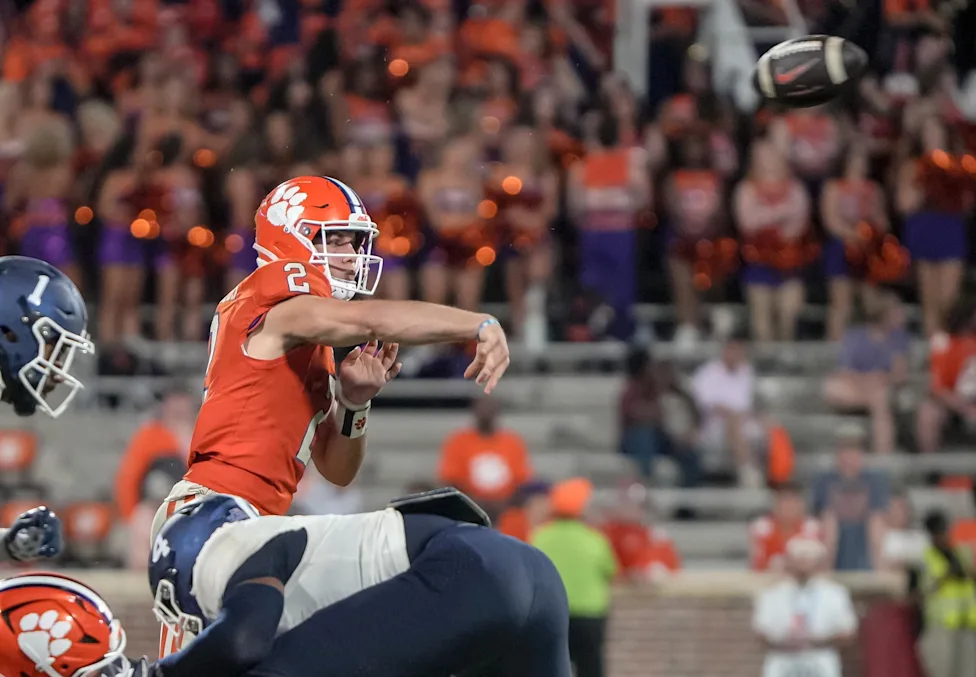
Freshman quarterback Tait Reynolds will make his fifth career start. Morris stopped practice Sunday to address Reynolds’ tendency to drop his eyes and scramble under pressure rather than keep receivers alive downfield. The coordinator wants the quarterback’s “internal clock” to accelerate, but the broader issue involves a receiving corps that has not consistently won one-on-one matchups.
Head coach Dabo Swinney characterized wide receiver T.J. Moore’s performance against Charleston Southern as his “worst game as a Tiger” after multiple drops on catchable deep balls. Morris said Moore allowed an early miss to compound through the remainder of the afternoon.
“Had he caught the third play of the game last week, I think the way the game unfolded for him would have been completely different,” Morris said.
The Tigers (4-2, 2-1 ACC) have leaned on a defense that ranks among the nation’s best in yards per play allowed. But the offensive imbalance has placed unsustainable pressure on that unit. Six of Clemson’s 12 drives against Charleston Southern lasted 10 plays or longer. Against Virginia Tech (5-2, 2-2), whose offense controls the clock at a top-25 pace, extended defensive snaps could become a liability.
Morris framed the solution as collective: “It’s from the coaches. That’s all of us.” The timeline is immediate. The Hokies’ run defense does not wait for development curves.