Ohio State’s Playoff Path Narrows After Losing Julian Sayin
Ryan Day confirms the starting quarterback will miss the remainder of the regular season and postseason.
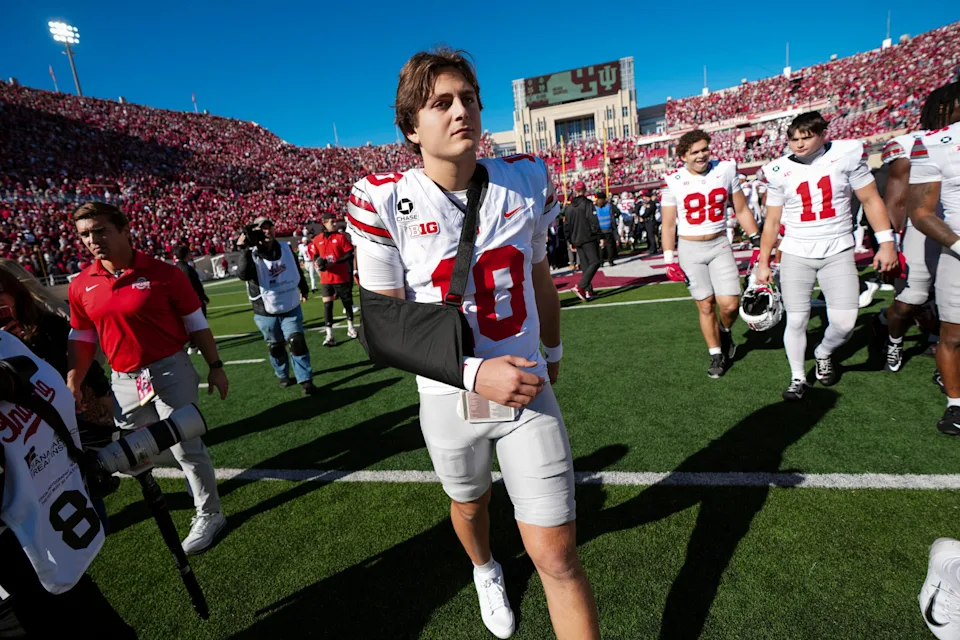
Ohio State has roughly six regular-season games left to secure a College Football Playoff berth without the quarterback who drove its offense for the past two years. Head coach Ryan Day confirmed Tuesday that Julian Sayin is out indefinitely following a throwing-arm injury, forcing the program into an immediate scramble to redesign its offensive approach.
“Based on the nature of the injury, we are putting together a plan for him not being available for the regular season and then also him not being available for the postseason,” Day told reporters after practice on October 20. “We’re not going to put any timeline on his recovery, but he is out indefinitely.”
The confirmation followed a 19-15 road win over Indiana on October 17, where Sayin was sacked by defensive lineman Mario Landino with just over eight minutes remaining in the fourth quarter. The hit pinned Sayin’s right arm against his body as he attempted to throw near the Indiana 38-yard line. He left the field at Memorial Stadium in Bloomington wearing a sling and did not return.



Day initially suggested immediately after the game that Sayin would “probably be out for several weeks.” By Monday, the assessment remained cautious but open-ended. Tuesday’s statement closed that window. As of October 21, 2026, the program has released no specific medical diagnosis beyond the head coach’s remarks.
Losing Sayin removes the statistical anchor of one of the country’s most efficient passing attacks. Operating as a redshirt freshman starter in 2025 after transferring from Alabama, Sayin threw for 3,610 yards and 32 touchdowns. His completion rate hovered near 77%, leading the nation. That production earned him Big Ten Freshman of the Year honors and a fourth-place finish in Heisman Trophy voting.
Those numbers dictated how opponents schemed against Ohio State. Defenses had to respect deep-shot capabilities and rapid processing at the line of scrimmage. Without Sayin under center, opposing coordinators can compress their coverages and allocate additional defenders to the run game. Offensive coordinators across the Big Ten have historically leaned heavily on play-action and short-to-intermediate timing routes when transitioning to backup quarterbacks late in a season, sacrificing downfield explosiveness to limit turnovers.
The timing compounds the damage. Under the current 12-team College Football Playoff format, conference championships carry heavy weight in selection committee deliberations. A team relying on a new starter in late October faces steep margins for error in November matchups that directly influence seeding and at-large bids. Ohio State cannot afford extended adjustment periods during the final stretch of the Big Ten schedule.
If he’s not able to return this fall, Day noted, the staff is already building contingency plans. “That’s the update I have right now,” he added.