Hyperscaler borrowing costs hit 10% as oil spikes to $108
Bank of America warns a marked shift in AI spending could arrive next year if bond yields stay elevated.
The cost of capital for the world’s largest cloud and AI infrastructure providers has more than doubled since 2023, reaching 10% and forcing a new profitability threshold on hyperscalers racing to build out artificial intelligence networks. That figure, published by Bank of America strategist Savita Subramanian, marks a sharp departure from the 4% weighted average cost of capital these companies relied on just three years ago.
Ten percent is now the return on incremental invested capital that hyperscalers must clear to justify continued spending, according to Subramanian. The math is unforgiving. When returns fall below that borrowing threshold, the investment stops making economic sense.
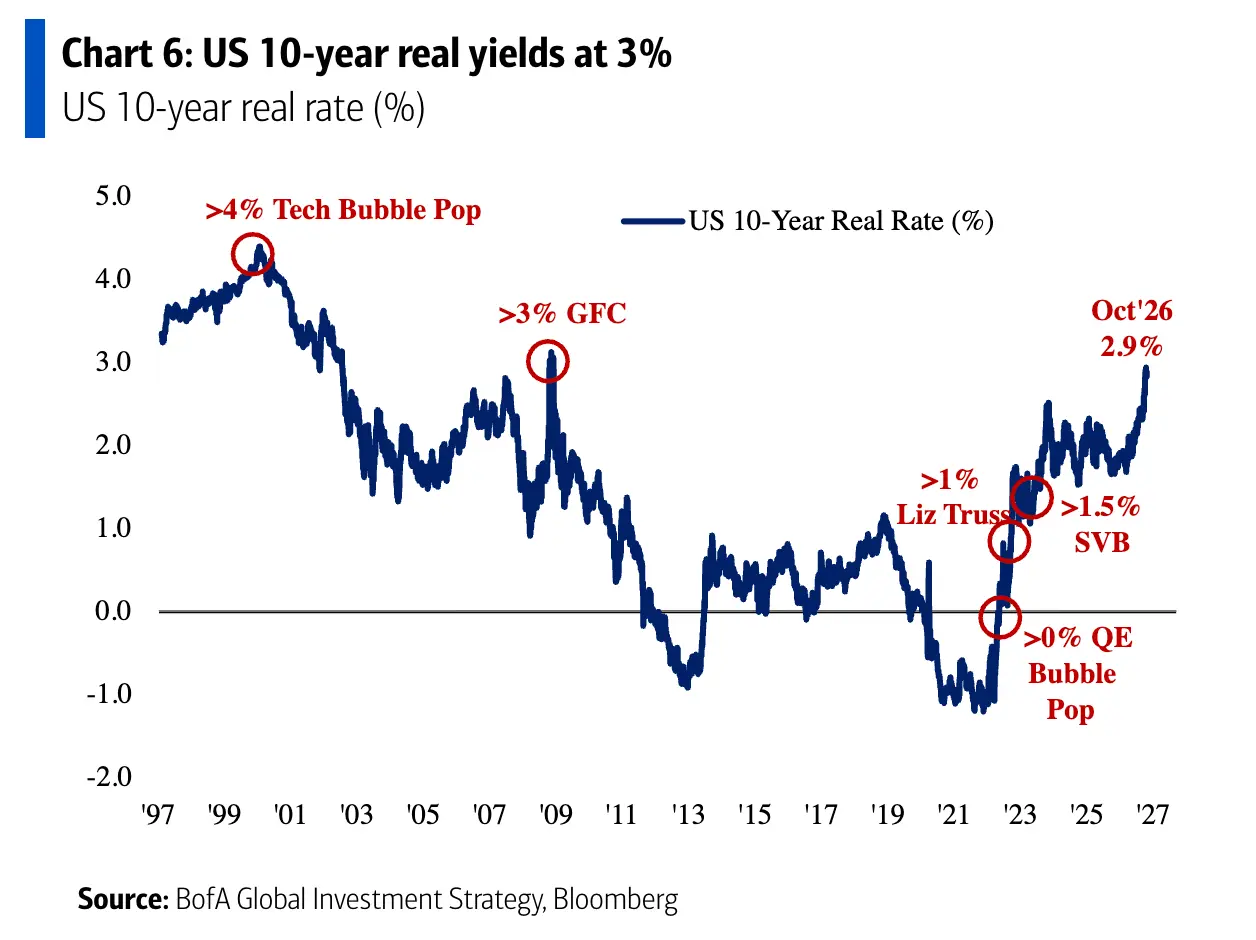
Rising yields in the bond market are driving the shift. The benchmark 10-year Treasury yield sat at 5.08% Monday morning, down from a recent peak of 5.3%. Michael Hartnett’s team at Bank of America noted that the market was pricing in risk levels comparable to the Great Financial Crisis during last week’s spike. It is exactly thirty-nine years since Black Monday, when the Dow Jones fell 22.6% in a single trading session in October 1987.


Subramanian said most equity meetings her team conducts are now “90% AI, 10% everything else,” with conversations ultimately boiling down to whether hyperscalers can generate returns above their elevated borrowing costs. She expects the current capital expenditure wave to continue but warned of a potential “marked shift in trend” next year if yields fail to decline. Inflation, real yields, credit events, increased regulations, and equity supply outpacing demand remain the primary risks, she wrote in a client note.
Energy prices compounded pressure on global markets Monday. Brent crude climbed to $108 per barrel. Equities split along regional lines. South Korea’s KOSPI gained 1.76%, while Japan’s Nikkei 225 dropped 0.62%. India’s Nifty 50 fell 1.19%. China’s CSI 300 edged up 0.09%.
In Europe, the Stoxx 600 declined 0.78% in early trading. The U.K.’s FTSE 100 lost 0.87% before lunch.
U.S. futures pointed higher following a tech-led selloff on Friday that knocked the S&P 500 down 1.09%. S&P 500 futures rose 0.47% Monday morning. Nasdaq futures also climbed before the open in New York. Chris Beauchamp, chief market analyst at IG, told Fortune that buyers had reappeared after last week’s drop, noting the S&P 500 was at a record high just two weeks prior and characterizing the pullback as a rotation rather than the start of a broader downturn.
Bitcoin traded at $82,769.