

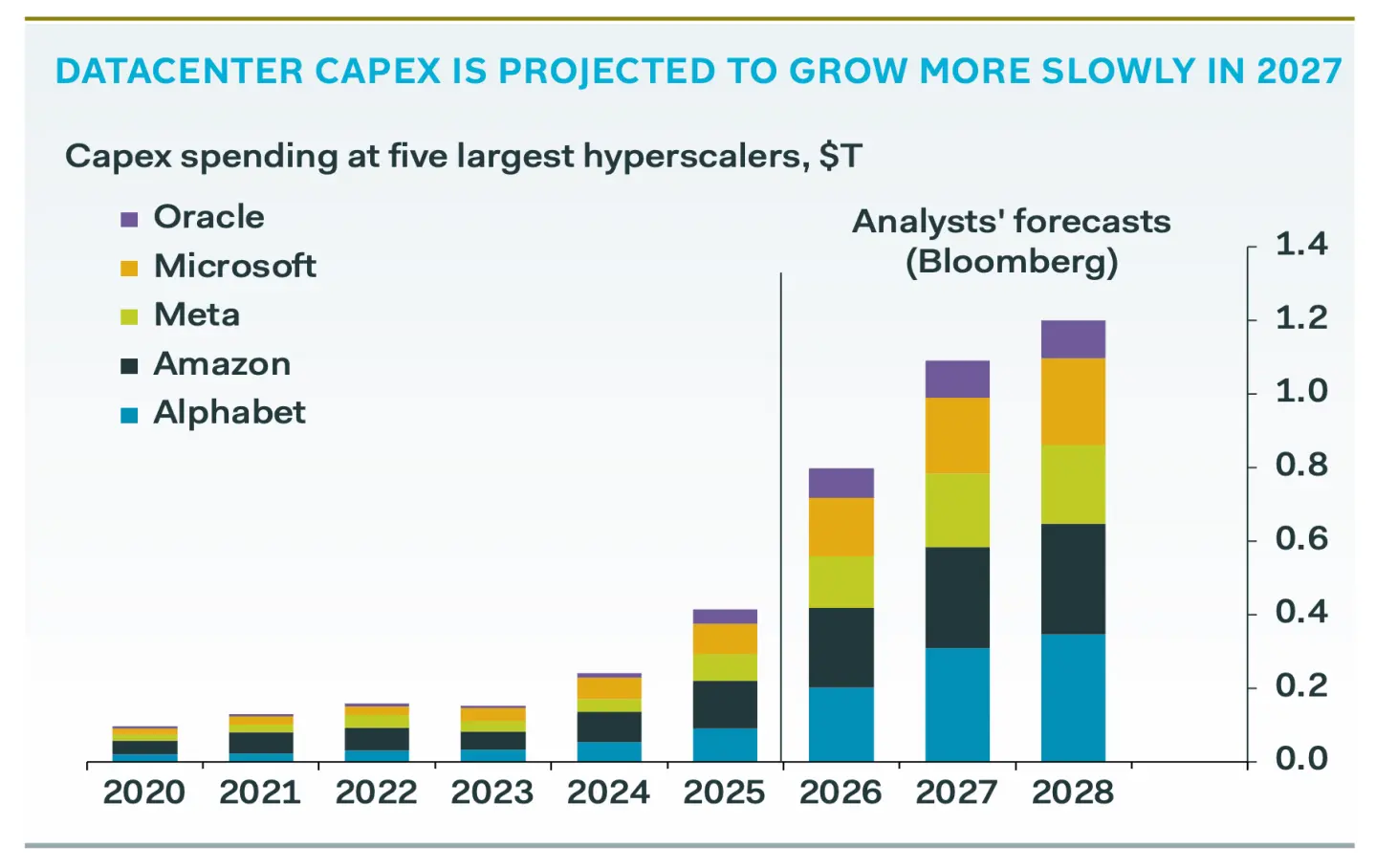
Wall Street analysts are converging on a timeline for the artificial intelligence infrastructure boom: capital expenditure by the world’s largest cloud providers will likely peak in 2027 before decelerating, driven by tightening cash flows, rising borrowing costs, and mounting physical supply constraints.
The financial math underpinning the AI buildout is shifting. Stijn Van Nieuwerburgh of Columbia Business School projects that combined capital expenditure across Oracle, Microsoft, Amazon, Meta, and Alphabet will surpass their aggregate operating cash flow for the first time this year. Internal revenue generation can no longer independently fund the projected pace of data center investment without heavier reliance on external debt or off-balance-sheet financing structures.
This liquidity squeeze is forcing a recalibration across trading desks. Wells Fargo analyst Ohsung Kwon told clients this week that markets will begin pricing in a 2027 capex peak following third-quarter earnings reports and the U.S. midterm elections. By 2028, most investors expect meaningful spending reductions. Samuel Tombs and Oliver Allen at Pantheon Macroeconomics reinforced that view, noting nominal capex growth among the top five hyperscalers is forecast to slow materially next year compared to current levels.


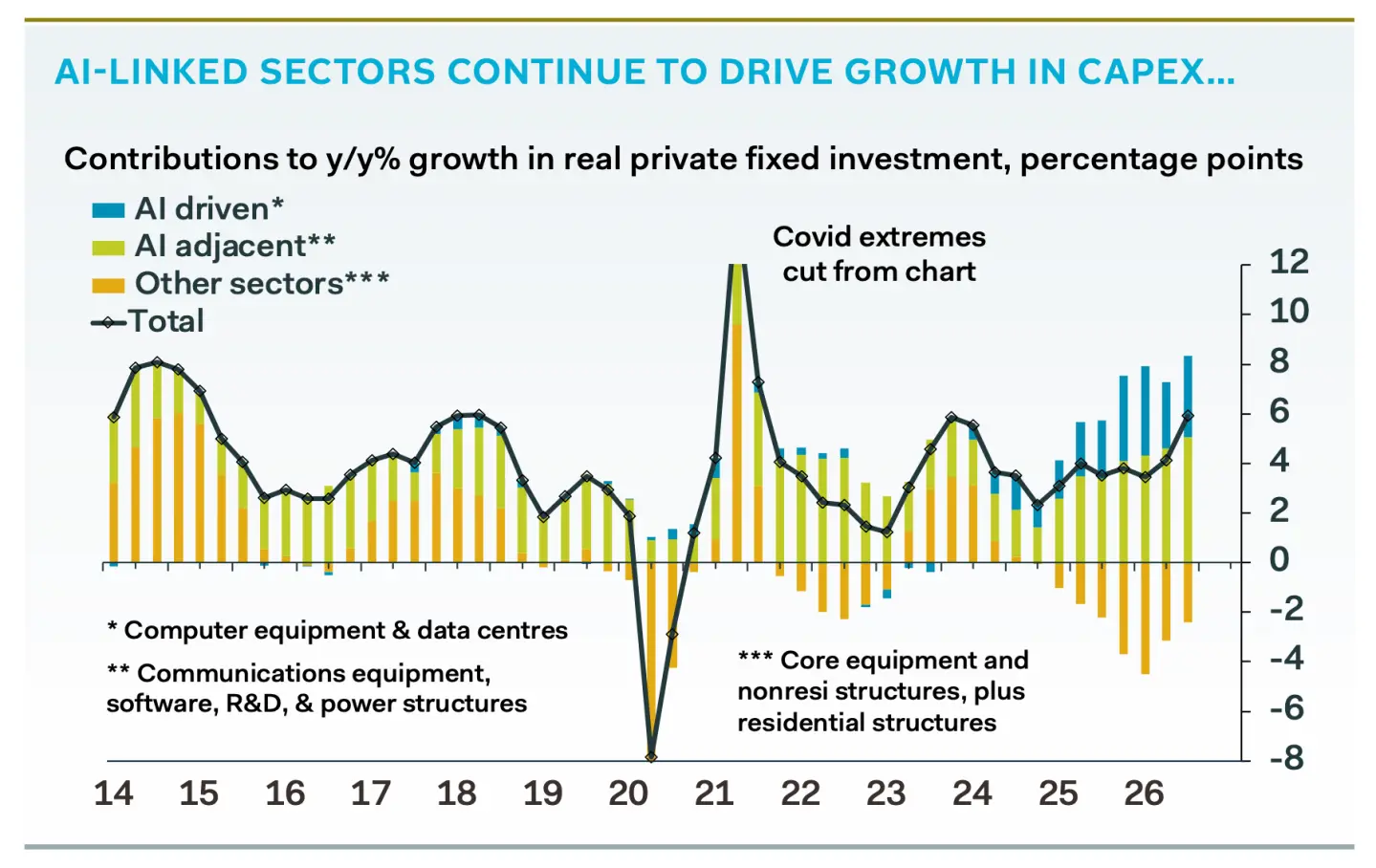
Physical bottlenecks are compounding the financial strain. The industry faces acute shortages in advanced semiconductor packaging, electrical grid capacity, construction labor, and raw materials required to erect massive data centers. These supply-side constraints make it structurally impossible to maintain the exponential spending curves seen over the past three years, regardless of how much capital hyperscalers attempt to deploy.
Rising yields on long-dated bonds further compress margins for firms already carrying elevated leverage. Yet analysts caution against predicting a collapse in AI investment. Financing remains accessible, and major technology companies continue to project exceptionally high returns from artificial intelligence applications. The trajectory points toward moderation rather than contraction.
Not all market participants accept the slowdown thesis. Dan Ives, who recently departed Wedbush to launch merchant bank Yorkville Ives, published his inaugural research note maintaining an aggressively bullish stance on 49 technology stocks. Ives argues that supply, rather than demand, defines the current phase of the AI cycle, asserting the infrastructure layer will remain constrained through at least 2027. His top picks include Nvidia, Microsoft, Palantir, Apple, and CrowdStrike.
Broader equity markets reflected investor hesitation amid these competing narratives. After the S&P 500 closed at a record 7,818.93 yesterday, futures dipped 0.07% in pre-market trading as traders took profits. European indices retreated, with the Stoxx 600 falling 0.48% and the FTSE 100 dropping 0.44%. Asian markets saw steeper declines, led by South Korea’s KOSPI shedding nearly 2%. Brent crude traded at $101 per barrel while Bitcoin held at $83,721.
Geopolitical risk continues to influence energy prices and broader market sentiment. Escalating Houthi attacks on Saudi Arabia and Iranian disruptions to shipping through the Strait of Hormuz have pushed oil higher, adding inflationary pressure that complicates central bank rate-cutting timelines.
Domestically, the U.S. housing market remains frozen by interest rate dynamics. Goldman Sachs data indicates 90% of homeowners with mortgages hold rates below the current 7.3% market average, effectively eliminating any financial incentive to sell or relocate. Mortgage rates have climbed more than one percentage point since February.
In public health, the Centers for Disease Control and Prevention is tracking an unusual autumn surge in common cold cases, reaching levels unseen since 2019, even as influenza and Covid-19 transmission rates decline nationwide.



