Tennessee vs. Alabama Cigar Tradition: History and 2026 Game
How a 1961 locker room celebration became an annual NCAA fine that neither program intends to stop paying.
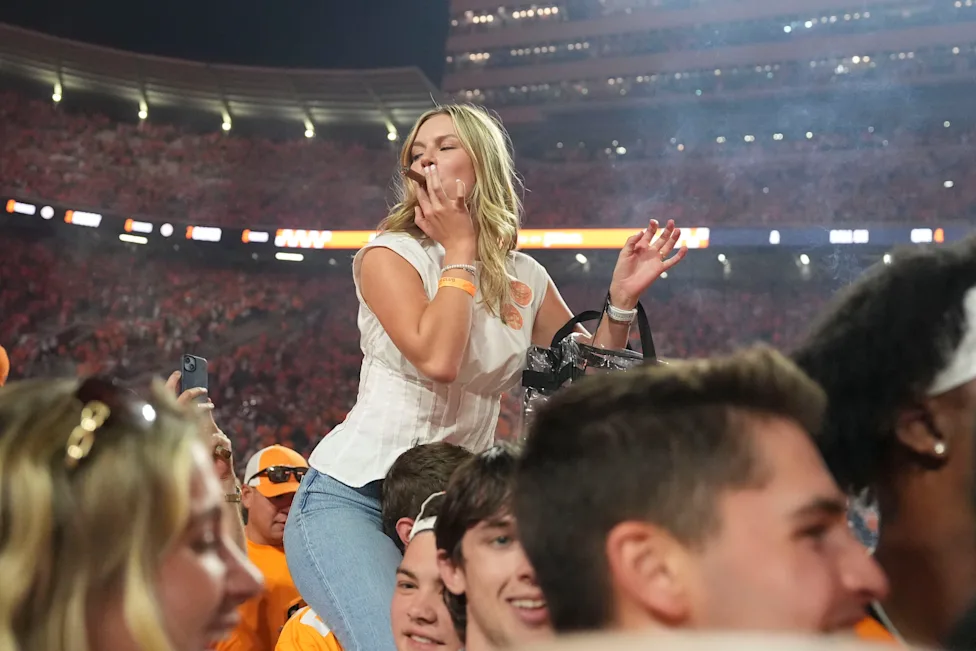
The NCAA banned all tobacco use on playing fields, in locker rooms, and during practice sessions starting with the 1994 season. Yet every October, one of college football’s most recognizable traditions survives through a calculated willingness to absorb a financial penalty.
When Tennessee (5-1, 2-1 SEC) hosts Alabama (5-1, 3-1 SEC) at Neyland Stadium today at 3:30 p.m. ET on ABC for the 109th meeting between the programs, the winning team will smoke cigars immediately after the final whistle. The university athletic department treats the resulting NCAA fine as a standard operational cost rather than a deterrent.
Under current NCAA bylaws, member institutions are responsible for policing tobacco use within their facilities. Violations typically result in fines levied against the offending school rather than individual players or coaches. For the victor of this specific rivalry, paying that fine has become an annual budget line item, preserving a ritual that transcends conference rulebooks.

The tradition traces back to 1961, originating not from a head coach or a star quarterback, but from Jim Goostree, an Alabama athletic trainer who happened to be a Tennessee alumnus. Following a 34-3 Crimson Tide victory over the Volunteers, Goostree distributed cigars inside the Alabama locker room. Tennessee eventually co-opted the celebration, transforming it into a shared symbol of supremacy in the matchup historically branded as the Third Saturday in October.
Unlike spontaneous fan celebrations such as rushing the field or tearing down goalposts — which carry heavy SEC fines and safety risks — the cigar tradition is a coordinated, cross-generational act involving players, coaching staffs, and more than 100,000 spectators simultaneously. Local tobacconists in Knoxville and Tuscaloosa routinely report their highest annual sales volumes during the week preceding the game. While both the University of Tennessee and the University of Alabama enforce smoke-free campus policies, stadium security faces an impossible logistical challenge in preventing thousands of fans from smuggling cigars past gates.

For nearly two decades, the cigars burned almost exclusively in Tuscaloosa. Alabama won 16 consecutive matchups against Tennessee from 2007 through 2021, a stretch covering the entirety of Nick Saban’s dominance in the series. Saban, now serving as a television analyst, referenced that streak earlier this season while appearing on ESPN’s College GameDay in Knoxville before Tennessee played Texas, joking that Alabama had smoked 16 out of 17 cigars against the Volunteers.
Tennessee broke the 16-game losing streak with a 52-49 victory in 2022 under head coach Josh Heupel. Players including quarterback Hendon Hooker, wide receiver Squirrel White, offensive lineman Javontez Spraggins, and placekicker JT Carver lit up on the Neyland Stadium turf alongside fans who stormed the field. Heupel walked off the field with a cigar in his mouth, declaring that everyone was lighting one that night.

The Volunteers repeated the feat at home in 2024, with players like wide receiver Chris Brazzell II, defensive back Kaleb Beasley, and defensive lineman Jordan Ross celebrating another win while fans carried the torn goalposts across the field through a thick haze of smoke.
Today’s matchup presents distinct stakes beyond the rivalry trophy. Both teams enter with 5-1 overall records, but Alabama holds a 3-1 mark in SEC play compared to Tennessee’s 2-1 conference record. With the expanded 12-team College Football Playoff format now firmly established, a conference loss in mid-October carries heavier mathematical consequences for playoff seeding and first-round byes than it did during the four-team era when the tradition saw its longest interruptions.

Both programs have navigated early-season schedules to arrive in Knoxville with identical overall records. Kickoff is scheduled for 3:30 p.m. ET, with national television coverage on ABC.