
Snapchat Launches Native Event Tool to Rival Facebook and Partiful
Snapchat Launches Native Event-Creation Feature for Private In-Person Gatherings
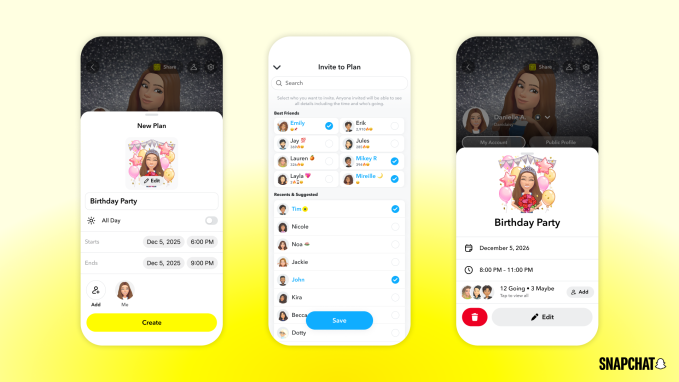
Snap Inc. has introduced a native event-coordination feature called Snapchat Plans, designed to manage offline get-togethers directly within its messaging platform. The feature allows users to create, distribute, and track private invitations for in-person events such as birthday parties, study sessions, and casual weekend gatherings. Recipients can respond directly within individual one-on-one messaging threads using three standard RSVP statuses: “Going,” “Maybe,” or “Can’t Go.”
Event organizers can set a title, designate a date and time, specify a location, and send direct invitations to as many as 200 friends. Rather than publishing invitations to a public feed or broadcasting them in multi-user group chats, Snapchat Plans delivers invitations through direct one-on-one messaging threads with each guest. Confirmed guests receive an automated push notification reminder one hour before the scheduled start time.
Snapchat added a dedicated “My Plans” tab to user profiles, serving as a centralized hub for current, upcoming, and past invitations. When a user views a friend’s profile, the app displays a shared event log highlighting gatherings both users are scheduled to attend together. Snapchat confirmed that all events created through the system are private and operate on an invite-only basis.


The move reflects broader changes in how younger demographics manage their social lives online. For years, digital event planning was heavily dominated by Facebook Events, which Meta Platforms Inc. introduced in 2005. However, shifting demographic trends have seen younger users move away from legacy social networks in favor of specialized invitation tools and mobile-first messaging apps.
According to data from the Pew Research Center, Facebook usage among American teenagers dropped from 71 percent in 2014–2015 to less than 20 percent in recent years, while Snapchat has maintained a stable presence, with approximately 60 percent of U.S. teens aged 13 to 17 actively using the app. That demographic shift fueled the rapid growth of Partiful, an event-planning startup founded in 2020 by Shreya Murthy and Joy Liu.
Snap’s entry into native event management aligns with its historical focus on close-friend communication rather than public content broadcasting. Founded in 2011 by Evan Spiegel, Bobby Murphy, and Reggie Brown, Snap Inc. built its user base on ephemerality and direct-messaging before expanding into location-based services and augmented reality. The integration of Snapchat Plans expands on Snap’s existing location-based tools, most notably Snap Map, which launched in June 2017 following Snap’s acquisition of French social mapping startup Zenly for approximately $250 million.
Partiful gained popularity among Gen Z and millennial users by offering mobile-friendly event pages, customizable themes, and text-based RSVP management, offering an alternative to traditional email invitation platforms like Evite, which was founded in 1998. Competition in the mobile invitation space has intensified across the tech industry. Last year, Apple Inc. introduced its own native invitation application, Invites, integrating event coordination across iOS devices, iCloud calendars, and iMessage.
Snap Map allows users to share their location in real time and discover popular venues, places, and events nearby. Snap, which went public on the New York Stock Exchange in March 2017, reported reaching 443 million daily active users globally in the third quarter of 2024. By embedding event creation directly into its existing messaging ecosystem, Snap is positioning itself against independent digital invitation platforms like Partiful, as well as established tools from major tech rivals.
Event hosts maintain administrative control over the listing, allowing them to modify event details, review attendee rosters in real time, and invite additional contacts as needed. The addition of structured planning tools represents an effort to convert high daily app usage into actionable, real-world utility, keeping event coordination within Snap’s ecosystem rather than losing user engagement to third-party web tools or external messaging apps.
Image Credits:Snapchat /