
GPU Prices Turn Nvidia’s Advantage Into AMD and Intel’s Opportunity
AMD and Intel exploit Nvidia’s inflated graphics card prices
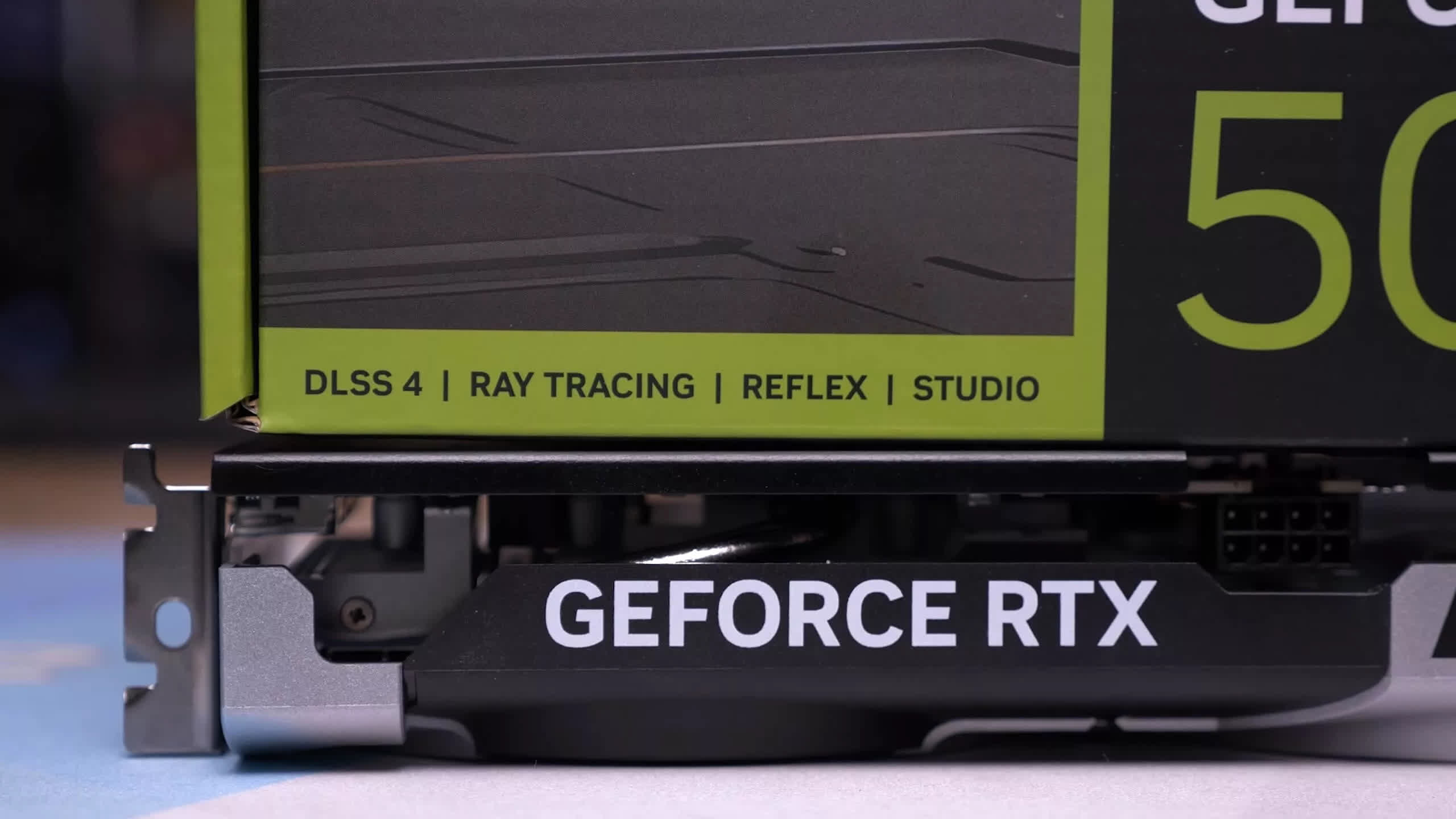
A global squeeze on semiconductor manufacturing and a persistent memory supply crisis have distorted the graphics processing unit (GPU) market. Nvidia Corp.’s GeForce lineup has been hit by disproportionate price inflation, giving Advanced Micro Devices Inc. (AMD) and Intel Corp. room to pursue value-conscious consumer PC gamers.
Global retail tracking data from 10 key international regions shows that Nvidia’s aggressive pricing has opened opportunities for AMD’s Radeon RX 90-series and Intel’s Arc Battlemage graphics cards. The shift is most visible in the mid-to-high-end brackets, where AMD has developed a significant cost-per-frame advantage.
The change is especially stark at the top of the market. Nvidia’s ultra-enthusiast GeForce RTX 5090 now sells for approximately $5,000, moving it effectively outside the consumer gaming sector. Industry analysts classify it as professional workstation-class hardware comparable to the enterprise-targeted RTX Pro 6000, making its cost-per-frame metric irrelevant for standard gaming benchmarks.


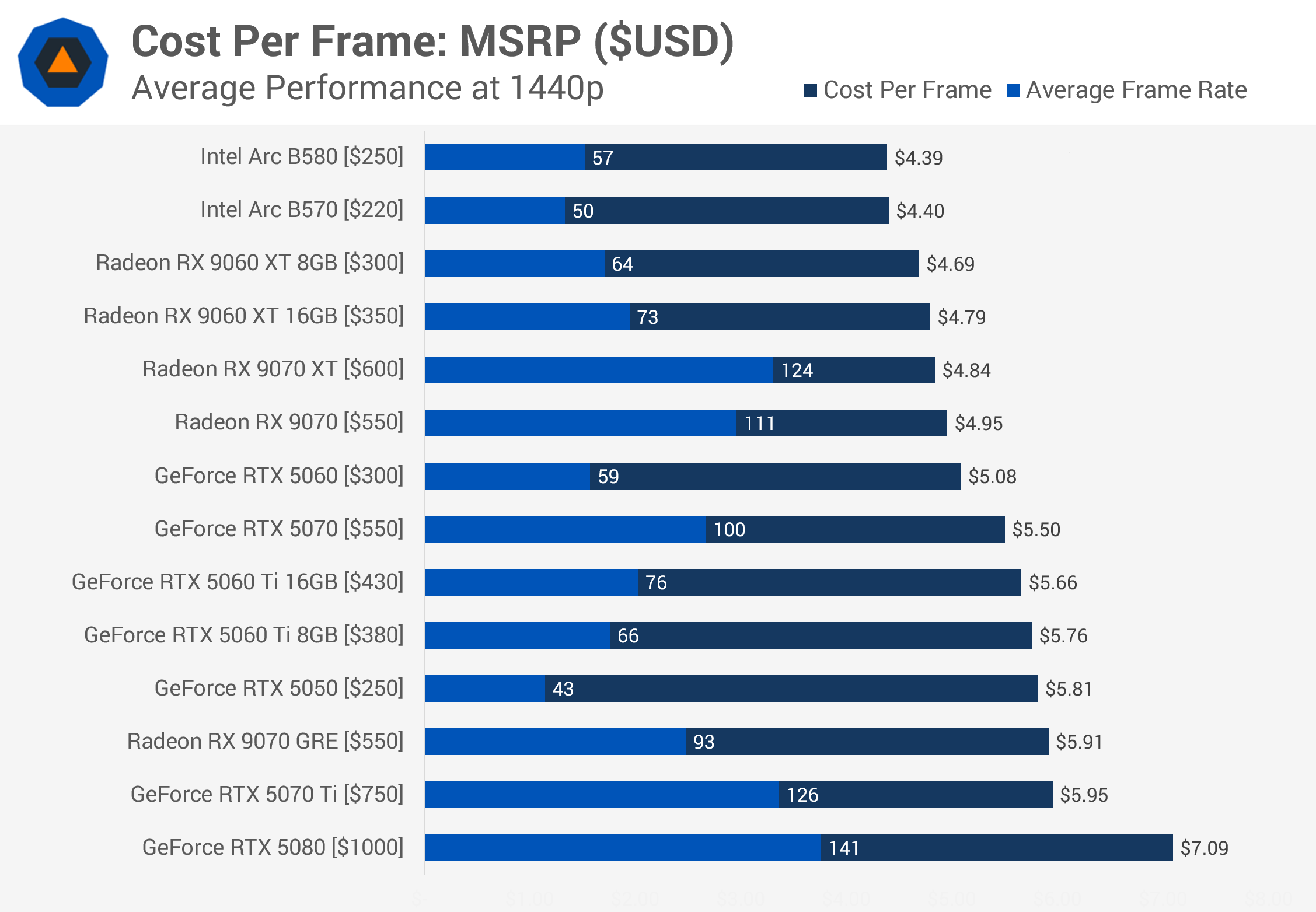
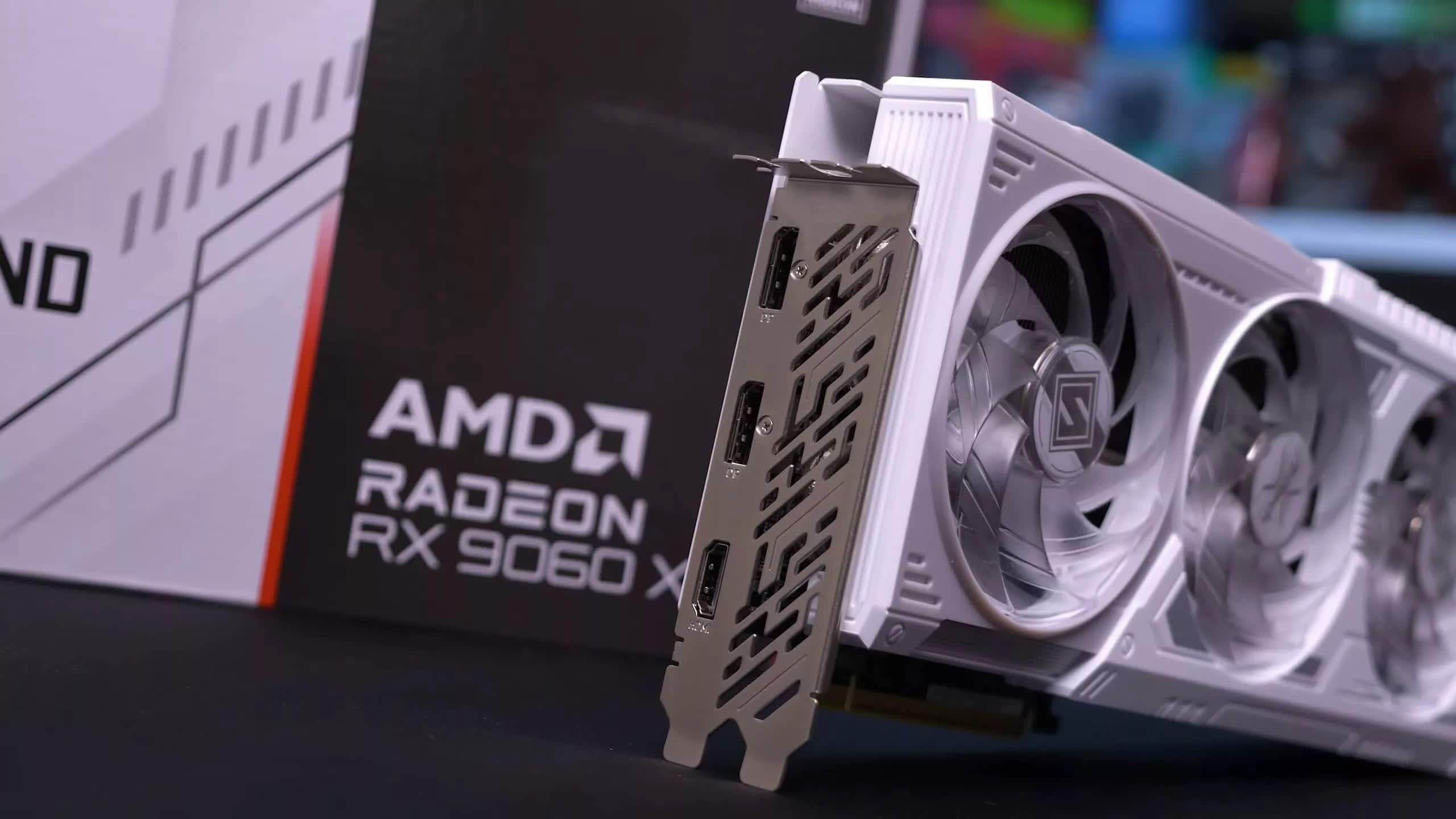
Graphics cards once routinely traded near their manufacturer’s suggested retail prices (MSRP). At those baseline prices, Intel’s entry-level Arc B580 dominated the sub-$250 market, while AMD’s Radeon RX 9060 XT stood out for budget-conscious buyers seeking higher performance and increased video random-access memory (VRAM).
Under normal market conditions, AMD’s mid-range RX 9070 XT delivered a 12% lower cost per frame than Nvidia’s RTX 5070 and nearly a 20% advantage over the RTX 5070 Ti. Specialty products such as the RX 9070 GRE (Golden Rabbit Edition) and Nvidia’s entry-level RTX 5050 struggled to justify their positions at MSRP because of performance and value imbalances. Ongoing supply chain pressures have overturned those relationships.
## North American price divisions
In the United States, Intel’s Arc B570 holds an 8% cost-per-frame lead over AMD’s 8GB Radeon RX 9060 XT at the lowest end of the market. The Arc B580 and RX 9060 XT 8GB offer comparable value metrics, but Intel supplies 12GB of onboard VRAM against AMD’s 8GB.
As modern game engines demand larger memory pools for high-resolution textures, VRAM capacity has become a central point of competition. That is apparent in the $450 tier, where the RX 9060 XT 16GB competes with Nvidia’s RTX 5060. Both cards sell above their targeted $300 to $350 launch brackets, but the Radeon provides double the VRAM and faster rendering, producing a 17% cost-per-frame advantage.
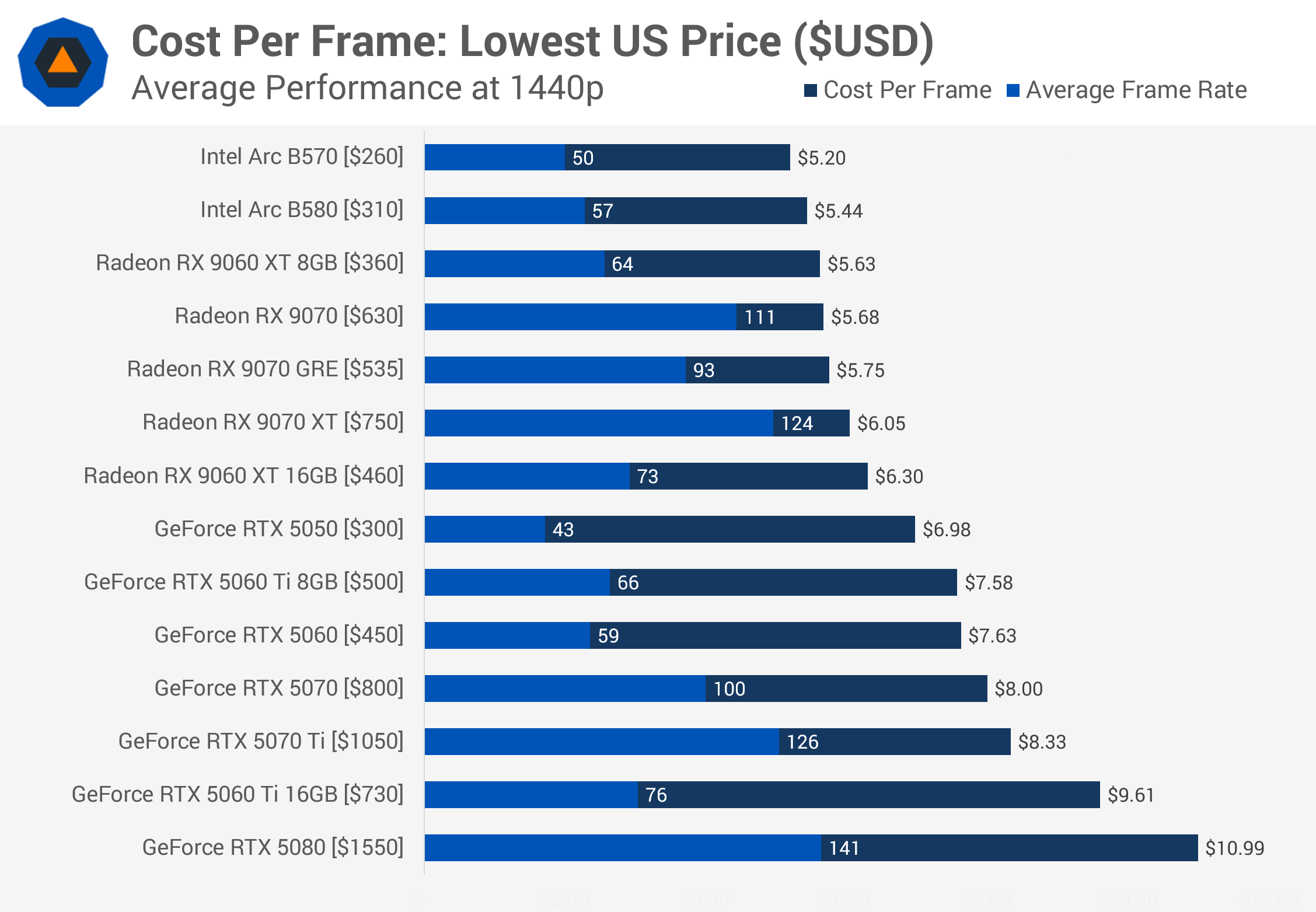
Nvidia’s higher prices for the RTX 5070 and RTX 5060 Ti 16GB have left the $600 price point largely uncontested. AMD’s RX 9070 and RX 9070 GRE dominate there, with the standard RX 9070 holding a slight edge because it includes 16GB rather than the GRE’s 12GB. Nvidia’s nearest product in the bracket, the 8GB RTX 5060 Ti, is weakened by its limited memory buffer.
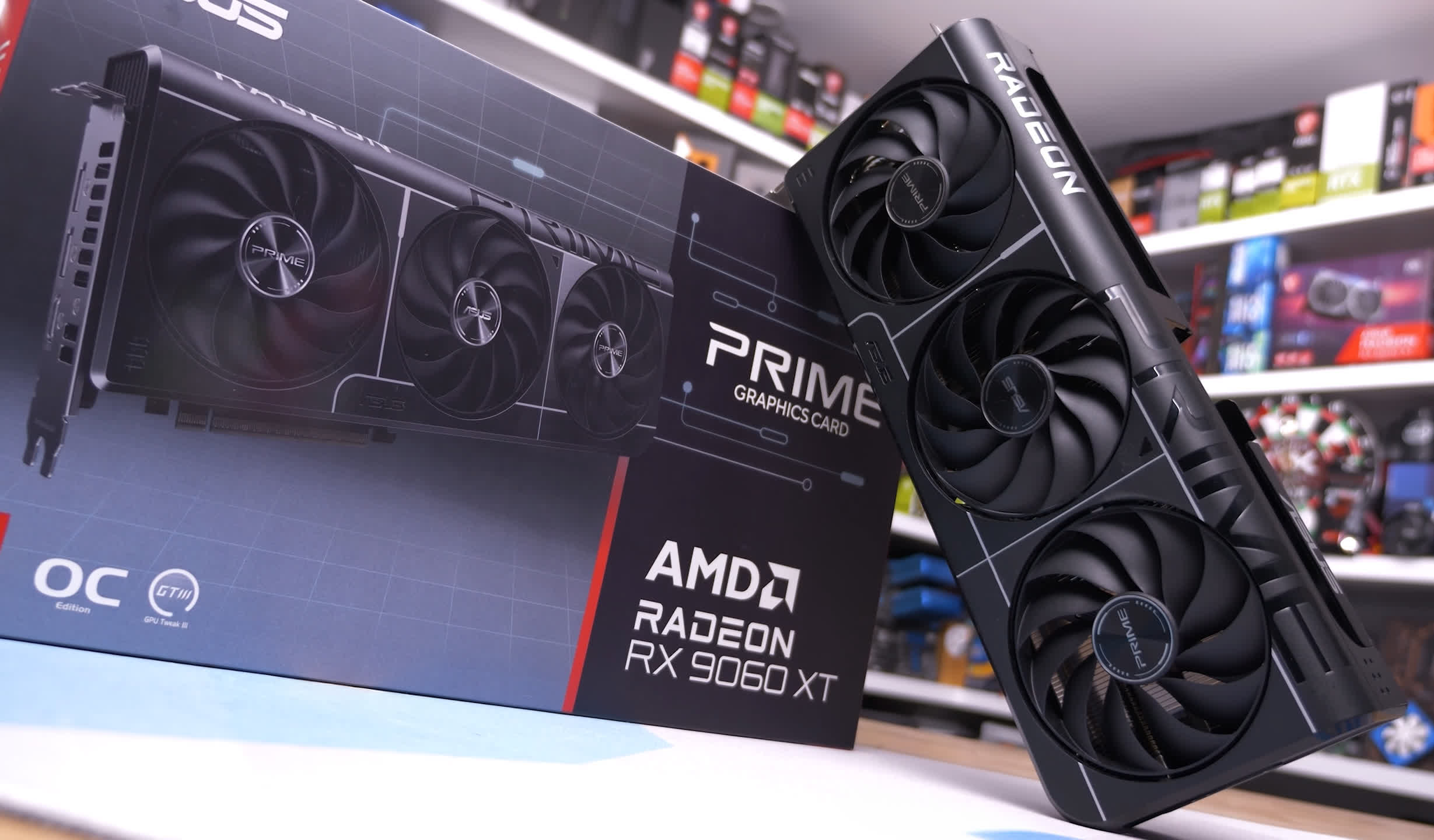
The RX 9070 XT extends AMD’s position further up the stack. It offers a 24% lower cost per frame than the RTX 5070, a 37% advantage over the RTX 5060 Ti 16GB, and a 27% value advantage over the RTX 5070 Ti. Nvidia’s proprietary Deep Learning Super Sampling (DLSS) ecosystem does not erase the raw performance deficit of the GeForce cards.
Canada is more favorable to Nvidia at the low end, although AMD retains the stronger position in upper tiers. The country has avoided some of the severe retail markup applied to the RTX 5060 in the United States, leaving that card viable as a budget option alongside Intel’s Arc B580. The Arc B580 holds a 9% value lead over the RX 9060 XT 8GB.
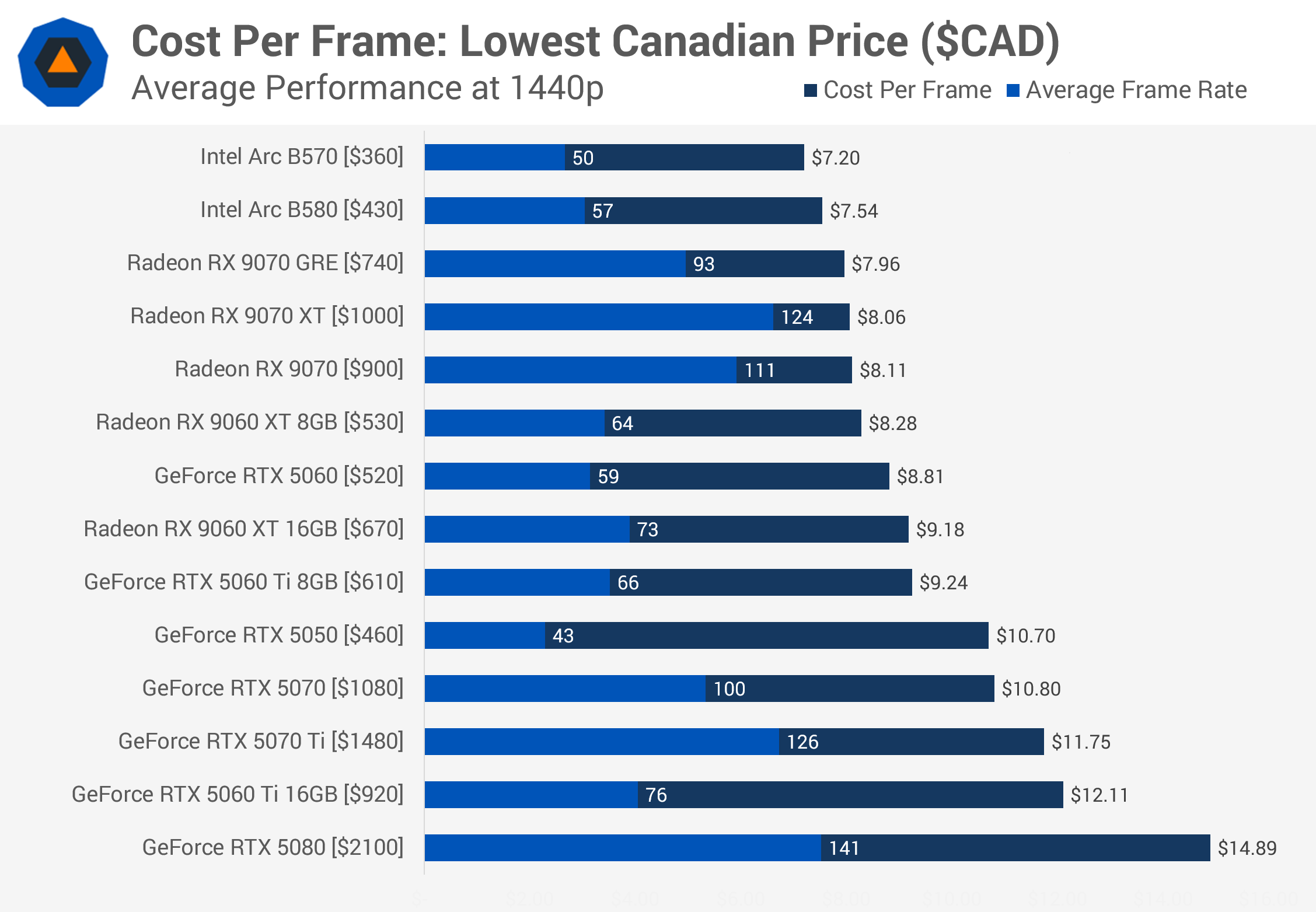
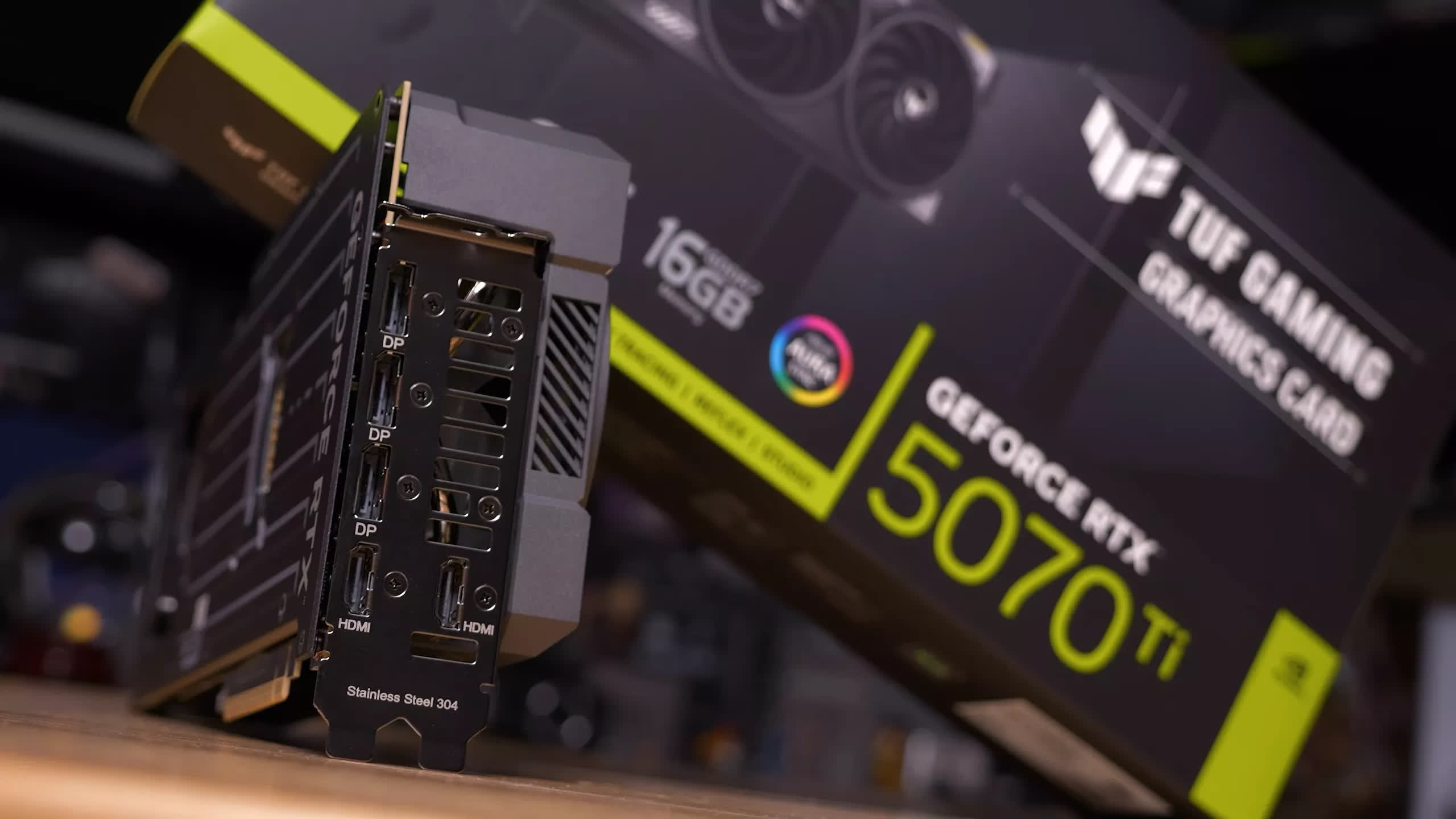
At mid-range prices in Canada, the RX 9060 XT 16GB matches the cost-per-frame value of the RTX 5060 Ti 8GB. Reviewers favor the Radeon because of its superior memory buffer. Higher up, the RX 9070 XT has a 25% cost-per-frame lead over the $1,080 CAD RTX 5070 and a 33% advantage over the $920 CAD RTX 5060 Ti 16GB.
## Europe’s uneven GPU hierarchy
Local distribution networks, import tariffs, and value-added taxes (VAT) create different pricing outcomes across continental Europe and the United Kingdom. Germany gives Intel’s Arc B570 the strongest budget value, while AMD’s RX 9060 XT 8GB holds an 8% advantage over both the RTX 5060 and RTX 5060 Ti 8GB in the mainstream category.
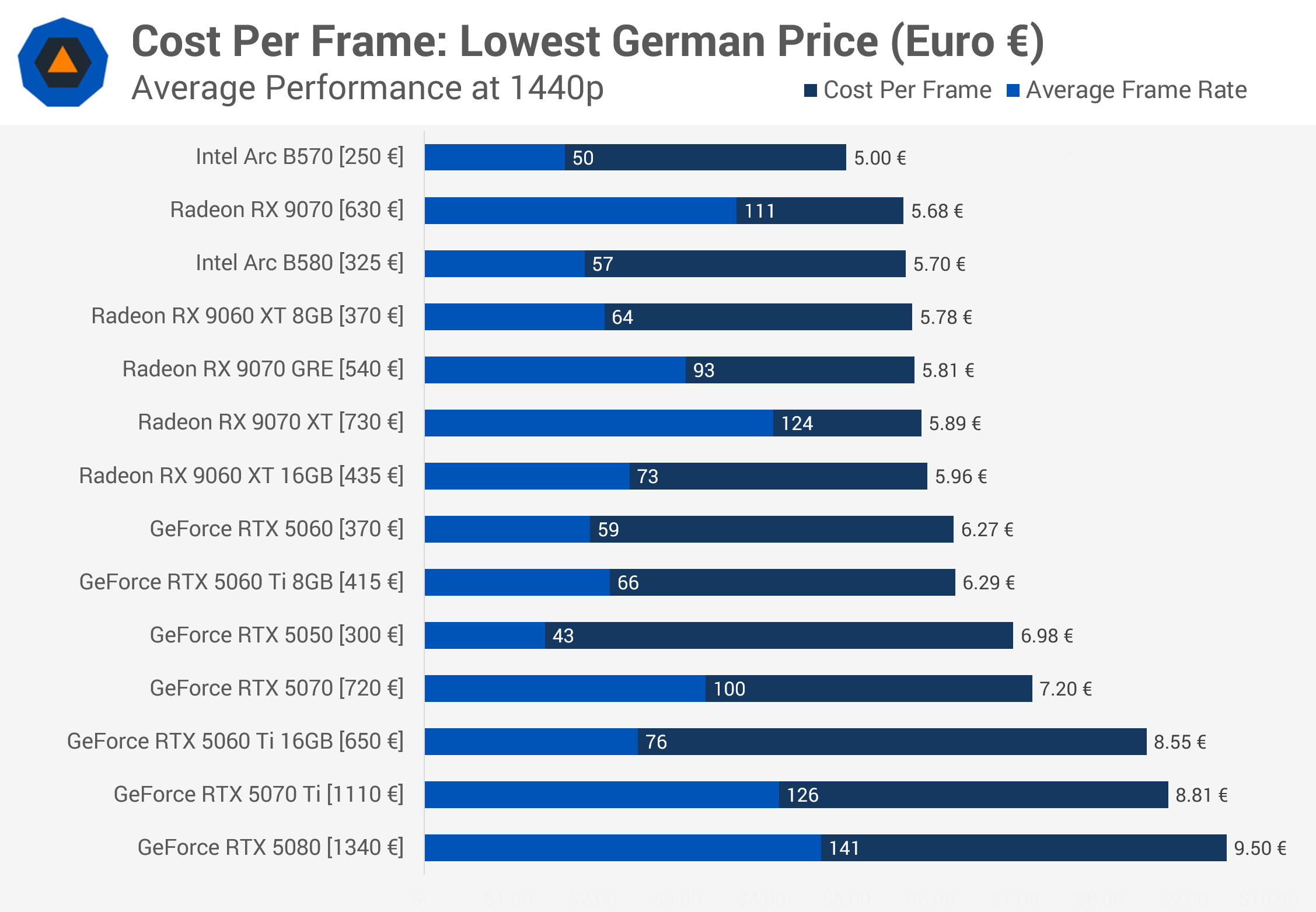
German buyers shopping in the mid-range show a strong preference for the RX 9060 XT 16GB, which costs €65 more than the 8GB version. At €600, the RX 9070 and RX 9070 GRE outperform the RTX 5060 Ti 16GB, with the standard RX 9070 recording a 34% lower cost per frame.
German retail prices for the RX 9070 XT and RTX 5070 have converged at approximately €720. At that parity, the Radeon provides an 18% cost-per-frame advantage, rising to 33% against the RTX 5070 Ti. The compressed price gap between the RTX 5070 Ti and higher-tier RTX 5080 has also encouraged many local consumers to bypass the mid-tier Ti model.
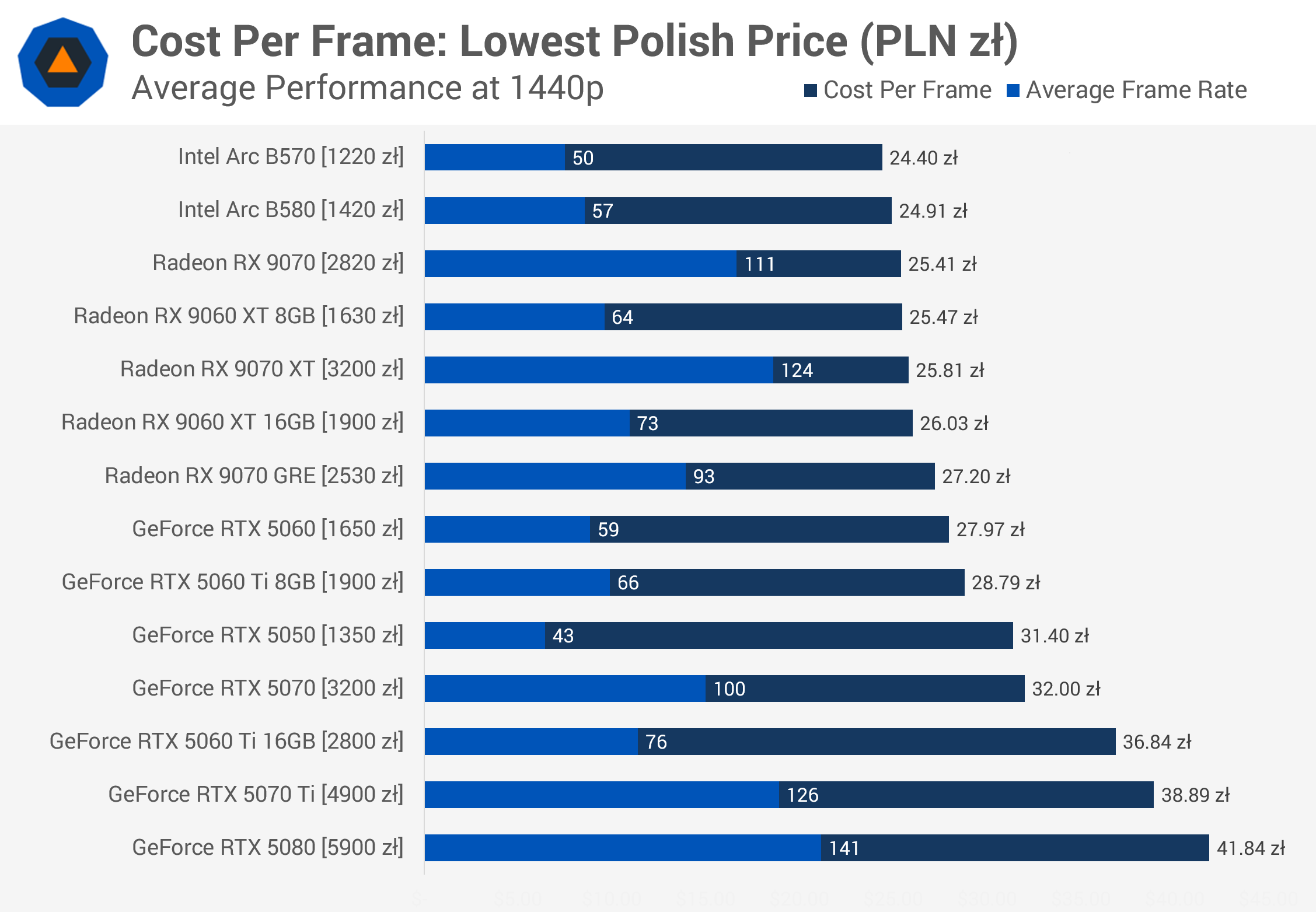
Poland displays a highly similar pricing pattern. Local currency valuations preserve the same general hierarchy and cement Intel’s slight value lead at the entry point.
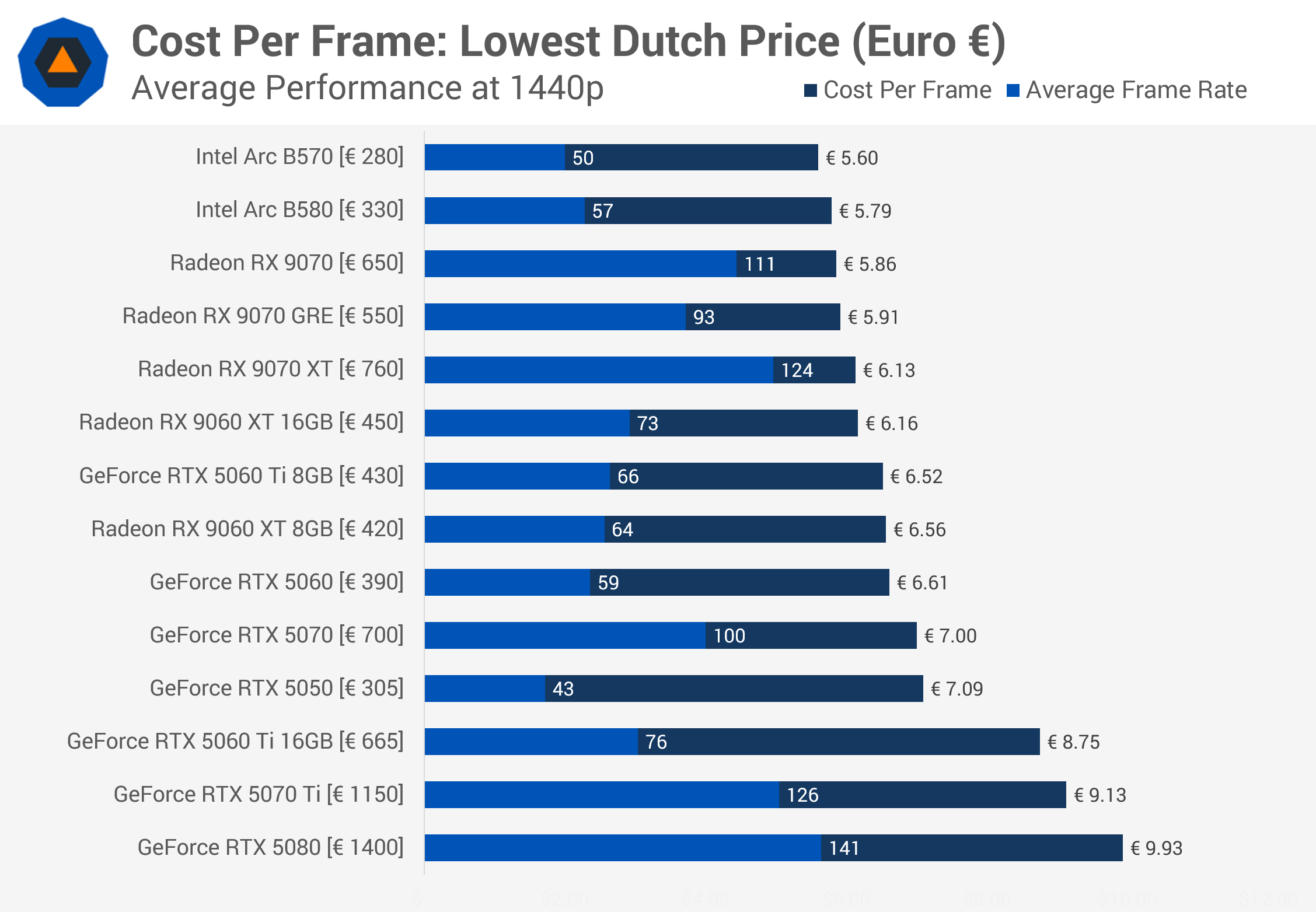
In the Netherlands, small fluctuations give the RTX 5070 a slightly better value position than in Germany and narrow its gap with the RX 9070 XT. Dutch pricing, however, penalizes the RX 9060 XT 8GB, making the 16GB version the mathematically superior buy.
The United Kingdom produces a different result because Intel’s Arc lineup loses its usual cost-per-frame advantage under local pricing structures. The £550 Radeon RX 9070 becomes the UK’s absolute value leader, undercutting the RTX 5070 and RTX 5060 Ti 16GB, both priced near £600, by 17% and 37% in cost-per-frame metrics.
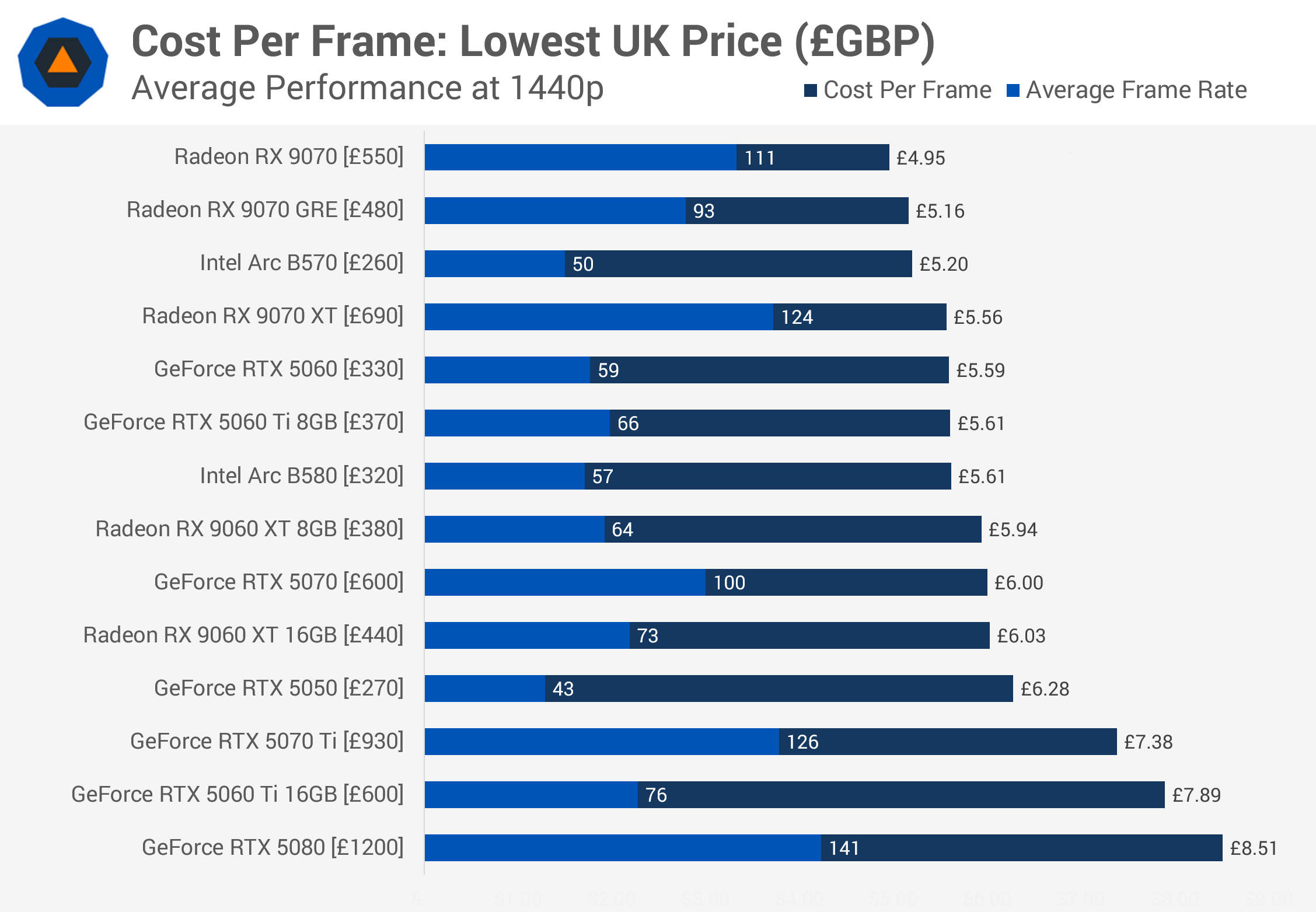
UK budget buyers face less favorable choices. The RX 9060 XT 8GB is poorly priced, while the 16GB version demands a steep 33% price premium.
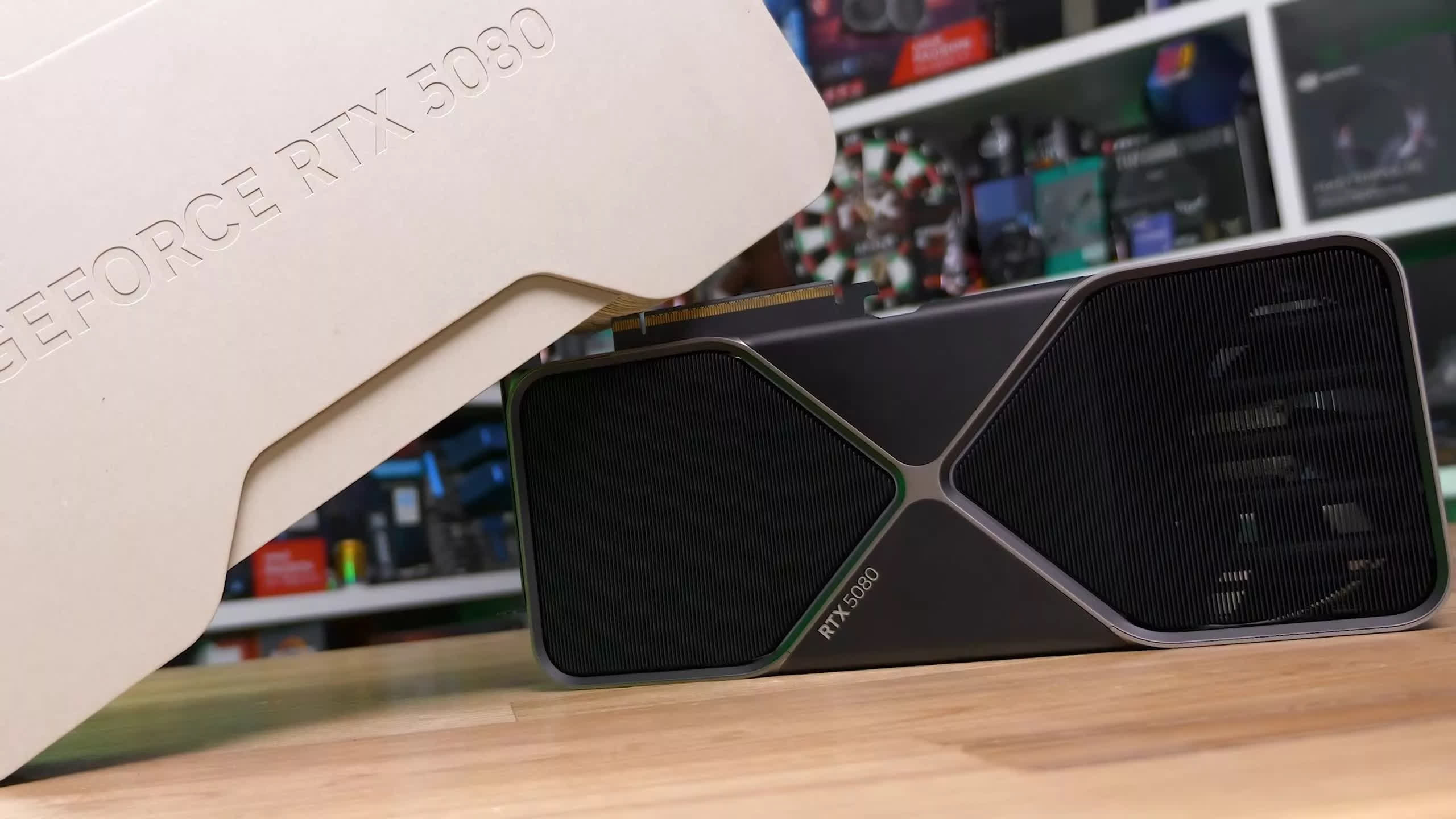
The same mid-range inflation makes Nvidia’s high-end RTX 5080 unexpectedly competitive in Britain. Although it costs roughly twice as much as the RTX 5060 Ti 16GB, it delivers nearly twice the performance, leaving only an 8% value penalty. Its theoretical MSRP tax would normally produce a 25% premium per frame.
## Tariffs, currencies, and regional outliers
Australia broadly follows the United States, although localized prices alter individual matchups. The RTX 5060 and RX 9060 XT 8GB sell at comparable prices, with the Radeon retaining an 8% value advantage. At $700 AUD, the RX 9060 XT 16GB supplies a 17% cost-per-frame benefit and twice the VRAM of the RTX 5060 Ti 8GB.
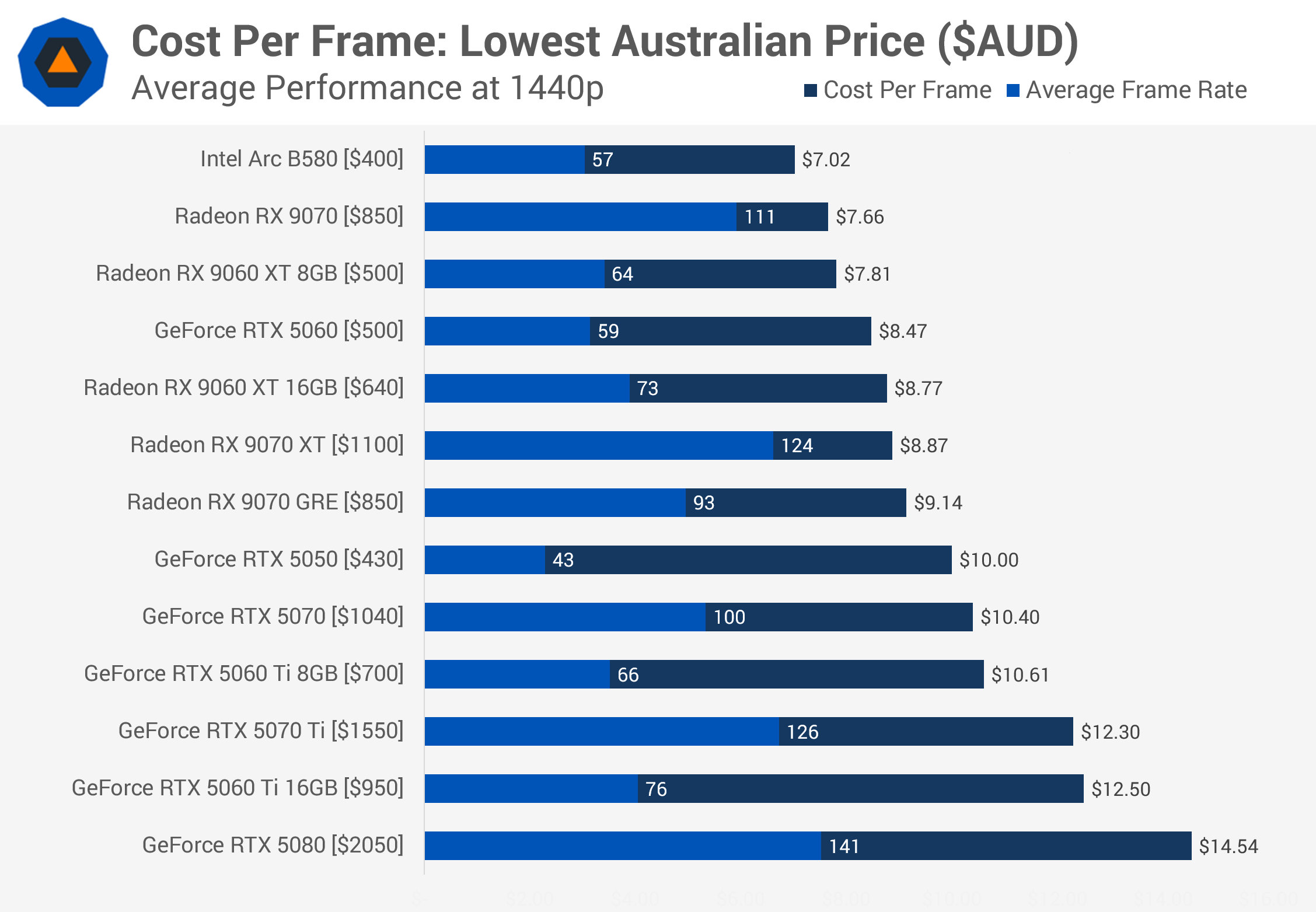
Australia’s RTX 5060 Ti 16GB is one of the market’s poorest purchasing options. At $900 AUD, the competing RX 9070 delivers a 39% lower cost per frame.
India shows the most extreme separation between the two major GPU designers. AMD occupies the market’s top five value positions, while Nvidia products carry heavy premiums. The RX 9070 XT is 29% cheaper per frame than the RTX 5070, 41% cheaper than the RTX 5060 Ti 16GB, and 42% cheaper than the RTX 5070 Ti.
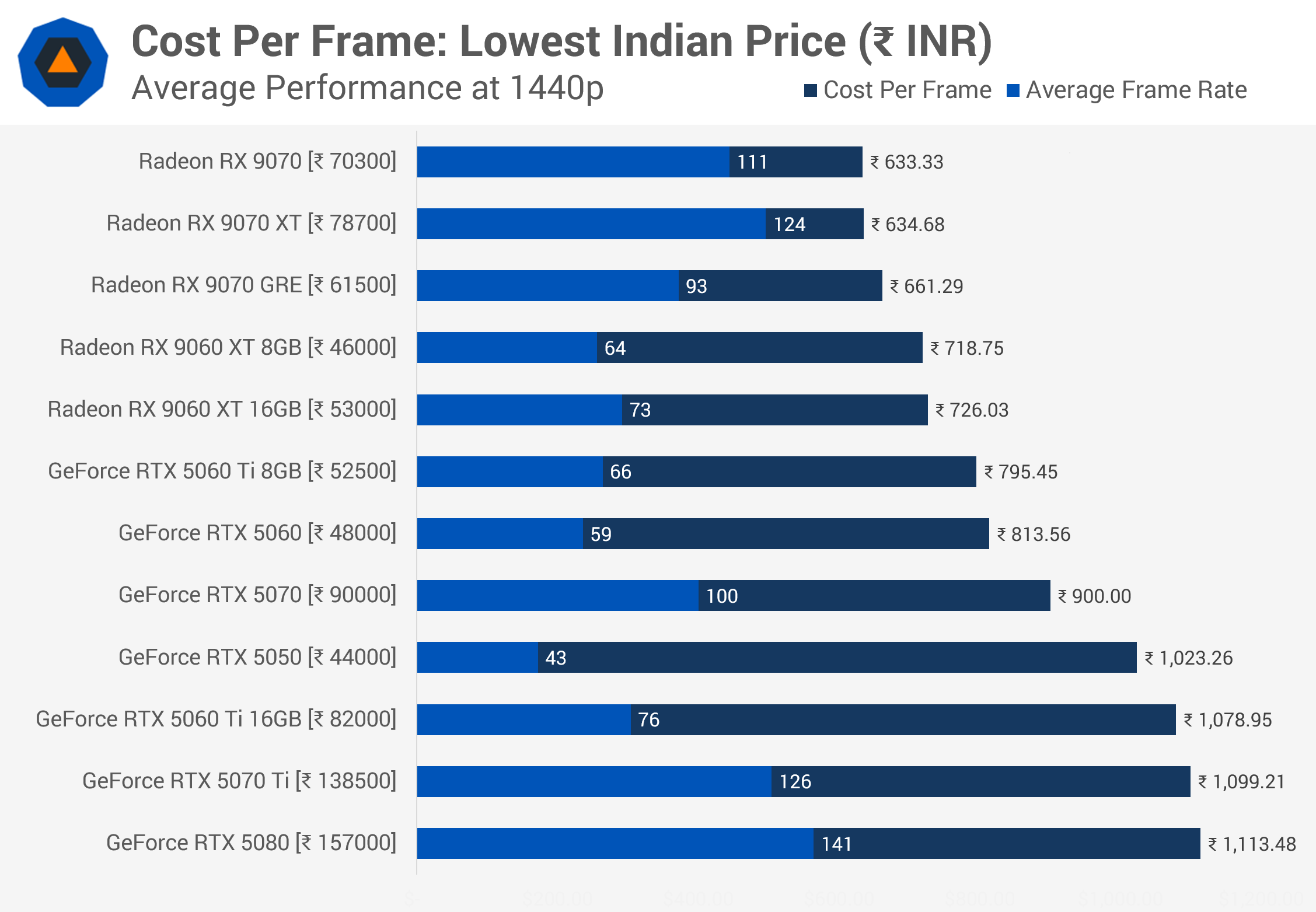
Indian mid-range buyers are steered toward the RX 9060 XT 16GB, which matches the RTX 5060 Ti 8GB in price while offering a safer long-term memory configuration.
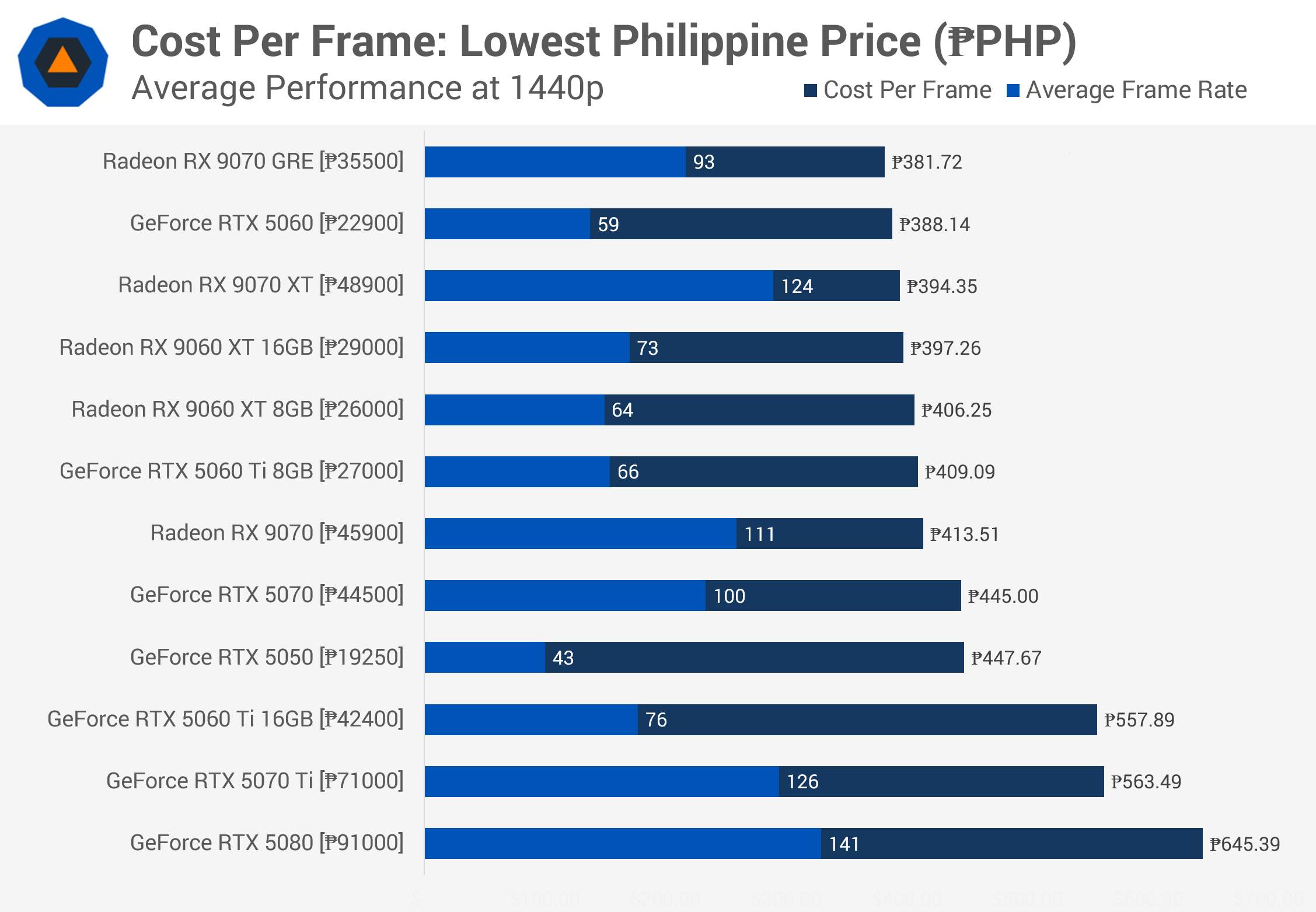
The Philippines follows a similar but more moderate pattern. The RX 9070 XT has a 29% value advantage over the RTX 5060 Ti 16GB, while its lead over the RTX 5070 narrows to 11%, one of the narrowest margins recorded globally. The RTX 5060 remains a viable lower-cost entry point, but the 16GB Radeon card is the recommended path for system longevity.
Brazil is the only major market where Nvidia occupies the top position on the value charts. Unique local import duties and distribution networks give the RTX 5060 a 5% to 8% better cost-per-frame value than the RTX 5060 Ti 8GB and RX 9060 XT 8GB.
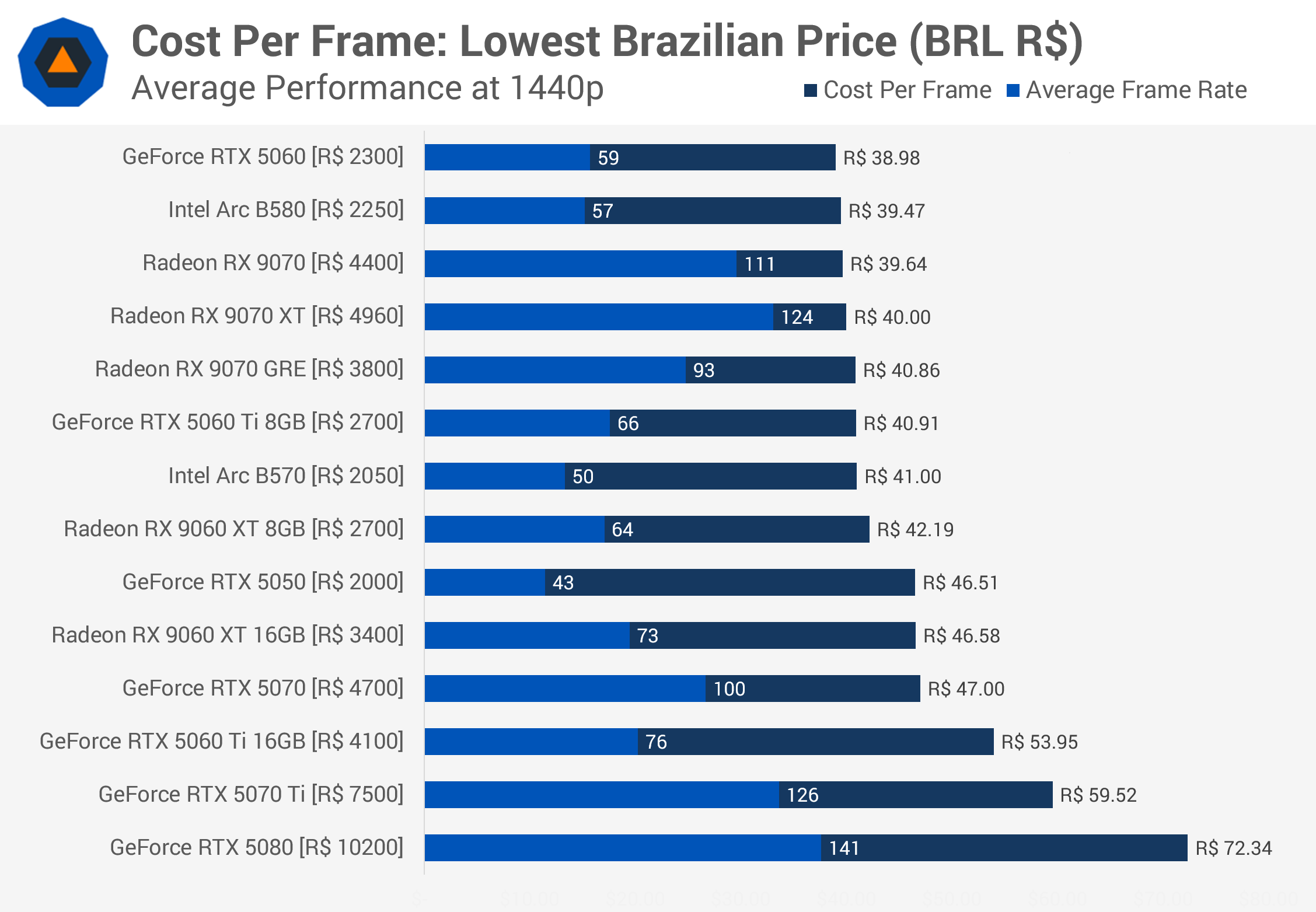
The RX 9060 XT 16GB is poorly positioned in Brazil, trailing the RTX 5060 by 16% in raw value, which gives Nvidia a strong grip on the mainstream segment. AMD’s RX 9070 XT regains the high-end advantage, running 15% cheaper per frame than the RTX 5070.
## What inflated prices leave behind
Nvidia’s pricing has left its mid-to-high-end lineup exposed to AMD’s aggressive cost-per-frame positioning. Cards such as the RTX 5060 Ti 16GB are priced outside their logical performance brackets, conceding the raw value argument to AMD’s RX 9070 and RX 9070 XT.
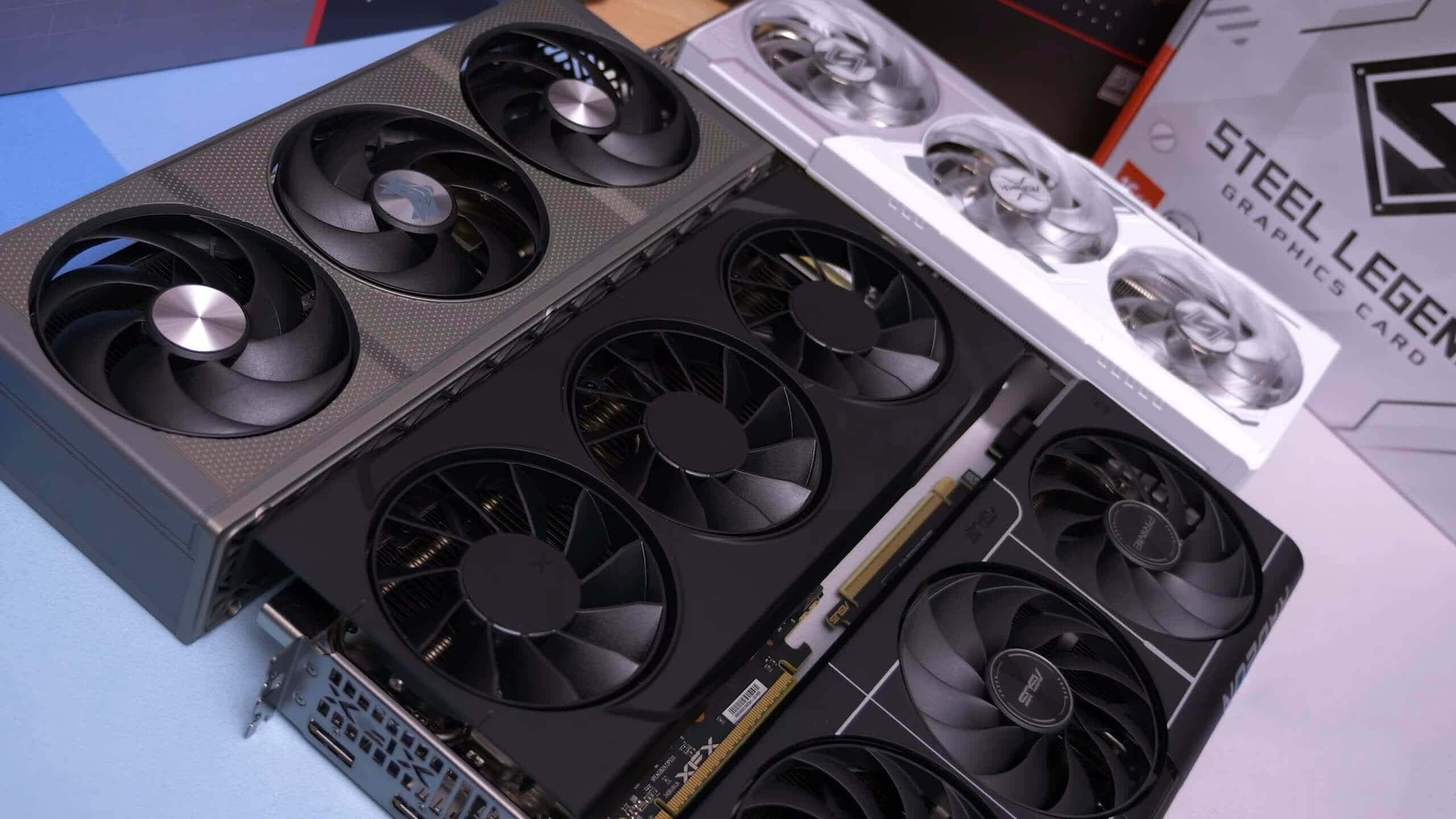
Nvidia continues to rely on brand loyalty and proprietary software features such as DLSS to maintain market share. AMD’s larger VRAM configurations provide a physical advantage for consumers.
The entry-level contest remains tighter. Across most regions, the RTX 5060 and RX 9060 XT 8GB trade blows for buyers focused on minimizing their initial outlay, while Intel’s Arc models remain highly competitive in Europe and North America.
The RTX 5050 is the singular consensus to avoid across all global markets because it fails to offer acceptable value in any territory.
Whether AMD and Intel can retain this opportunity remains uncertain. Industry forecasts indicate that Radeon GPU pricing may rise during the latter half of 2026, potentially eroding AMD’s current value lead. Parallel reports suggest Nvidia’s pricing has not yet reached its ceiling, so relative competitive margins could remain stable even as overall costs climb.
With hardware pricing highly inflated across the board, market analysts suggest that consumers defer graphics card purchases unless absolutely necessary, because current price-to-performance ratios remain unfavorable compared with historical standards.