Christian Leaders Rally in Jerusalem for Oct. 7 Memorial
Former hostages and Israeli officials joined the Friends of Zion Ambassador Summit to counter rising global antisemitism.
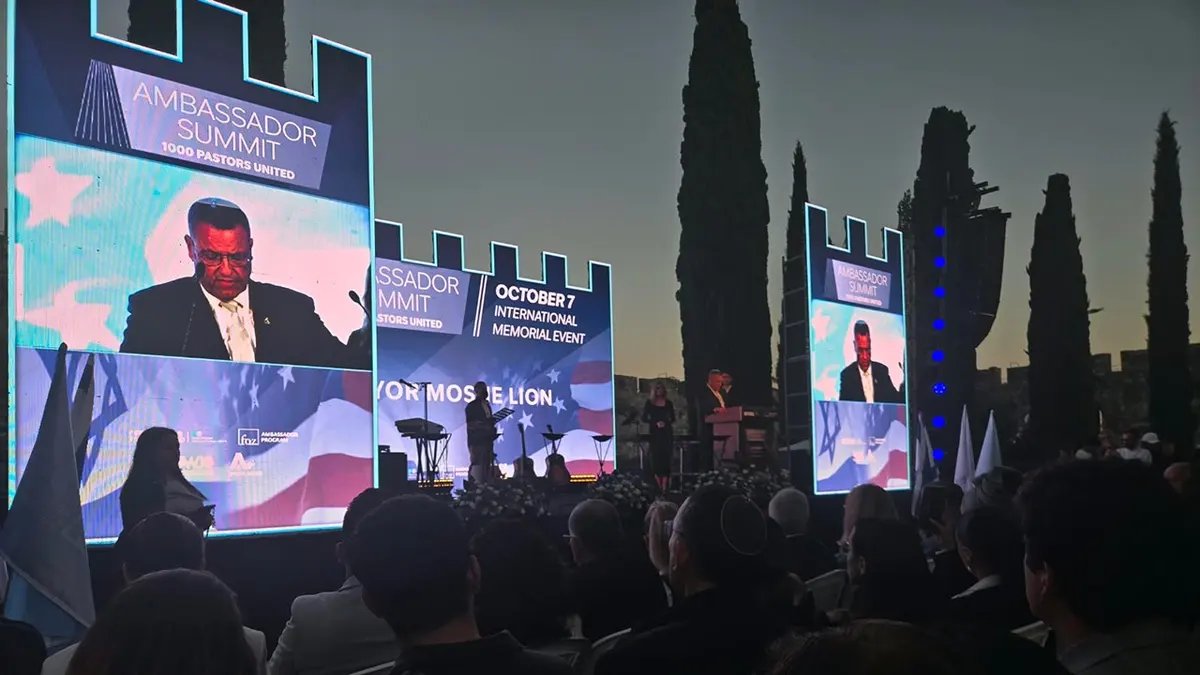
More than 1,000 Christian leaders and influencers from 122 countries converged on Jerusalem this week to mark the third anniversary of the Oct. 7, 2023, Hamas attacks, joining released hostages and bereaved Israeli families in a coordinated show of solidarity that organizers say represents the largest non-Jewish pro-Israel mobilization since the massacre.
The gathering, held under the banner of the Friends of Zion Ambassador Summit, culminated Wednesday with an internationally broadcast memorial ceremony. Former hostages Agam Berger, Sagui Dekel-Chen, Bar Kupershtein and Evyatar David appeared alongside Kupershtein’s grandfather, Holocaust survivor Michael Kupershtein, underscoring a generational throughline of trauma that summit organizers deliberately highlighted to counter what they describe as global indifference to Jewish suffering.
Unlike the first anniversary, which was dominated by the immediate shock of the war in Gaza and the unresolved hostage crisis, the 2026 commemoration arrives amid a shifting diplomatic landscape. While several Western governments have moved toward recognizing Palestinian statehood or conditioning arms sales to Israel over the past two years, evangelical and charismatic Christian networks have simultaneously deepened their institutional ties to the Israeli government. The summit is organized in direct cooperation with Israel’s Ministry of Foreign Affairs, reflecting a formalized diplomatic strategy by Jerusalem to cultivate alliances outside traditional state-to-state channels.


Israel’s Special Envoy to the Christian World, George Deek, framed the alliance around three pillars: shared biblical heritage, mutual security against antisemitism, and the protection of Middle Eastern Christians facing regional persecution. The envoy role itself, established to manage relations with the estimated hundreds of millions of Christian Zionists worldwide, signals how heavily Israel now relies on religious communities to sustain its international standing when secular diplomatic support fractures.
Mike Evans, founder of the Friends of Zion Heritage Center, pointed to the displacement of more than 70,000 Israelis from southern border communities and northern towns during the conflict — a demographic upheaval that has received less international attention than the roughly 1,200 people killed on Oct. 7. Many residents of kibbutzim such as Kfar Aza and Be’eri remain unable to return to fully rebuilt homes three years later, living instead in temporary housing scattered across central Israel.
The summit also targets a specific demographic vulnerability: younger evangelicals. Organizers noted a concerted effort to engage youth who may be encountering anti-Israel narratives on university campuses or through algorithmic social media feeds. This reflects broader data from U.S. polling firms showing a widening generational divide within American evangelicalism, where older cohorts remain overwhelmingly supportive of Israel while younger believers increasingly mirror the skepticism found in secular progressive circles regarding the Israeli-Palestinian conflict.
Participants opened the event Tuesday on the Mount of Olives before visiting Yad Vashem, Israel’s official Holocaust memorial. The itinerary connects historical Jewish persecution directly to contemporary threats, a theological framework common in Christian Zionist thought that views the modern State of Israel as a fulfillment of biblical prophecy and its defense as a spiritual obligation.
Influencer Oli London, who first traveled to Kibbutz Kfar Aza six weeks after the 2023 attacks, returned to advocate for trauma survivors and promote religious tourism. Pilgrimage travel to Israel suffered a catastrophic collapse following the outbreak of the war, devastating local economies in cities like Nazareth, Tiberias and Bethlehem. Efforts by figures like London aim to reverse that economic damage by reassuring potential visitors of their safety.
Iranian-born activist Hooman Khalili used the platform to connect Israel’s security posture with broader regional resistance movements, specifically highlighting Iranian dissident causes. His presence illustrates how pro-Israel advocacy networks increasingly intersect with anti-regime activism targeting Tehran, linking the two struggles in the eyes of participating diaspora communities.
Sylvan Adams, president of the World Jewish Congress Israel, participated as a full partner in the proceedings, bridging the gap between mainstream Jewish institutional leadership and the predominantly evangelical summit attendees. The involvement of the World Jewish Congress lends diplomatic weight to an event that might otherwise be categorized strictly as a religious gathering.
The delegation’s itinerary continues Thursday with a visit to the Nova music festival site near Kibbutz Re’im, where over 360 attendees were murdered in 2023. There, participants are scheduled to meet Romi Gonen, Elkana Bohbot and Noa Argamani, all of whom were abducted from the festival and subsequently released during various phases of hostage negotiations. The summit concludes Friday at the ancient archaeological site of Shiloh in the West Bank.