

Apple’s Smartwatch Rewind Feature Collides With Wiretap Laws
How Apple’s rolling audio buffer on the Watch Series 12 challenges consent laws and evidence rules.

Under United States law, audio capture is governed by a patchwork of federal and state regulations. Federal law under Title 18 of the United States Code (18 U.S.C. § 2511) permits the recording of oral communications provided at least one party to the conversation consents. However, 12 states—including California under Penal Code § 632, Florida, Illinois, Pennsylvania, and Massachusetts—enforce all-party consent mandates, requiring every participant in a private conversation to grant permission before an audio record can be legally made.
Central to this setup is “Live Rewind,” a capability that maintains a continuous 15-second audio buffer in the device’s volatile random-access memory (RAM). The buffer continuously overwrites itself in real time until a user double-presses the watch’s Digital Crown. Upon activation, the system processes the preceding 15 seconds of acoustic data through on-device machine learning models, converts the speech into text, and saves the transcript to a standalone Siri application.
Apple’s new features test these legal boundaries by altering how sound data is captured and held. Unlike traditional recording devices that save digitized sound files directly to local storage or cloud servers, Apple’s software processes ambient speech in temporary, volatile memory before either discarding the raw audio or converting it into encrypted text.



To signal that transcription has occurred, Live Rewind triggers an audible chime and displays a full-screen microphone graphic animation. However, because the rolling 15-second buffer actively captures ambient sound prior to the physical crown press, non-consenting individuals are processed in temporary memory before any visual or acoustic cue is delivered.
The deployment of continuous audio processing and rolling buffer memory across consumer wristwear is bringing mobile technology into direct collision with federal and state wiretapping statutes. At a hardware event, Apple Inc. unveiled an array of smartwatch capabilities designed to passively monitor, summarize, and retroactively transcribe live human speech. While framed around personal productivity and accessibility, the technology introduces novel legal questions regarding wiretap laws, consent, courtroom evidence admissibility, and the statutory definition of electronic surveillance.
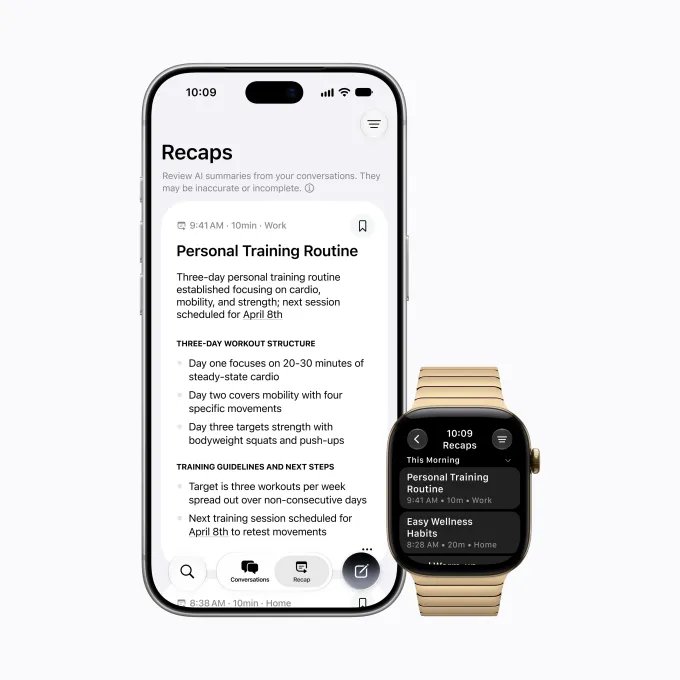
Apple also introduced “Siri Recap,” an ambient listening feature that monitors extended conversations to generate structured written notes. Rather than producing verbatim transcripts, Siri Recap processes live dialogue to generate titles, high-level summaries, and key points within the Siri application on iOS devices.
By executing speech models directly on the smartwatch’s integrated Neural Engine rather than transmitting streams to cloud infrastructure, Apple aims to limit security vulnerabilities associated with external server processing. Nevertheless, as consumer wearables absorb the capability to continuously process and digest ambient human speech, federal and state legal systems face the task of defining where temporary volatile buffering ends and statutory electronic interception begins.
Compliance requirements vary considerably across these platforms. Plaud explicitly instructs users in its terms of service to obtain legal consent from all participants prior to recording. Similarly, Amazon’s Bee terms specify that the end-user maintains sole responsibility for complying with wiretapping laws and data privacy statutes regarding minors across applicable jurisdictions.
This creation of text-only transcripts without underlying audio recordings creates distinct challenges under judicial rules of evidence. Under Federal Rule of Evidence 901, physical or digital evidence must be authenticated with proof establishing that the item is what its proponent claims it to be. In traditional court proceedings, audio recordings are authenticated through voice identification, acoustic analysis, or chain-of-custody testimony. Text-only transcripts generated on-device without an accompanying audio file leave legal systems to evaluate whether machine-generated summaries satisfy evidentiary standards for reliability or fall under hearsay prohibitions.
In addition to transcription tools, Apple incorporated “Audio Intelligence,” an accessibility feature tailored for deaf and hard-of-hearing users. Operating locally on the device’s silicon hardware, Audio Intelligence utilizes neural models to continuously monitor ambient acoustics for specific environmental sounds, including emergency vehicle sirens, smoke and carbon monoxide detector alarms, doorbells, and crying infants. The system operates independently of a paired iPhone, delivering haptic and visual alerts directly to the user’s wrist.
Users can control when Siri Recap operates by manually toggling the feature in the watchOS Control Center or configuring schedule parameters, such as limiting execution strictly to business hours. Apple’s architecture ensures that raw audio is never written to persistent storage, is inaccessible to Apple servers, and is not tagged with individual speaker voiceprints. Generated summaries are secured using end-to-end encryption.
Apple’s expansion into ambient speech processing comes amid broader movement across the artificial intelligence hardware industry. Competitors have increasingly prioritized ambient voice capture as a core functionality for wearable products. Devices such as the Plaud Note and Plaud NotePin utilize hardware microphones to transcribe meetings and calls via third-party AI models, while form factors like the Friend pendant, the Limitless AI pendant, and Amazon’s experimental Bee project focus on continuous passive note-taking.