

Is the Entry-Level Kia Sorento a Trap? The Base Trim’s Cabin Flaws Add Up
The Sorento has the space, but the best family-car features sit behind a costly trim upgrade
From the driver’s perspective, the Kia Sorento immediately feels like a large family SUV. The lofty driving position gives a good view over the squared-off bonnet, making it easier to judge the car’s position on the road. Large side windows help with visibility, although the glass line gently rises towards the rear.
During our drive on the UK launch, we found that the black background on the infotainment and digital instrument displays made things hard to read in direct sunlight.
That issue is particularly frustrating because the screen is also where several important vehicle functions are managed. Entry-level Pure trim uses a basic 4.2-inch digital driver’s display. On Evolve trim and above, the larger 12.3-inch display presents information more clearly and provides access to the driver-assistance settings and trip computer functions.
The Sorento’s safety equipment includes a five-star Euro NCAP rating and an IIHS Top Safety Pick rating. Standard Drive Wise systems include Lane Keeping Assist and Blind-Spot Collision-Avoidance. The rising rear glass line is a styling choice from inside the cabin, but it makes over-the-shoulder visibility less convincing during lane changes, increasing the importance of those blind-spot driver assists.
Seven years of connected telematic services add live traffic, weather and parking information. The phone app can send routes to the car before a journey. For U.S. buyers, the ownership package also includes Kia’s industry-leading 10-year/100,000-mile powertrain warranty and a five-year/60,000-mile limited basic warranty.
Apple CarPlay and Android Auto are standard, while the infotainment system can pair two phones at the same time through Bluetooth. One phone can play music while the other handles a call.
Behind the second row, the Sorento’s greatest strength is its cabin space. There is generous room for four adults, and the two rearmost seats are more comfortable than those in many rival seven-seaters. The middle seat in the second row is less comfortable over longer trips, however, and access to the third row is tighter than in some competitors.
A passenger sitting in that middle seat can at least keep a device powered. There are two USB chargers in the front, three in the middle row and another two around the boot and third-row area. That gives the cabin seven charging points in total, while a wireless charging mat at the front allows someone to bring a second device.
Seat adjustment adds another gap between the trims. All versions have height adjustment for the driver’s seat, but electric front-seat adjustment and electric lumbar adjustment for the driver are reserved for Evolve trim and above.
The audio system follows the same pattern. Pure trim receives a basic six-speaker setup, while Evolve and higher versions get a 12-speaker BOSE system. For long trips, that upgrade sits alongside the Sorento’s extra rear-seat space and determines how well the cabin works as a road-trip environment.
At 4,815mm long, 1,900mm wide and roughly 1,700mm tall, the Sorento has a substantial footprint without being the largest seven-seat SUV on the UK market. It is longer and slightly wider than a Skoda Kodiaq, significantly longer than a Land Rover Discovery Sport, and smaller than the full-size Land Rover Discovery.
A Kia Sorento 7 seater dimensions comparison shows how closely it matches the Hyundai Santa Fe in width and wheelbase, while the Kodiaq is shorter and narrower:
| Model | Length | Width | Height | Wheelbase | Boot space |
|---|---|---|---|---|---|
| Kia Sorento | 4,815mm | 1,900mm | 1,695mm | 2,815mm | 179-1,996 litres |
| Hyundai Santa Fe | 4,830mm | 1,900mm | 1,770mm | 2,815mm | 179-1,949 litres |
| Skoda Kodiaq | 4,758mm | 1,864mm | 1,659mm | 2,791mm | 340-2,035 litres |
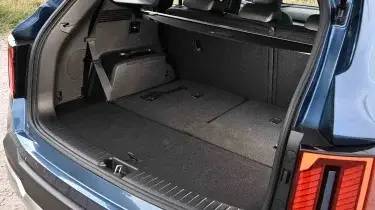
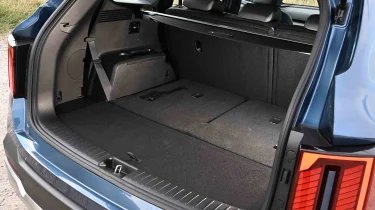
Boot capacity ranges from 179 to 1,996 litres in the standard Sorento, although the plug-in hybrid offers 175 to 1,988 litres. With all seven seats in use, the boot is smaller than those of some rivals, but folding the rear rows creates a large load area.
The powertrain choice changes how useful that space and size are. The heavy-duty 2.2-litre CRDi diesel has a towing capacity of 2,500kg (5,500lbs). Hybrid and plug-in hybrid versions use a 1.6-litre turbocharged petrol engine paired with electric motors and are limited to 1,650kg (3,637lbs), reducing towing utility despite their potential fuel-saving advantages.
This Kia Sorento towing capacity diesel hybrid split is one of the clearest practical differences between the versions. The diesel suits buyers who regularly tow heavier loads, while the HEV and PHEV models trade some towing ability for electrified driving. The PHEV also gives up a small amount of boot space, with a 175-1,988-litre range.
The result is a spacious seven-seat cabin with four Isofix child-seat mounting points, but some of its most useful equipment is tied to the pricier trims. The Kia Sorento Evolve vs Pure trim decision affects the display, driver-assistance controls, seat adjustment and audio system as much as it affects convenience.