UK Family Stocks 300,000 Calories for $265: Inside a Practical Emergency Food Plan
How one household builds a month's calories for $265 using everyday meals and annual rotation
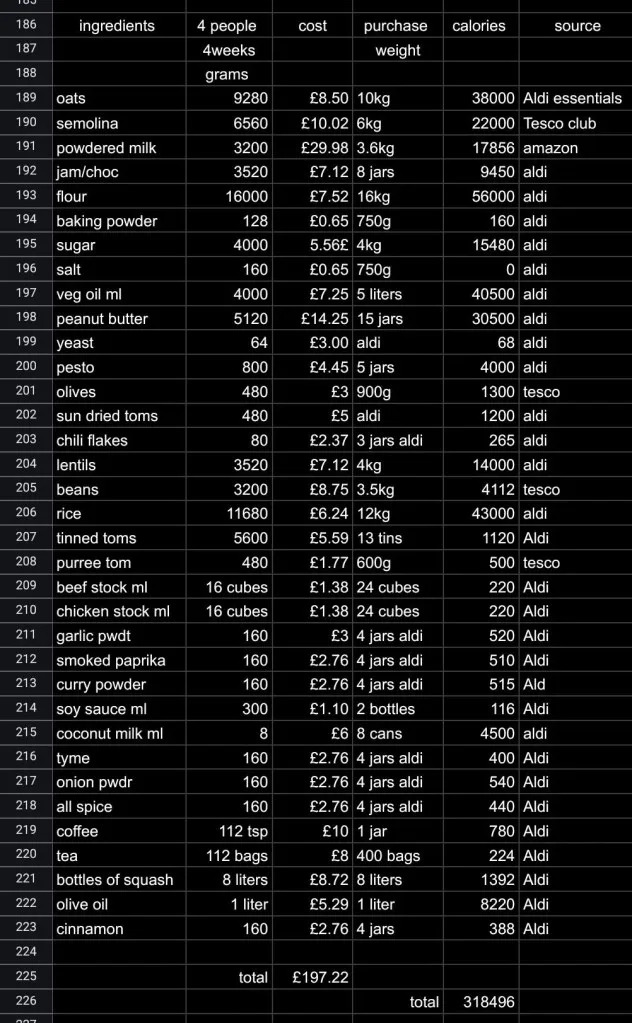
A British household has demonstrated how to assemble a month’s worth of emergency calories for a family of four at a cost of roughly £200 — about $265 at current exchange rates — drawing attention on Reddit’s r/UKPreppers forum for a system that prioritizes familiarity and rotation over specialized survival gear.
The anonymous poster, who repeats the purchase every November, shared a spreadsheet totaling more than 300,000 calories built almost entirely from Aldi own-brand staples and Nido milk powder sourced from Amazon. The supply is plant-based, centered on one-pot meals the family already batch-cooks and freezes during normal weeks. “This is an emergency supply for a family of 4 for a month,” the poster wrote. “The goal is less about variety than about having a formula the family can repeat.”
What distinguishes the approach is its integration with daily life. The family doesn’t store obscure ration packs or freeze-dried entrees. They eat the same lentil-heavy, carb-dense dishes routinely, which the poster says limits waste and guarantees acceptance during a crisis. “I know my family will eat this,” they noted. Older stock cycles out each December — most donated to a food bank, the rest moved into kitchen cupboards — so nothing expires unseen in a bunker.


Storage is remarkably compact: the entire cache fits in a lockable van vault inside a garden shed, visited once a year. Water purification is handled by a Lifesaver jerry can kept in the loft, described as a “£35 a year insurance policy.” Cooking gear includes a Trangia multi-fuel stove and a Zebra billy can from monthly camping trips, though the poster emphasizes that a basic stockpot and inexpensive IKEA cookware would suffice.
The strategy traces back to a trip to Cuba, where the poster observed households adapting a single base dish — rice and beans — with whatever vegetables, fats, or proteins were available that day. That flexibility informed a system built on dense, shelf-stable calories: pasta, rice, oats, lentils, oil, and powdered milk. No meat, no refrigeration required.
Nutritionists note that while 300,000 calories over 30 days averages 2,500 calories per day for a family of four — adequate for adults but potentially light for active teenagers — the protein content of a legume-and-grain-heavy plan can meet minimum needs if portions are calibrated. The lack of fresh produce means vitamin C and fiber gaps would need addressing in any extended emergency, though the poster’s rotation into regular meals mitigates this in practice.
The £200 figure also underscores how far bulk commodity prices have fallen from 2022–2023 peaks. UK food inflation, which hit 19.2% in March 2023, cooled to 1.7% by late 2024, making staple-heavy stockpiling more affordable than at any point since the pandemic. Aldi’s consistent pricing on own-brand dried goods — 500g pasta at £0.75, 1kg lentils at £1.55 — allows predictable budgeting.
UK government resilience guidance recommends households hold at least three days of non-perishable food and water; this plan exceeds that by a factor of ten. The Cabinet Office’s 2024 “Prepare” campaign encourages exactly this kind of low-profile, rotation-based preparedness integrated into normal shopping habits rather than panic buying.
Commenters on the thread praised the practicality. One asked whether expiration-date tracking in the spreadsheet would improve rotation; the poster replied they had tried and abandoned it as unsustainable, preferring the annual December clear-out. Another noted the approach mirrors institutional catering logic: predictable inputs, standardized outputs, minimal decision fatigue.
The poster’s final advice: “If you decide to have a go, you have to learn to cook this stuff.” Flatbreads and calzones require practice, they said, but the rest is straightforward. The family’s next annual restock is scheduled for November 2025.