U.S. Deported Asylum Seekers to a War Zone They Had Never Visited. Now They Are Trapped.
Migrants protected under the Convention Against Torture were pepper-balled onto planes and left without identity documents in a nation under a U.S. 'Do Not Travel' advisory.
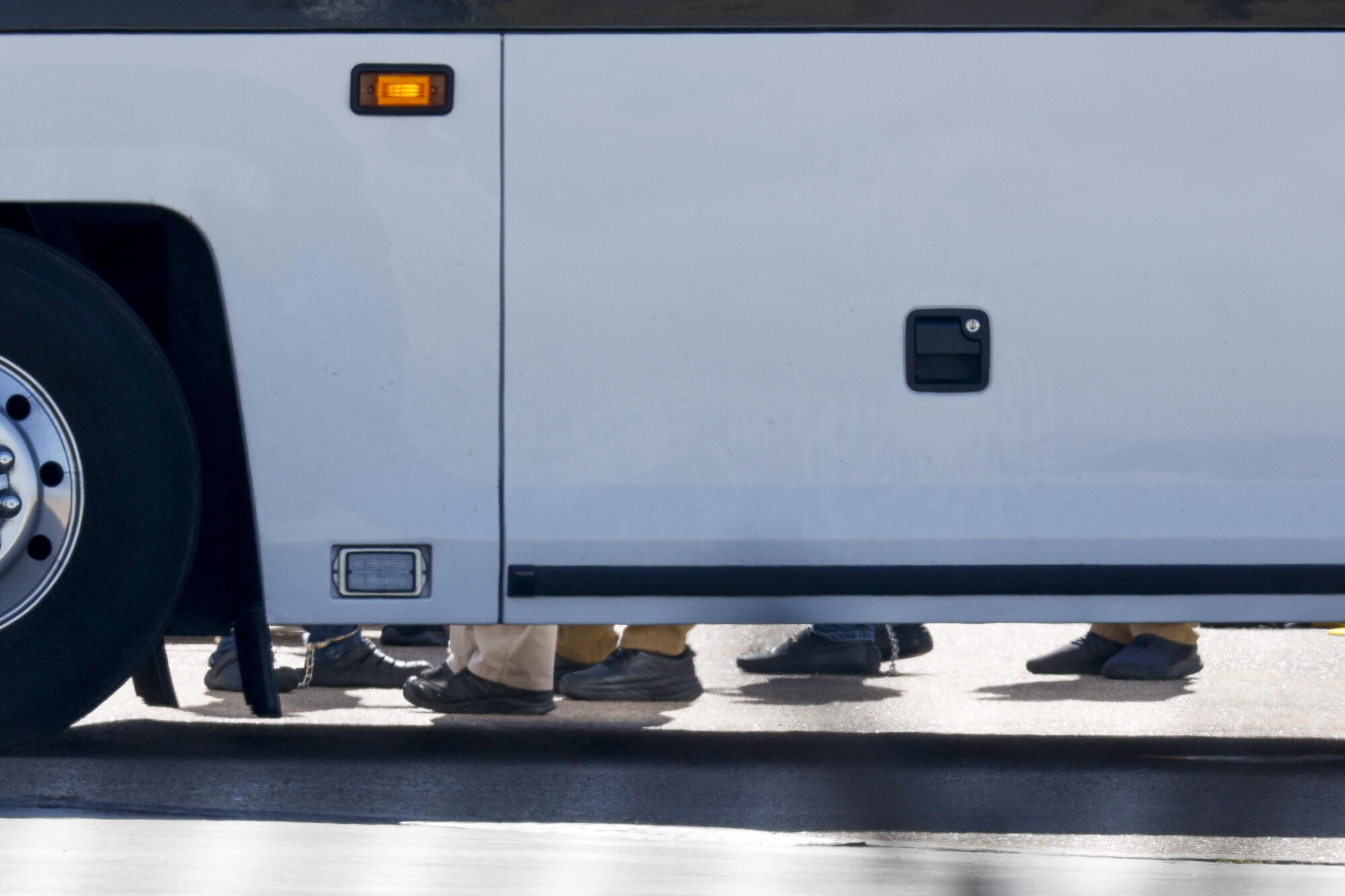
BANGUI, Central African Republic — Dozens of migrants who fled authoritarian governments and won legal protection from deportation in the United States are now confined under armed guard in one of the world’s most dangerous cities, stripped of their identity documents and unable to leave.
They were flown 6,000 miles to Bangui, the capital of the Central African Republic, a country where none had ever lived, worked or held citizenship. Their arrival is the direct result of a Trump administration strategy that has rapidly expanded the use of “third-country” deportations, sending more than 25,000 people to nations with which they have no ties.
The policy has triggered a constitutional clash over due process and raised urgent questions about whether the U.S. government is violating its own court orders by delivering protected individuals into active conflict zones.


Under international law and longstanding U.S. immigration practice, migrants who prove to an immigration judge that they face torture or death if returned to their home countries are granted withholding of removal, typically under the Convention Against Torture. For decades, this designation functioned as a safeguard: these individuals could not be deported to the country they fled and were generally permitted to remain and work in the U.S. indefinitely.
That framework has been dismantled over the past year. Driven by President Trump’s stated goal of expelling 1 million people annually, the Department of Homeland Security has reinterpreted withholding of removal not as permission to stay, but as a prohibition only against returning someone to their specific country of origin. The administration argues it retains full authority to place those migrants on planes bound for any other nation willing to accept them.
To secure that cooperation, Washington has earmarked approximately $500 million in foreign assistance for countries agreeing to take third-country deportees, according to an investigation by the nonprofit journalism consortium Forbidden Stories. That financial leverage has opened doors in nations that historically had no migration agreements with the U.S., including several in sub-Saharan Africa.
Bangui has received at least three flights of U.S. deportees since June. The destination presents severe risks. The Central African Republic has endured 15 years of civil war between rival armed factions. The U.S. State Department maintains a Level 4 “Do Not Travel” advisory for the entire country, citing crime, kidnapping, landmines, terrorism and a collapsing health infrastructure. Bangui is currently managing a cholera outbreak amid chronic water shortages and rolling power failures.
The government of President Faustin-Archange Touadera, which has moved to eliminate presidential term limits and suppress political opposition, relies heavily on Russian mercenaries for security. Wagner Group contractors, accused globally of human rights abuses, operate openly in the country. A bronze statue of late Wagner chief Yevgeny Prigozhin stands outside the Russian House in central Bangui.
For deportees who originally fled repressive regimes, the geopolitical alignment between Russia and their home countries has generated immediate fear. Nicaraguan dissidents, in particular, point to a documented pattern of Sandinista operatives targeting exiles abroad, including a series of shootings and abductions in neighboring Costa Rica in recent years.
Luis Mendoza Santamaría, 38, marched in Nicaragua’s 2018 pro-democracy protests before fleeing violent government suppression. An American immigration judge denied his asylum claim but explicitly barred his return to Nicaragua under the Convention Against Torture. He spent years working quietly as a hotel waiter in Washington, D.C.
In February, he attended a routine immigration check-in and was detained. On Aug. 28, he was bused to a tarmac in Texas. He said agents never informed him of his destination, though rumors of flights to Africa had circulated among detainees. When he and others refused to board the Eastern Air Express aircraft, agents fired pepper-ball projectiles at close range, according to Mendoza and two other men on the bus.
Kenis Adalberto López, 44, also from Nicaragua, said he was struck twice in the chest. López, who had asked agents for access to a lawyer, said he told them through tears, “I’d rather die here than in Africa.” Agents eventually boarded the bus, and López said he was strapped to a stretcher and carried onto the plane.
Two men who continued to resist were placed in full-body restraint suits resembling straitjackets for much of the roughly 24-hour journey, witnesses said. All 43 passengers on the Aug. 29 flight were shackled at the wrists and ankles. The group included nationals from Iran, Bangladesh and Afghanistan. Among them was an Afghan man whose brothers had served alongside the U.S. military, according to human rights lawyers tracking the cases. None had criminal records.
Upon landing in Bangui after stops in two other African nations, the deportees were administered yellow fever vaccines and transferred to a guarded housing complex. They remain there today. Multiple deportees report that U.S. immigration agents confiscated their passports and identification documents upon initial detention in the U.S. and never returned them, rendering international travel legally impossible. Their formal immigration status within the Central African Republic remains undefined.
Without papers, some have attempted to navigate the city. Yasmani Moreno, 31, a Cuban national who arrived in Florida by raft in 2016 under the now-defunct “wet foot, dry foot” policy, said he and another detainee were seized off the street by armed men they believed to be police officers following their arrival on a July 31 flight. Moreno said they were released only after each paid the equivalent of $100. He has since documented his confinement on TikTok, broadcasting walks along unpaved streets. “They sent me to a failed state,” he said.
The physical removals have intensified scrutiny on how enforcement operations are conducted. The administration maintains that all deportations comply with federal law and that detainees are treated humanely. Attorney General Todd Blanche has called the third-country program “an entirely legal and invaluable tool to stem the tide of illegal immigration.”
Federal courts have begun to intervene. Last week, a U.S. appeals court ordered a pause on the third-country deportation program, ruling that the government failed to provide migrants with “a meaningful opportunity” to challenge their removals to nations where they have no connections. The administration has pledged to appeal the injunction to the Supreme Court.
Despite the appellate order, advocates monitoring the flights report ongoing uncertainty regarding compliance. Human Rights First policy director Savi Arvey characterized the transfers as “a deliberate attempt by the Trump administration to place refugees whom the U.S. government has determined need protection directly in harm’s way.” The Forbidden Stories investigation further found that in certain instances, deportees sent to third countries were subsequently forced back to their home nations against their will, potentially violating the very withholding orders U.S. judges issued.
Mendoza said he went days without food or sleep after arriving in Bangui, experiencing what he described as a mental breakdown. His attorney in the U.S. has urged him to seek asylum from another country, but without his confiscated documents, he cannot cross borders. From the guarded compound, he continues to monitor American legal news, specifically the appeals court ruling halting the program that sent him there.
“There will be justice,” Mendoza said. “There’s still a democracy there.”