

Trump’s AI Force Puts Tech Competition on a Wartime Footing
The proposal links AI policy directly to national security and the U.S.-China technology race
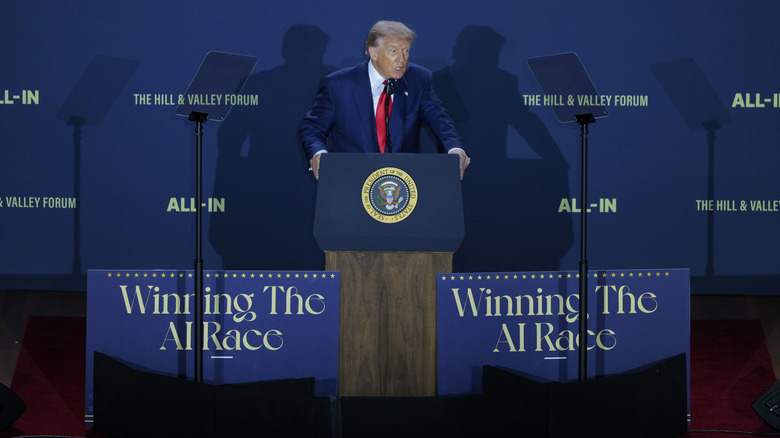
WASHINGTON — The Chinese government has articulated ambitions to dominate the global AI sector, outlining a national strategy in 2017 to become the primary global center for AI innovation by 2030. Washington has responded with strict semiconductor export controls targeting advanced graphics processing units (GPUs) from firms like Nvidia, restricting China’s capacity to train state-of-the-art models.
President Donald Trump’s plan to launch a new “AI Force” and appoint a dedicated “AI czar” comes as his administration prepares for high-stakes bilateral talks with Chinese leadership next week. The proposal positions artificial intelligence as a critical national security asset and marks a strategic pivot toward unrestricted technological competition that must not be slowed by regulatory hurdles.



Trump announced the initiative on his social media platform Truth Social, framing AI development as a geopolitical race that the United States must dominate. He indicated that he would announce his choice for “AI czar”—a high-level coordinator tasked with leading the initiative—in the near future.
“We will not in any way hinder or stifle the Growth of this incredible Industry,” Trump wrote. “Rather, we will cherish it, help it, and watch over it, as it grows!”
The president compared the proposed “AI Force” to the U.S. Space Force, established in December 2019 under the National Defense Authorization Act as the first new branch of the U.S. Armed Forces in more than seven decades. The Space Force was designed to secure American interests in a newly contested domain; the AI Force appears structured to treat computational power and advanced software as a primary theater of international competition.
Trump dismissed concerns about slowing development, arguing that any unilateral slowdown by American firms would hand a decisive advantage to Beijing. His upcoming meeting with his Chinese counterpart is expected to feature these technological battle lines as a central topic, while the administration’s focus on speed over restriction signals a likely departure from Biden-era regulatory frameworks.
That earlier framework included the October 2023 Executive Order on Artificial Intelligence, which established safety standards and reporting requirements for developers of dual-use foundation models. Trump’s position directly rejects recent appeals from prominent Silicon Valley executives to establish safety-oriented guardrails and slow the deployment of advanced models.
Last week, Dario Amodei, the CEO of Anthropic, published a detailed proposal calling for a coordinated, industry-wide pacing of frontier AI development to mitigate systemic risks. OpenAI CEO Sam Altman and xAI founder Elon Musk publicly agreed with Amodei’s cautionary stance; both have previously supported international governance frameworks to ensure safety and alignment.
Trump also used Truth Social to propose rebranding the technology itself. He launched an online poll asking followers to vote on a “far more elegant and accurate description” for artificial intelligence, suggesting alternatives such as “extreme intelligence” or “supreme intelligence.”
Concrete details regarding the funding, departmental structure, or specific legislative mandate of the “AI Force” have not yet been released.










One Comment