
Steam Frame Brings Half-Life: Alyx and PC Gaming to a Standalone VR Headset
Valve's standalone headset brings native VR, SteamOS gaming, and wireless PC streaming into one device
Valve is expanding its hardware presence with the Steam Frame, a standalone virtual reality headset designed to bridge untethered mobile spatial hardware and full-scale desktop gaming environments. Its integrated implementation of SteamOS marks Valve’s major hardware pivot since the launch of the high-end tethered PC headset Valve Index in June 2019.
SteamOS is the Linux-based operating system that also powers Valve’s handheld Steam Deck console, but Valve has optimized it for spatial display environments. The interface mirrors standard desktop Steam and provides direct access to existing software libraries. Unlike Meta Platforms’ Quest 3, which runs on an Android-based operating system tied to a mobile app store, the Steam Frame is built to execute native 3D VR titles, flat-screen 2D PC games, and high-bandwidth wireless streaming directly from host gaming PCs.
The headset uses liquid crystal display (LCD) panels with pancake optics. Those optical assemblies allow a significantly thinner front housing than traditional Fresnel lenses, while the LCD system delivers resolution levels comparable to the Quest 3’s dual 2064×2208 displays per eye. Text remains sharp in game worlds and system menus, although the display lacks the dynamic contrast ratios and absolute black levels of the micro-OLED displays used in premium spatial platforms such as the Apple Vision Pro and Bigscreen Beyond.


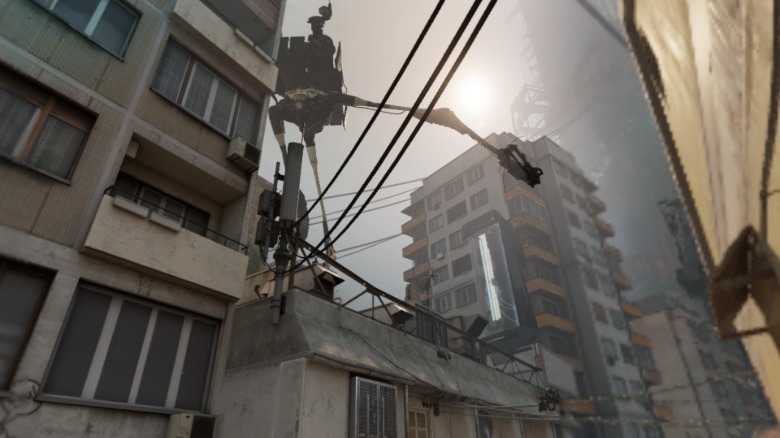
A modified native port of Half-Life: Alyx is central to Valve’s standalone strategy. The company’s flagship 2020 virtual reality title was originally built for high-end desktop hardware running the Source 2 engine, while the native version runs directly on the Steam Frame’s mobile processor without external PC rendering. It makes visual compromises compared with the PC original, including reduced visual sharpness, increased edge aliasing, and lower-resolution texture assets.
The mobile port retains manual weapon reloading, environmental object manipulation, glass-writing features, and full-scale spatial rendering of large assets, including the iconic Strider creatures introduced in 2004’s Half-Life 2. Users seeking peak graphical fidelity can instead bypass the mobile processor and stream the uncompressed PC version of Half-Life: Alyx from a local gaming computer.
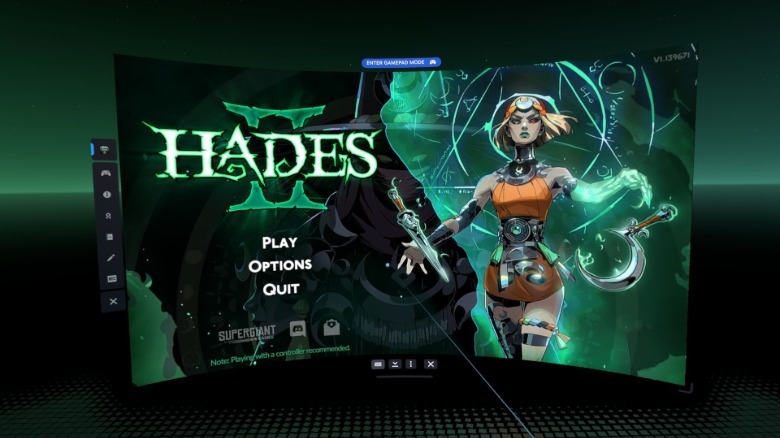
For legacy virtual reality titles including Beat Saber, Superhot, and Moss, the hardware delivers faster application loading cycles and lower latency during quick-resume state transitions than rival standalone headsets. The Steam Frame also functions as a virtual display unit for standard 2D games running through SteamOS. Supergiant Games’ Hades II, for example, can be projected onto virtual screen spaces larger than traditional physical monitors or 120-inch home projection systems.
Resource-intensive PC titles such as Control and Onimusha: Way of the Sword exceed the processing constraints of mobile silicon. Valve therefore bundles a dedicated high-frequency wireless USB dongle that streams content from a local gaming PC directly to the headset, trading native monitor pixel density for flexible virtual screen scaling.
Audio delivery differs from the approach used in previous Valve hardware. The 2019 Valve Index used off-ear near-field extra-aural speakers with balanced mode radiator (BMR) technology, designed to suspend near the ear without contact. The Steam Frame instead uses integrated strap speakers that provide wide spatial staging but reduced low-frequency bass response, affecting rhythm-heavy games such as Beat Saber and Pistol Whip.
There is no standard 3.5mm analog audio jack, so external wired headphones require a USB-C adapter connected to the rear port. The rear area also houses the battery enclosure, which is designed to balance the physical weight of the front optical assembly. Continuous operational endurance ranges from 90 minutes for intensive native VR software such as Half-Life: Alyx to approximately two hours for lighter 2D gaming and video playback. Active charging during use is supported through a USB-C cable attached to the rear battery compartment.