

Outside Money Dwarfs Candidate Fundraising in Los Angeles Mayoral Runoff Between Bass and Raman
Unlimited spending by labor unions, hedge fund managers and corporations is reshaping the Nov. 3 contest as candidates rely on capped donations and public matching funds.
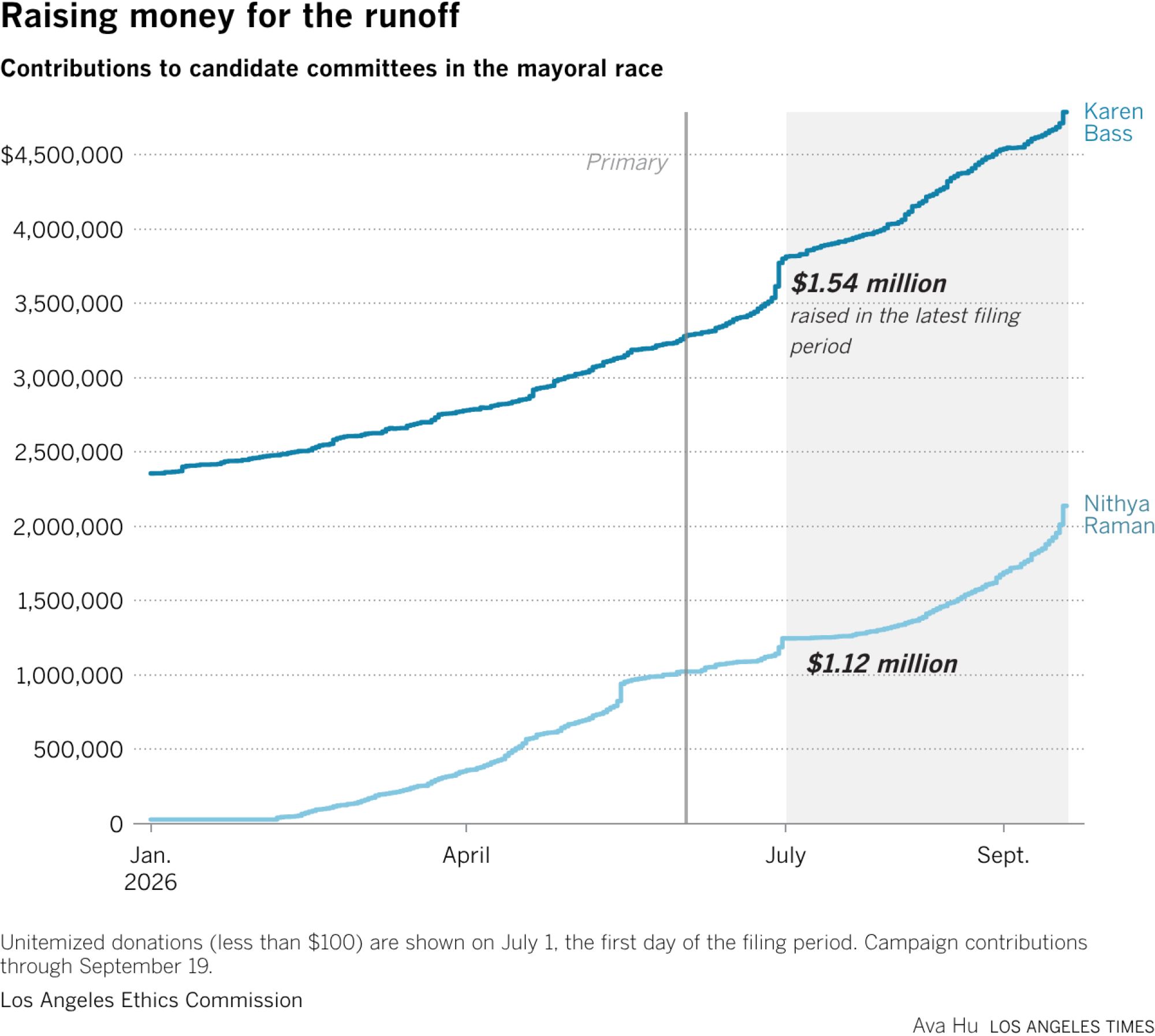
Independent expenditure committees backed by hedge fund managers, labor unions and tech companies have injected millions of dollars into the Los Angeles mayoral runoff, fundamentally altering a race where the candidates themselves are operating under strict donation caps.
As Mayor Karen Bass and City Councilmember Nithya Raman head into the Nov. 3 election, outside groups face no legal limits on how much they can spend to influence voters, provided they do not coordinate with the campaigns. That dynamic has turned the contest into a proxy war between organized labor, real estate interests and wealthy individual donors, even as the candidates’ own fundraising totals remain nearly identical.
Campaign finance filings through Sept. 19 show Raman holding $2.53 million in combined direct contributions and public matching funds, compared with $2.51 million for Bass. But those figures represent only a fraction of the total money shaping the outcome.


Estamos Con Nithya for Mayor 2026, an independent committee sponsored by the Western States Regional Council of Carpenters, has amassed $6 million. Half came directly from the carpenters’ council, while the other $3 million was donated by Aaron Sosnick, a Reno-based hedge fund manager who has publicly advocated for expanding Los Angeles bus networks and bicycle infrastructure. The committee has deployed those funds across television advertising, radio spots and campaign signage, according to chief strategist Estevan Montemayor.
Bass draws heavy financial support from law enforcement and the technology sector. The Los Angeles Police Protective League, representing rank-and-file officers, has directed nearly $2.8 million toward pro-Bass efforts this year. Airbnb contributed $1.75 million to a committee supporting the mayor during the primary phase, and company spokesperson Nicolette Velasquez confirmed plans for an additional seven-figure investment across several Los Angeles races in the coming weeks.
The influx of outside capital exploits a structural tension in Los Angeles election law. Candidates participating in the city’s public financing program accept a $1,800 cap on individual donations. In exchange, the city matches qualifying local contributions at a 6-to-1 ratio, up to $257 per donor. The system is designed to amplify small-dollar giving, but it cannot restrict spending by unaffiliated third parties operating under federal and state rules that treat independent expenditures as protected political speech.
Raman leveraged the matching system aggressively, securing $1.4 million in public funds by drawing from nearly 4,000 donors — more matching money than any candidate in city history, her campaign said. Bass collected $1.5 million in direct contributions, outpacing Raman’s $1.1 million haul, but received only $1 million in matching funds.
Heading into the final stretch, Raman reported approximately $1.9 million in cash on hand, leaving her with roughly $700,000 more than Bass’s $1.2 million reserve.
Bass spokesperson Alex Stack accused Raman’s backers of attempting to purchase the election, pointing to the massive sums flowing through the Estamos committee. Stack countered that the mayor retains the support of workers, small businesses and community organizations.
The donor rolls reflect distinct political coalitions. Bass received maximum $1,800 contributions from Lt. Gov. Eleni Kounalakis, comedian Tiffany Haddish and Democratic Party financier Haim Saban. Her campaign also logged donations from U.S. Reps. Judy Chu (D-Monterey Park), Sydney Kamlager-Dove (D-Los Angeles) and Steny Hoyer (D-Md.), alongside various state lawmakers and city employees.
Raman’s direct contributors skew heavily toward the entertainment industry. Actor Adam Scott, producer Phillip Lord and dozens of writers and producers gave the maximum amount. Actor Bob Odenkirk donated $1,500 and narrated a recent campaign advertisement. Raman also received $1,800 from Ann Sewill, the former general manager of the city’s housing department appointed under Mayor Eric Garcetti.
Down-ballot races are following similar financial trajectories, though without the same volume of outside interference.
In the city attorney runoff, Deputy Attorney General Marissa Roy holds a fundraising edge over Deputy District Attorney John McKinney. Roy raised approximately $375,000 for the current cycle and entered the final weeks with $472,000 in cash on hand. McKinney raised about $311,000 and reported $163,000 available. Roy emphasized her refusal to accept corporate or Trump-aligned donors, while McKinney pitched himself as a pragmatic alternative backed by grassroots investors seeking new leadership at City Hall.
Two open City Council seats are also being contested. In the South Los Angeles district vacated by Curren Price, former council aide Jose Ugarte raised $155,000 against community organizer Estuardo Mazariegos, who brought in $119,000. Despite trailing in total receipts, Mazariegos held more cash on hand at $161,000 compared with Ugarte’s $134,000.
In the west San Fernando Valley seat left open by Bob Blumenfield, business owner Tim Gaspar significantly outraised political aide Barri Worth Girvan, collecting $265,000 to her $101,000. Gaspar reported $277,000 in reserves, while Girvan held $132,000.
All candidates filed their latest campaign finance disclosures covering activity through Sept. 19.










One Comment