Meloni Targets Italy’s Classrooms With Student Caps and Veil Ban
Meloni’s government advances classroom limits, language requirements and a face-covering ban

ROME — Prime Minister Giorgia Meloni’s Italian government is preparing a legislative package that would cap the number of foreign students in individual classrooms and prohibit face-covering Islamic veils in schools. The proposal is a major structural push to align the public education system with Italy’s strict, bloodline-based citizenship framework.
Italy’s citizenship rules are regulated primarily by a 1992 statute. Under the principle of *jus sanguinis* (right of blood), children born in Italy to foreign parents do not automatically receive citizenship at birth and must wait until turning 18 to apply for naturalization.
That distinction shapes school enrollment figures. Education Ministry data cited by the ISMU ETS Foundation show that students without Italian citizenship account for roughly 11.6% of total enrollment nationwide. A significant portion of those classified as “foreign” were born and raised entirely in Italy.


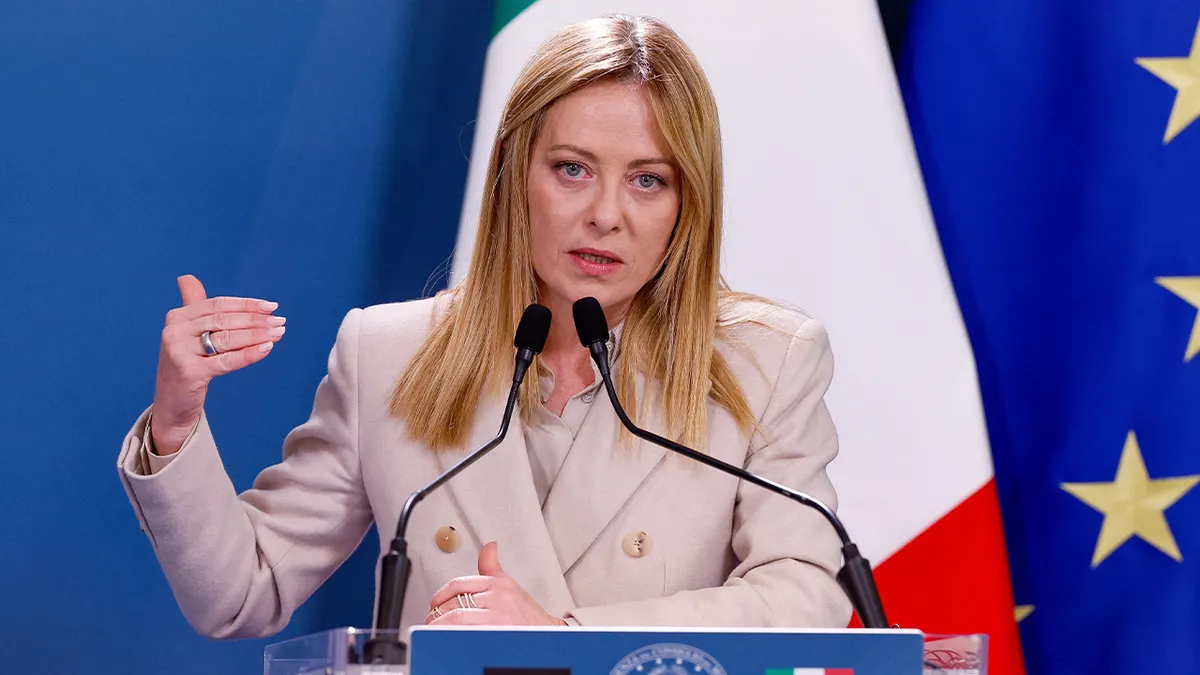
Meloni announced the details during an address in Rome to *Gioventù Nazionale* (National Youth), the youth wing of her conservative Brothers of Italy party. She argued that classrooms with high densities of non-Italian-speaking students disrupt the learning environment for all pupils.
“If in a classroom there is only one child who doesn’t understand Italian, it is possible that that child will manage, with the help of his peers and teachers, to learn the language and integrate fast,” Meloni said. “But if these children are many, or even the majority, that’s not integration anymore, that’s abandonment.”
The government plans to set a percentage limit on non-Italian citizens in individual classrooms, with the stated aim of preventing high concentrations in particular urban districts. Meloni did not announce the exact cap. Earlier, Education and Merit Minister Giuseppe Valditara had advocated a 30% limit on non-native students to support balanced integration.
The package would also require foreign parents whose children struggle to integrate to attend mandatory Italian-language courses. Meloni said her administration’s primary objective was to safeguard the cultural identity of native students: “There’s no way that in an Italian classroom, the ones who feel marginalized are Italian children because they have become a minority.”
The proposed legislation is scheduled for review by the Council of Ministers before moving to Parliament. Its second major measure would prohibit face-covering garments, specifically the burqa and the niqab, inside educational institutions. The restriction would not cover Islamic clothing that leaves the face visible, including the hijab.

The Brothers of Italy party supported the measure on social media, stating that “school is attended with one’s face uncovered” and arguing that “no tradition can impose on a young woman the obligation to hide herself.”
Italy’s proposal follows a wider regulatory trend in Western Europe. France introduced a ban on full-face veils in public spaces in 2010 under President Nicolas Sarkozy, and Belgium followed in 2011. Austria, Denmark, and the Netherlands have since adopted varying restrictions on face coverings in public or educational sectors.
The initiative comes during a period of unprecedented political stability in modern Italy, which has experienced dozens of coalition governments since World War II. Meloni has led the Brothers of Italy since 2014 and served as president of the European Conservatives and Reformists Party from 2020 to 2025 before becoming prime minister in October 2022.
Her center-right coalition includes Matteo Salvini’s League and Forza Italia. The coalition recently surpassed records set by the late Silvio Berlusconi’s administrations, becoming the longest-serving uninterrupted government in modern Italian history. The durable majority gives Meloni’s administration the political capital to advance controversial cultural and integration laws that previous short-lived administrations were unable to pass.