

L.A. Restraining Orders Rejected as Domestic Violence Protections Fail
Procedural dismissals leave thousands without court protection

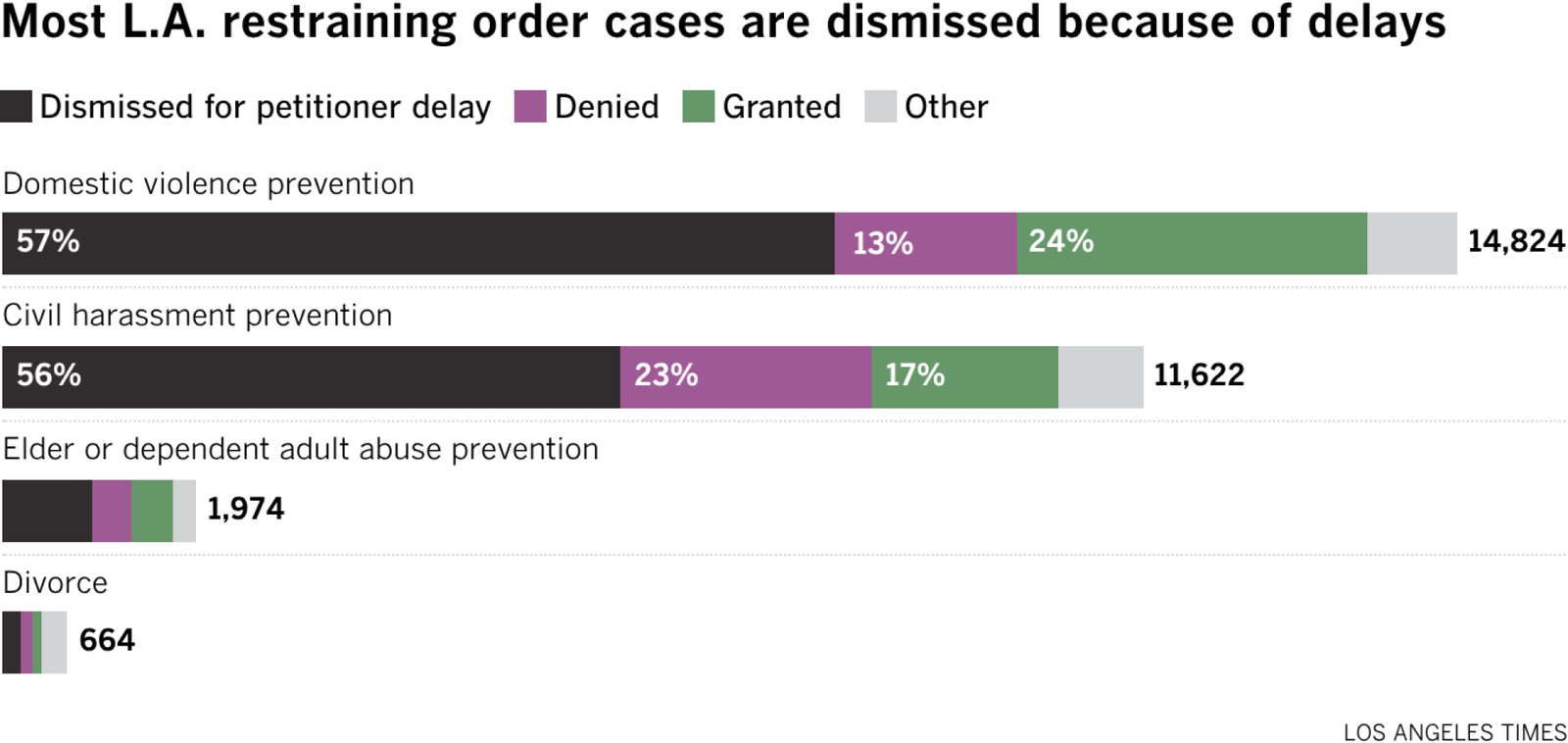
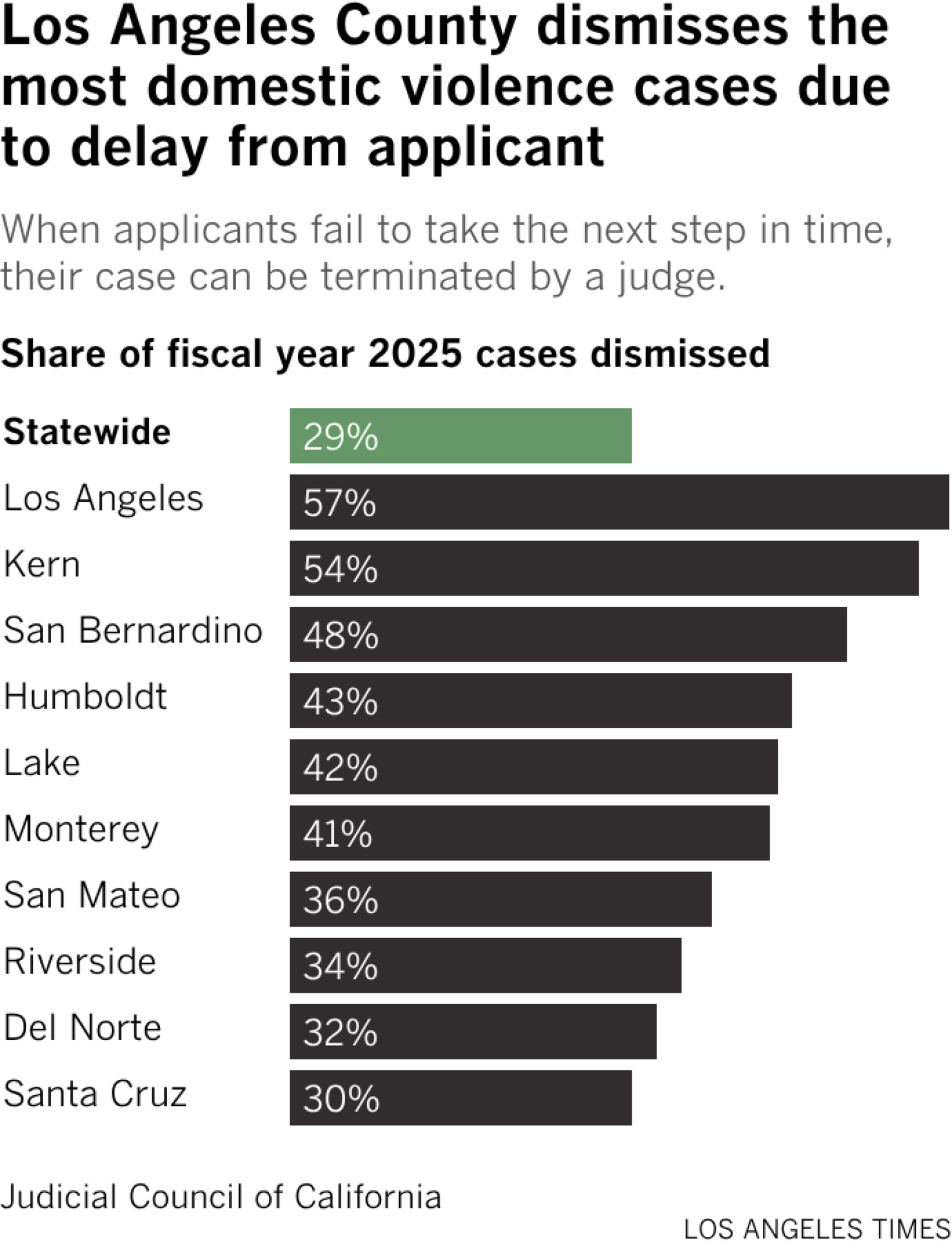
LOS ANGELES — In 2025, Los Angeles County courts logged nearly 15,000 domestic violence restraining order petitions. Judges granted only 21% of the requests, while 57% were dismissed because of petitioner-related procedural delays, including missed filing deadlines, incomplete document packets, or failure to attend scheduled hearings.

The dismissal rate is nearly double California’s statewide average of 29% across its 58 counties. More than half of all domestic violence restraining order petitions submitted in Los Angeles County are thrown out because of administrative and procedural hurdles rather than the legal merits of the allegations, leaving thousands of applicants without court protection in the nation’s largest trial court system.


Under the California Domestic Violence Prevention Act, applicants must submit multi-step documentation, including detailed declarations describing dates, locations, and specific accounts of physical harm or harassment. Court records show that 90% of petitioners navigate the process without legal representation.
Alyson Messenger, managing staff attorney at the Jenesse Center, a Los Angeles-based domestic violence legal organization, said statutory law allows judges to issue orders based exclusively on sworn testimony. Unrepresented petitioners, however, routinely face evidentiary challenges. Establishing “good cause” for a permanent multi-year order frequently requires corroborated physical evidence, including text message transcripts, police incident reports, hospital records, and witness declarations. Self-represented petitioners must introduce that evidence under civil evidentiary rules while managing trauma and family obligations.
Formal service of process is another primary driver of procedural dismissals. Before a court can conduct a permanent restraining order hearing or enforce a temporary restraining order, or TRO, the named respondent must be formally served with court documents under state procedural law. Of the cases in which service was uncompleted in 2025, 70% were ultimately dismissed by presiding judges.
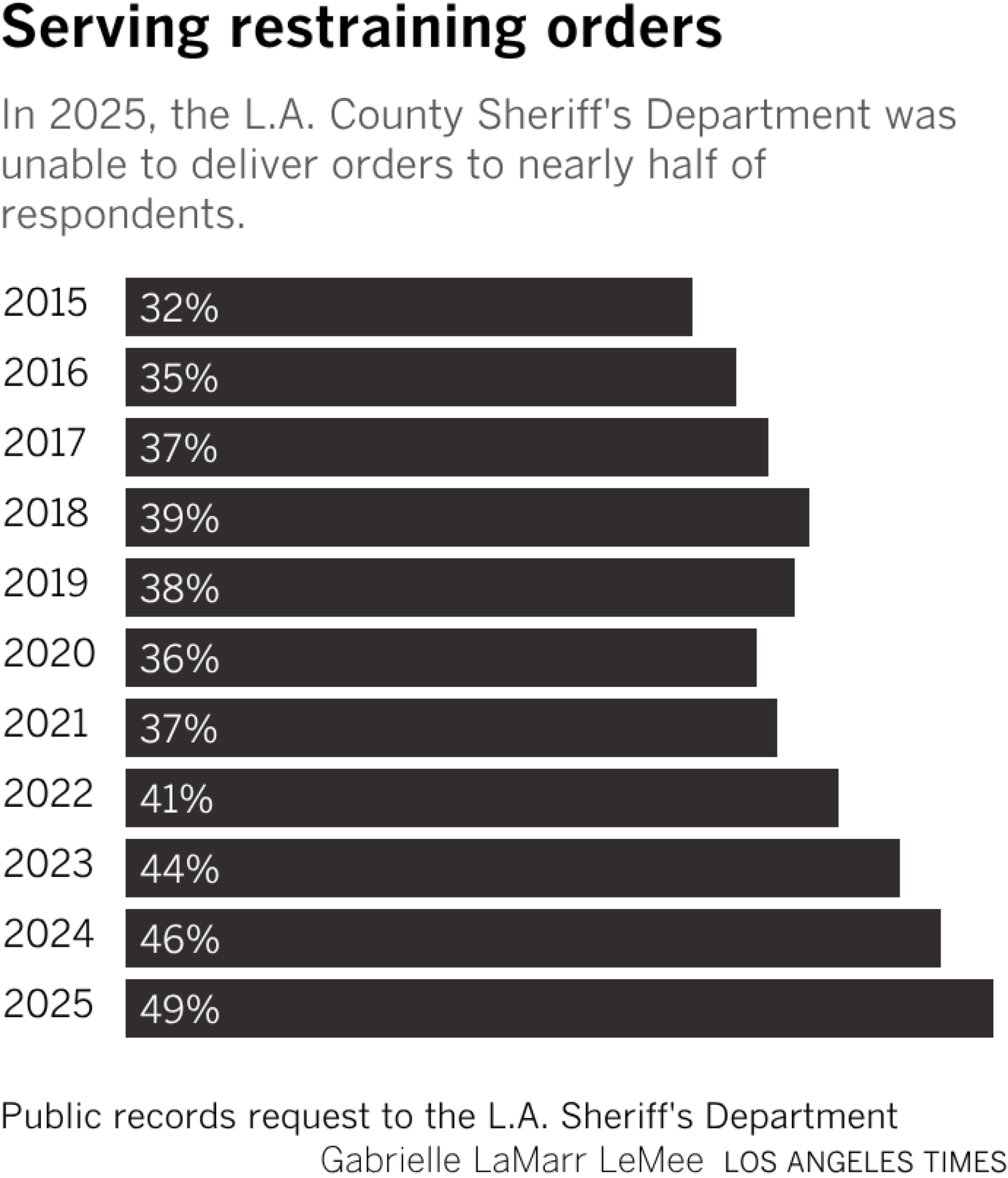
Petitioners may hire private process servers or enlist third-party adults, but the Los Angeles County Sheriff’s Department is the county’s primary free process server for domestic violence litigants. Department performance data shows a continuous decline in successful service completions since 2020. By 2025, sheriff’s deputies had failed to locate and serve respondents in nearly 50% of the requests assigned to them.
In a formal response, the Sheriff’s Department said evaluating the multi-year drop in completed service would require more comprehensive data. The department added that deputies encounter respondents who use sophisticated tactics to conceal their physical locations and evade process servers.
The court figures come amid an intimate partner homicide toll documented in county medical examiner records. Across 2024 and 2025, at least 63 women and girls, including two minors under 18, were killed by current or former romantic partners, family members, or family associates. Those domestic homicides accounted for more than 40% of the 156 women slain in the county during the two-year span.
At least 10 of those victims had sought judicial intervention by filing for restraining orders. Judges had issued permanent protective orders to four before they were slain, while three others were killed within days of filing initial court petitions.
The administrative obstacles remained despite formal warnings to municipal and county leaders. In 2024, the Los Angeles County Office of Violence Prevention published a systemic evaluation identifying multiple structural drop-out points across the civil court pipeline. The office submitted 13 targeted recommendations to city and county domestic violence task forces and oversight committees; to date, only three have been fully implemented.
Office of Violence Prevention Director Andrea Welsing confirmed that most of the recommended policy adjustments have stalled because of unresolved funding constraints and coordination difficulties among independent municipal agencies, law enforcement divisions, and the court system.
Similar operational bottlenecks occur at the first point of contact with municipal law enforcement. A 2023 audit from the Los Angeles Police Commission’s Office of the Inspector General found that the Los Angeles Police Department’s Domestic Abuse Response Teams, or DART, were dispatched to only 3% of the more than 40,000 domestic violence 911 calls received by the department in 2022.
DART units are specialized paired teams made up of a trained patrol officer and a civilian crisis advocate. Although the Inspector General recommended expanding DART coverage and assigning two dedicated teams to every LAPD division, advocates said the expansion has not materialized.
Jasmine Rodriguez, lead DART advocate at Casa de la Familia, said responding patrol officers regularly neglect to summon available DART units to active scenes. Victims are consequently left without on-site assistance for emergency protective orders or guidance through the civil filing process.
When protective orders are secured, victims and legal advocates report significant lapses in field enforcement. Violations of civil restraining orders are criminal misdemeanors under California Penal Code Section 273.6, yet advocates say police responses to non-physical boundary violations often produce no formal incident reports.
Minty Siu-Kootnikoff, legal services director at the domestic violence agency Sojourn, said respondents routinely test restraining orders through non-violent contact, including unauthorized phone calls or text messages. Victims report that responding officers have sometimes characterized minor communications as inconsequential or asked petitioners why they answered calls, shifting culpability onto the victim instead of enforcing the judicial order.
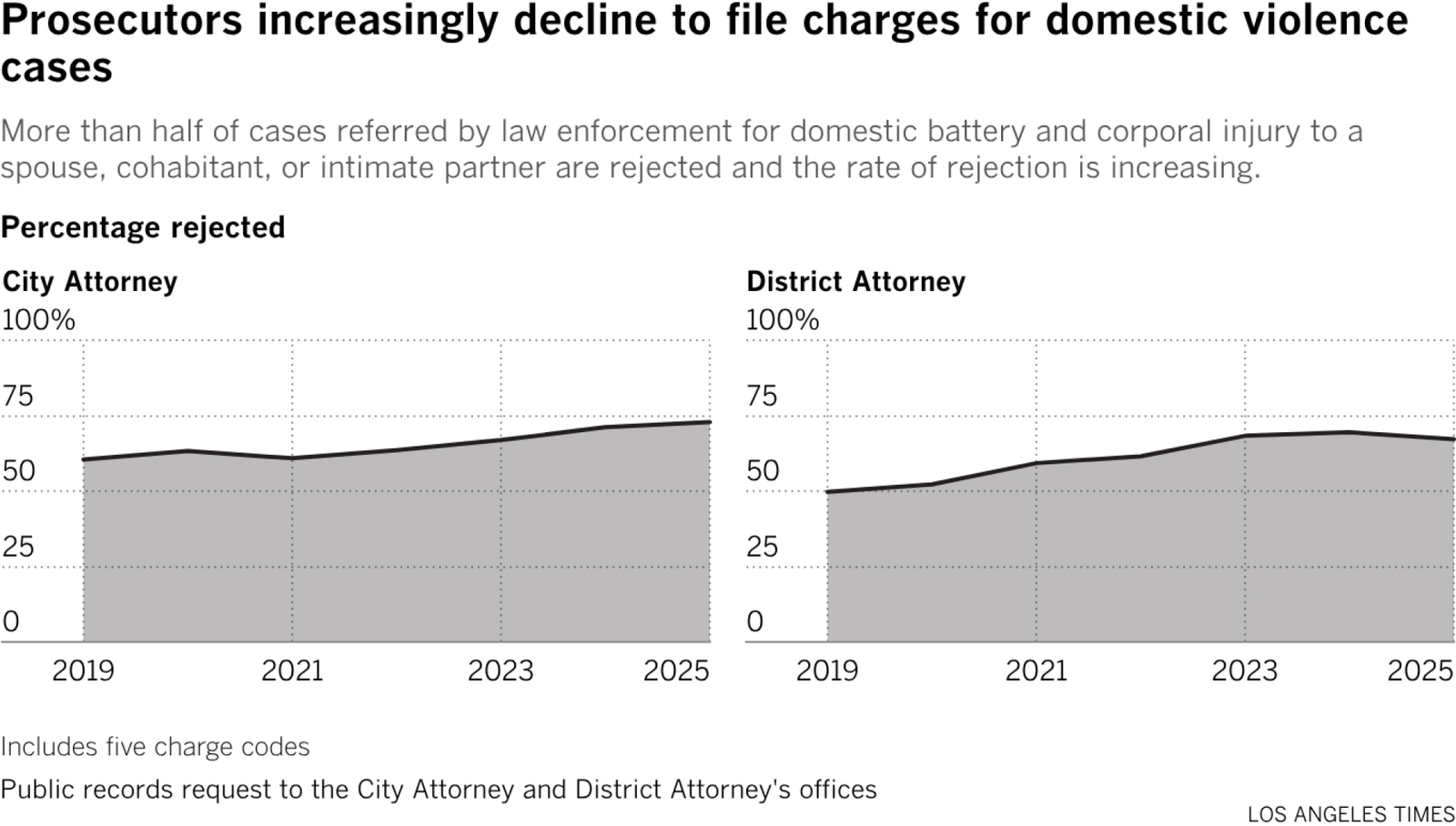
The civil court problems coincide with declining prosecution rates in the criminal justice system. To impose criminal penalties, law enforcement agencies must refer reported domestic violence incidents to the Los Angeles County District Attorney’s Office for felony consideration or to the Los Angeles City Attorney’s Office for misdemeanor filing.
Prosecutorial referral data shows a growing rejection rate for domestic violence cases. In 2025, the Los Angeles City Attorney’s Office rejected 84% of domestic battery and partner-injury misdemeanor referrals submitted by law enforcement, up from a 76% rejection rate in 2019.
Legal providers said declining criminal filings reinforce a cycle of non-enforcement that discourages police from submitting incident referrals, leaving restraining order violations unchecked until incidents escalate into severe violence.










One Comment