Ireland Overhauls Citizenship Rules and Crime Data Policies as Immigration Pressures Mount
Proposed legislation extends residency requirements to eight years and introduces language mandates as the government addresses severe housing shortages and asylum backlogs.

DUBLIN — Ireland is preparing to raise its citizenship residency requirement from five years to eight, mandate language proficiency for naturalization applicants, and potentially publish crime statistics broken down by nationality, signaling a sharp pivot in how one of Europe’s fastest-growing economies manages an unprecedented demographic shift.
Prime Minister Micheál Martin confirmed the policy overhauls while defending the country’s broader economic reliance on foreign labor. The proposed changes represent a direct response to mounting domestic pressure over housing shortages, a strained asylum processing system, and high-profile violent crimes that have fueled street-level unrest and political friction across the island.
The push to alter citizenship requirements marks a significant departure for a nation that historically relied on emigration rather than immigration to balance its population. Under the new migration strategy currently in development, applicants would need to demonstrate economic self-sufficiency alongside extended residency before qualifying for an Irish passport. The tightening mirrors recent legislative shifts across the European Union, where governments in Germany, France, and the Netherlands have similarly moved to restrict access to permanent residency and citizenship following surges in post-pandemic migration.


Martin also signaled willingness to end a longstanding statistical blackout regarding the nationalities of criminal suspects. Unlike the United Kingdom, which routinely publishes offender demographics through its Ministry of Justice, or the United States, where such data frequently drives local and federal policy debates, Ireland’s Central Statistics Office has not traditionally disaggregated crime figures by the suspect’s country of origin. This absence of public data has left a vacuum frequently filled by unverified claims on social media, intensifying polarization between immigrant communities and long-term residents.
“I’ve no issue with data … because that can inform, because sometimes you get a kind of distorted picture,” Martin said, though he cautioned against conflating nationality with criminality, noting that severe offenses are committed by both citizens and non-citizens alike.
The demand for transparency intensified following two highly publicized attacks. In November 2023, a stabbing outside a Dublin school by an Algerian-born man who had recently acquired Irish citizenship ignited riots in the capital, resulting in arson attacks on public transport and police vehicles. More recently, the murder of Jamey Carney, a 43-year-old American mother living in County Kerry, exposed critical gaps in the enforcement of deportation orders. The suspect, Carney’s Jordanian boyfriend whose asylum claim had been denied, remained in the country during his appeals process before fleeing to Turkey and ultimately Jordan following the killing. Irish authorities are now pursuing extradition.

That case underscored systemic bottlenecks in the International Protection Office, the agency responsible for evaluating asylum claims. Applications skyrocketed from roughly 3,500 annually prior to the pandemic to a record 18,561 in 2024. While those numbers have fallen nearly 30% over the past year, the backlog continues to strain state resources. To accommodate applicants awaiting decisions, the government spent approximately $1.4 billion on emergency accommodation in 2025, relying heavily on commercial hotels and purchasing properties outright, including a $175 million acquisition of the Citywest Hotel and Convention Centre near Dublin.
This emergency spending collides directly with a severe national housing deficit. Ireland’s population surpassed 5.3 million in recent years, driven largely by economic expansion that transformed the country into a European hub for U.S. technology and pharmaceutical giants like Apple, Meta, Pfizer, and Johnson & Johnson. Nearly 23.3% of residents are now foreign-born—the fourth-highest proportion in the EU—up from roughly one in seven twenty years ago. More than half a million non-EU citizens resided in the country at the start of 2025.
While construction output reached approximately 36,000 homes last year, a 20% increase and the highest volume since 2011, urban planners estimate Ireland needs closer to 50,000 units annually to stabilize the market. The shortage has made social housing allocation a volatile political issue. Recent Dublin City Council figures revealed that 42% of the capital’s 15,005 households waiting for social housing were categorized as non-Irish. Nationally, non-Irish citizens comprised 28.7% of applicants in 2025, including nearly 3,200 refugees from outside the EU—a 64% annual increase. Martin stated his government supports prioritizing Irish citizens on these waiting lists.

The tension between economic growth and infrastructure capacity drew pointed commentary from U.S. President Donald Trump during a recent visit to Dublin. Standing alongside Martin, Trump warned that Europe’s current approach to migration was self-destructive. Martin countered that legal migration remains inseparable from Ireland’s modern economic survival, comparing the EU’s freedom of movement framework to interstate mobility within the United States.
Ireland’s relationship with migration is deeply tied to its own history. Before the Great Famine in 1845, the island’s population stood near 8 million. Decades of starvation and mass emigration reduced it drastically, creating a vast global diaspora. Martin invoked this history to contextualize the current influx, noting that hundreds of thousands of Irish citizens currently live and work across other EU member states under the same free-movement treaties governing arrivals to Dublin.
Beyond the asylum system, the government is managing the integration of more than 120,000 Ukrainians who arrived under the EU’s Temporary Protection Directive following Russia’s 2022 invasion. Approximately 80,000 remain in Ireland, many having transitioned from state-supported accommodation into the broader labor market.
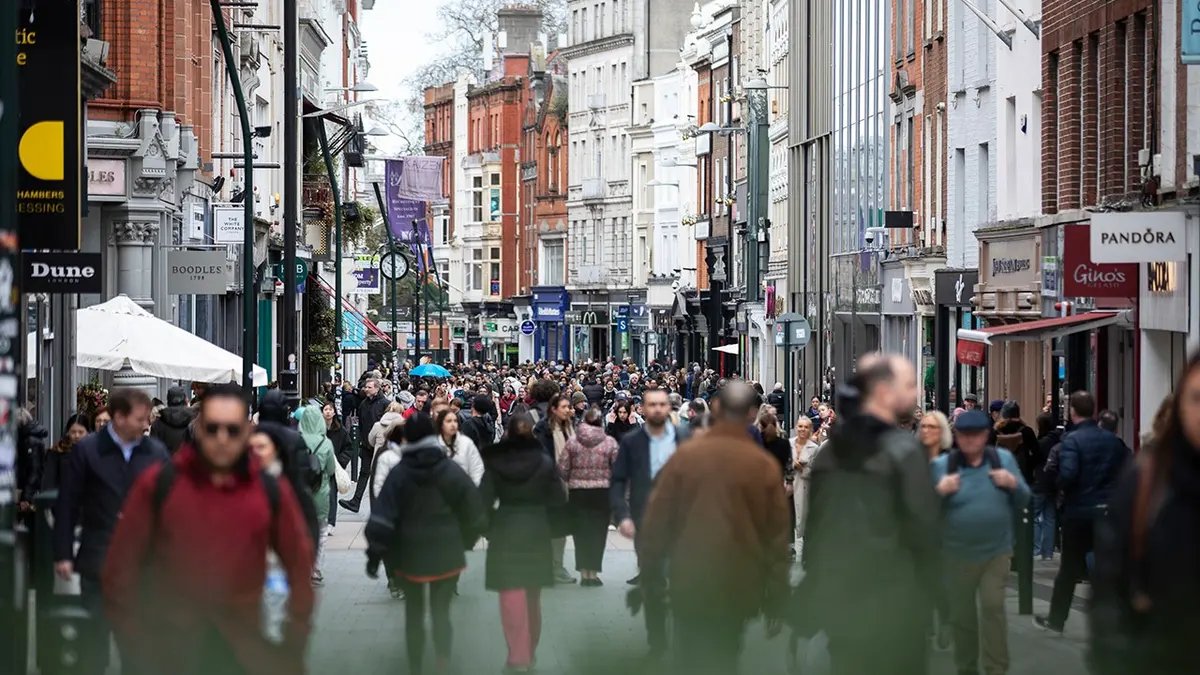
Despite recording 8% GDP growth in 2025, according to the Central Statistics Office, the macroeconomic prosperity has not insulated ordinary households. Recent surveys indicate nearly 45% of residents report difficulty covering basic expenses, with 64% citing housing and inflation as the country’s most urgent crises.


Legislative drafting for the extended citizenship requirements and accelerated deportation protocols is underway within the Department of Justice, with formal proposals expected to be introduced to the Dáil, Ireland’s lower house of parliament, before the end of the current legislative session.