Gulf Oil Flows Rebound as U.S. Blockade Squeezes Iran
Pipeline diversions restore supply volumes as Tehran faces economic collapse and infrastructure retaliation risks
Persian Gulf crude exports have returned to prewar volumes despite a U.S. naval blockade that has effectively halted Iranian shipments, creating a volatile divergence between regional energy security and Tehran’s economic collapse. While American military escorts and infrastructure adaptations have stabilized global supply, analysts warn the strategy risks provoking asymmetric retaliation against production facilities rather than shipping lanes.
JPMorgan estimates Middle East crude exports reached 17.5 million barrels per day last week, representing 98% of pre-conflict levels. Goldman Sachs placed the figure higher at 19 million barrels per day, while data firm Kpler confirmed flows exceeded 16.5 million barrels daily in September. This recovery occurred even as U.S. enforcement reduced Iran’s own exports to near zero, severing the regime’s primary revenue stream.
The volume rebound masks a fundamental restructuring of regional logistics designed to bypass Iranian chokepoints. Approximately 40% of Gulf crude now reaches global markets without transiting the Strait of Hormuz, a significant increase from the 17% prewar baseline. Saudi Arabia and the United Arab Emirates have maximized pipeline capacity to move oil directly to Red Sea and Gulf of Oman terminals. For shipments that still cross the strait, more than 70% undergo ship-to-ship transfers offshore to avoid direct transit through contested waters.


This logistical resilience has not eliminated risk. Attacks on commercial vessels have increased in recent days, keeping marine war risk insurance premiums elevated and preventing freight rates from normalizing. While U.S. naval assets have degraded Iran’s ability to interdict traffic systematically, drones and missiles continue to strike targets intermittently. The persistent threat ensures that despite physical flow recovery, the market retains a geopolitical risk premium.
Tehran’s leverage is shifting from maritime interdiction to infrastructure targeting. Esfandyar Batmanghelidj, CEO of the Bourse & Bazaar Foundation, noted that Iran retains the capability to destroy drilling platforms, refineries, and export terminals across the Gulf. Such strikes would damage regional economies and disrupt supply far more severely than tanker harassment, providing Iran with bargaining chips even as its own economy deteriorates.
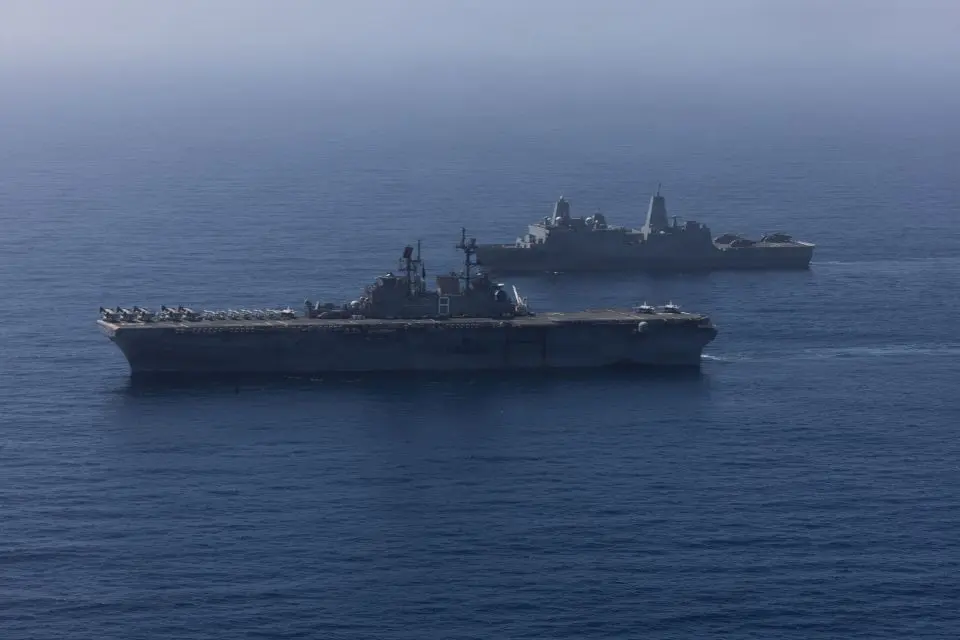
Diplomatic channels remain frozen. President Donald Trump rejected a seven-day ceasefire proposal that would have reopened the strait in exchange for sanctions relief and asset unfreezing. Administration officials indicated plans to resume airstrikes after the upcoming midterm elections, signaling a preference for military pressure over negotiation. To support this posture, the USS Theodore Roosevelt carrier strike group and the USS Makin Island Amphibious Ready Group are deploying to the region.
U.S. Navy Wasp-class amphibious assault ship USS Makin Island (LHD 8), front, and San Antonio-class amphibious transport dock ship USS John P. Murtha (LPD 26), sail in formation during routine training off the coast of California, Aug. 23, 2026.
Economic warfare is simultaneously tightening. New sanctions imposed last month target front companies and intermediaries facilitating Iranian trade. The Iranian rial has plummeted to record lows as revenues evaporate. President Masoud Pezeshkian acknowledged the liquidity crisis publicly, stating that funds held in China remain inaccessible due to banking restrictions, leaving Tehran unable to pay international creditors or import essential goods.
Regional mediators continue seeking a durable ceasefire framework, fearing that prolonged economic strangulation could trigger the very infrastructure attacks Washington seeks to avoid. The current equilibrium relies on Iran accepting severe economic pain without escalating to scorched-earth tactics—a calculation that may shift as domestic pressures mount and diplomatic off-ramps remain closed.