Germany’s Solar Boom Is Running Out of Financial Runway
Installers are booked through 2026 as insolvencies, tighter lending and a proposed 50% grid cap threaten the next downturn
BERLIN — Germany’s solar market is experiencing a banner year at the installation level, with local companies reporting packed order books through the end of 2026. At the same time, major industry players are slipping into insolvency or financial distress, while a sudden tightening of credit is raising fears of a systemic collapse reminiscent of the sector’s historic downturn.
The rush is being driven largely by consumer anxiety over a sweeping regulatory overhaul proposed by the Christian Democratic Union (CDU)-led government under Federal Minister for Economic Affairs and Energy Katherina Reiche. Homeowners and commercial developers are seeking to commission systems before the end of the year so they can secure favorable, long-term compensation rates under the current Renewable Energy Sources Act (EEG).
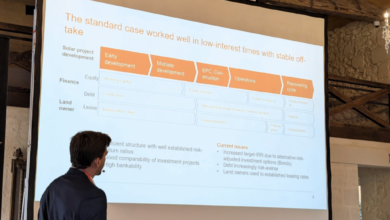
Since its inception in 2000, the EEG has provided commercial banks with a low-risk backstop. Its guarantee of fixed feed-in tariffs for 20 years allowed lenders to offer highly favorable non-recourse project loans with low equity requirements. The government’s plan to remove those statutory revenue guarantees is now prompting financial institutions to reassess their risk profiles.

The resulting credit squeeze is affecting the financing of Germany’s energy transition (*Energiewende*). Banks are tightening lending terms, raising interest rates, demanding higher debt service coverage ratios, and requiring developers to provide significantly more equity. Developers are consequently finding it harder to secure the liquidity needed to bridge the period between project planning and grid connection, even while consumer interest remains high.
The demand surge has temporarily masked deeper structural challenges. Small-scale installers remain fully booked, but major companies are running out of financial runway. Hamburg-based utility-scale project developer Enerparc and Konstanz-based solar storage manufacturer RCT Power have both slipped into insolvency or financial distress, developments that are serving as early warning signs for the broader European market.
The proposed reforms are awaiting debate in the German Bundestag and Bundesrat. Industry analysts have already coined the term “Reiche effect” for their potential fallout, drawing comparisons with earlier legislative interventions that crippled Germany’s domestic solar market. A proposed 50% cap on grid feed-in is at the center of the industry’s concerns.
Under current rules, solar system operators can export the vast majority of their unused generation to the public grid at guaranteed rates. If the new legislation passes, systems would be limited to exporting no more than half of their installed peak capacity (kWp) at any given time. Operators would then have to curtail output or purchase expensive battery storage systems to retain excess midday generation for later use.
The policy is intended to prevent grid overload and reduce the public cost of feed-in subsidies. Developers warn, however, that it could undermine the amortization models of both commercial and residential installations. The impending policy shift is arriving while solar hardware prices are relatively stable, although supply chain pressures remain.
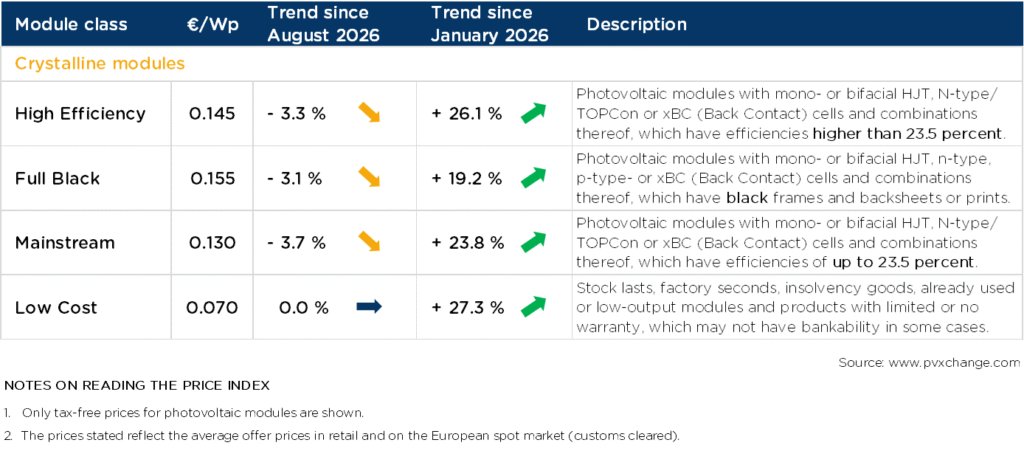
According to data tracked by pvXchange.com, a European wholesale trading platform for solar components founded in 2004 by electrical engineer Martin Schachinger, standard photovoltaic module prices recorded only moderate declines through mid-September 2026. Manufacturers in the battery storage segment have announced price hikes linked to steady demand and fluctuating raw material costs.
High fossil-fuel energy prices continue to keep domestic demand resilient, while maritime shipping disruptions along major trade routes to Europe have added volatility to component delivery schedules. Component prices, industry experts note, will provide little relief if the legislative framework destroys the underlying business case for new installations.
The concern is rooted in Germany’s previous solar crisis. Between 2012 and 2014, the industry suffered what became known as the “Altmaier effect,” named after then-Federal Environment Minister Peter Altmaier. After a period of rapid solar expansion, the government introduced drastic feed-in tariff cuts to curb rising retail electricity prices.
The abrupt policy change caught the industry unprepared. Without stable subsidy structures and amid intense competition from heavily subsidized Chinese manufacturers, more than half of Germany’s solar companies collapsed. Q-Cells, Solon, and Conergy, among the industry’s pioneers, went bankrupt or were acquired by foreign competitors, while tens of thousands of specialized manufacturing jobs were lost.
Industry veterans warn that insufficiently structured transitional measures could allow the “Reiche effect” to trigger an even wider wave of insolvencies in 2027. The projected downturn could affect not only hardware manufacturers but also the project developers and engineering firms that form the backbone of the current deployment pipeline.
If the 50% feed-in cap is enacted without transitional safeguards, only the most flexible companies are expected to survive the projected 2027 downturn. Those companies would need to pivot toward alternative, self-consumption-heavy business models.