Four States Put Abortion Rights Back on the 2026 Ballot
Missouri, Nevada, Idaho, and Virginia face pivotal abortion votes
Four years after the U.S. Supreme Court eliminated the constitutional right to abortion in *Dobbs v. Jackson Women’s Health Organization*, state ballot referenda remain the central battleground defining reproductive healthcare access. In the November 2026 general election, voters in at least four states—Missouri, Nevada, Idaho, and Virginia—will decide on constitutional amendments that could expand, solidify, or dismantle legal protections for abortion.
The 2022 ruling ended nearly half a century of federal abortion rights established under *Roe v. Wade* in 1973. Regulation was left to individual state legislatures and state constitutions, producing a nationwide mosaic of laws that ranges from complete prohibitions to statutory shield laws protecting local healthcare providers from out-of-state prosecutions, extraditions, and civil liability.
In Virginia, abortion is currently permitted through the first two trimesters—up to 28 weeks—under statutory law. Voters will decide whether to formally codify reproductive rights in the state constitution, an effort to protect them from future statutory changes.

Idaho enacted one of the strictest total bans in the nation after the *Dobbs* decision, but a ballot initiative qualified for November 2026 that would establish a constitutional right to abortion through fetal viability. Across the region, Utah permits abortion up to 18 weeks of pregnancy while state courts deliberate the constitutionality of a trigger ban passed by state lawmakers in 2020.

Nevadans for Reproductive Freedom spearheaded a 2024 citizen initiative seeking to guarantee abortion rights up to fetal viability, generally defined by medical professionals as around 24 weeks of gestation, or later if necessary to protect the patient’s life or health. Voters approved the measure with 64% support, but the vote was not enough to put it permanently into the state constitution.
Article 16 of the Nevada Constitution requires citizen-initiated constitutional amendments to pass by a majority in two consecutive even-numbered general elections before taking effect. Nevada voters will therefore return to the polls in 2026 for a second required vote. Existing state statute already permits abortion through 24 weeks, while constitutional codification would prevent future state legislatures from restricting access without direct voter approval in two separate elections.
Denise Lopez, president of the Nevadans for Reproductive Freedom coalition, said sustained voter turnout is the organization’s primary focus heading into November. “Folks care about it,” Lopez said. “They’re seeing what’s happening at the national level, and they want to make sure that whatever’s happening in our neighboring states, like Idaho and Utah, doesn’t happen here in Nevada.”
National anti-abortion organizations argue that the growing disparity in state laws reflects a legal and moral fracture across state lines. “I just think there’s a constitutional crisis that’s coming,” said Kristi Hamrick, vice president of media and policy for Students for Life Action. “Can you have 50 state standards on whether or not a human being is a human being? Can you have 50 state standards on whether human beings have legal protection?”

Missouri is the only state where the legislature is asking voters to undo constitutional abortion protections approved in the previous election cycle. Immediately after the Supreme Court’s June 24, 2022, ruling, Missouri became the first state in the nation to enact a near-total ban under its 2019 “Right to Life of the Unborn Child Act.”
Before *Dobbs*, three decades of Targeted Regulation of Abortion Providers (TRAP) laws had already severely reduced access. Those measures included a mandated 72-hour waiting period, mandatory hallway and procedure room dimension requirements, and clinical admitting privilege mandates at nearby hospitals. State health department records show that the annual number of abortions performed in Missouri fell from 5,772 in 2011 to 150 in 2021.
Missouri voters passed a citizen-led initiative in November 2024. Designated Amendment 3, it enshrined the right to reproductive freedom—including abortion up to fetal viability—in the state constitution. The Republican-dominated Missouri General Assembly responded by placing a measure on the November 2026 ballot to repeal those protections. In a quirk of state ballot administration, the legislative proposal is also designated Amendment 3.
The proposed 2026 amendment would eliminate the 2024 constitutional rights and institute a broad state ban if approved. It includes narrow exceptions for medical emergencies, severe fetal anomalies, and pregnancies resulting from rape or incest, with abortions in rape or incest cases allowed only during the first 12 weeks of pregnancy.

The competing measures with identical names have created legal confusion for voters and operational hurdles for healthcare providers across Missouri. Administrative challenges and regulatory delays meant medication abortion services took nearly two years to resume operating in the state, despite the late-2024 victory for abortion rights supporters.
Margot Riphagen-Dunn, CEO of St. Louis-based Planned Parenthood Great Rivers, said rapid shifts in the legal landscape create ongoing uncertainty for clinics and patients attempting to navigate state laws. “Chaos is kind of the point here,” Riphagen-Dunn said, “and it is absolutely a tactic that gets in the way of being able to provide.”
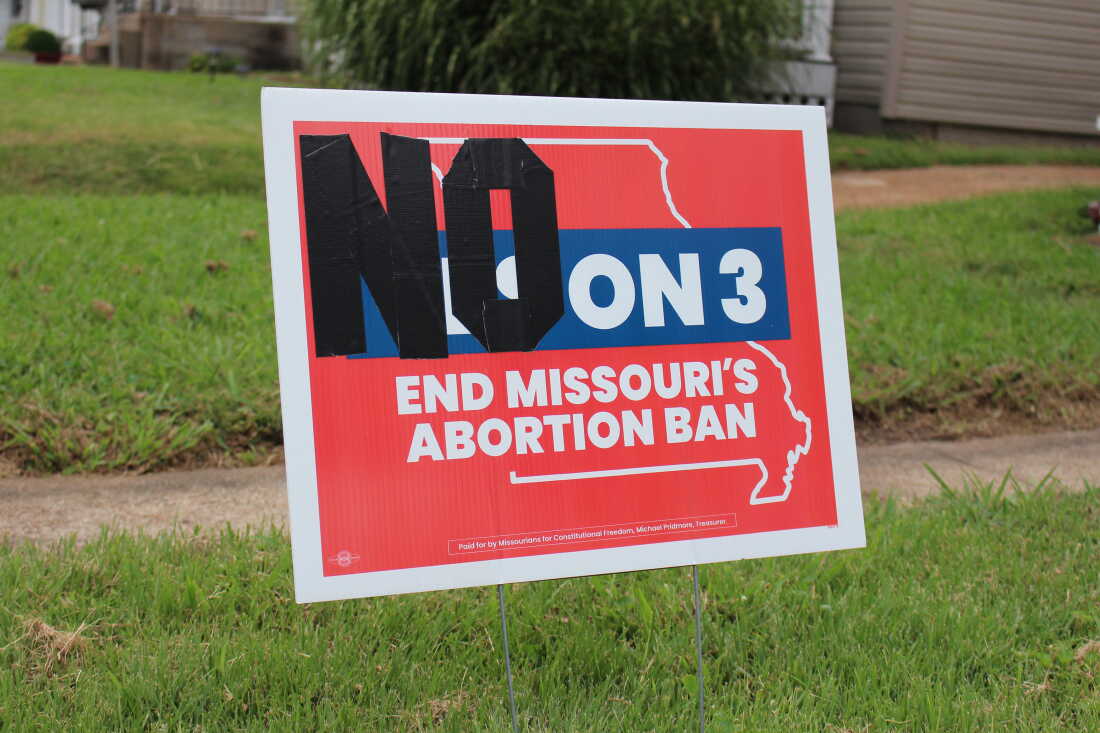
The identical naming has also forced advocacy campaigns on both sides to re-educate voters about the ballot mechanics. A “yes” vote in 2024 established constitutional protections, so a “no” vote on Amendment 3 in 2026 is required to keep them. Anti-abortion voters who voted “no” in 2024 must vote “yes” on Amendment 3 in 2026 to enact the legislative restrictions.
Reagan Barklage, vice president of Students for Life of America and treasurer of the Missouri Students for Life Ballot Committee, acknowledged the voter outreach challenges encountered during community canvassing. “People need to be very clear on what they’re voting for,” Barklage said. “It is crazy that it ended up being even the same number. I do not think that was intentional, but we’ve got to deal with what we’ve got. I hope the pro-choicers kept their yard signs from last time.”
Reporting for portions of this article was contributed by KFF Health News, a national newsroom producing in-depth journalism on health issues and an operating program of KFF.
In the St. Louis suburb of Maplewood, resident Kelly McCoomb retrieved her 2024 campaign sign supporting abortion protections from her basement. She used black duct tape to change the word “YES” to “NO” before reinstalling the sign in her front yard. “I have little faith in our Missouri government,” McCoomb said, noting that she had originally preserved the sign as a keepsake following the 2024 vote but anticipated further legislative action. “I hope lots of people see and remember to revote.”