Fortescue Is the Last Miner Standing as China’s State Buyer Freezes It Out
Rio Tinto signed this week. BHP settled for a one-year deal in yuan. Fortescue's warning Thursday shows what holding out costs — and its own guidance now hangs on a negotiation it can't control.
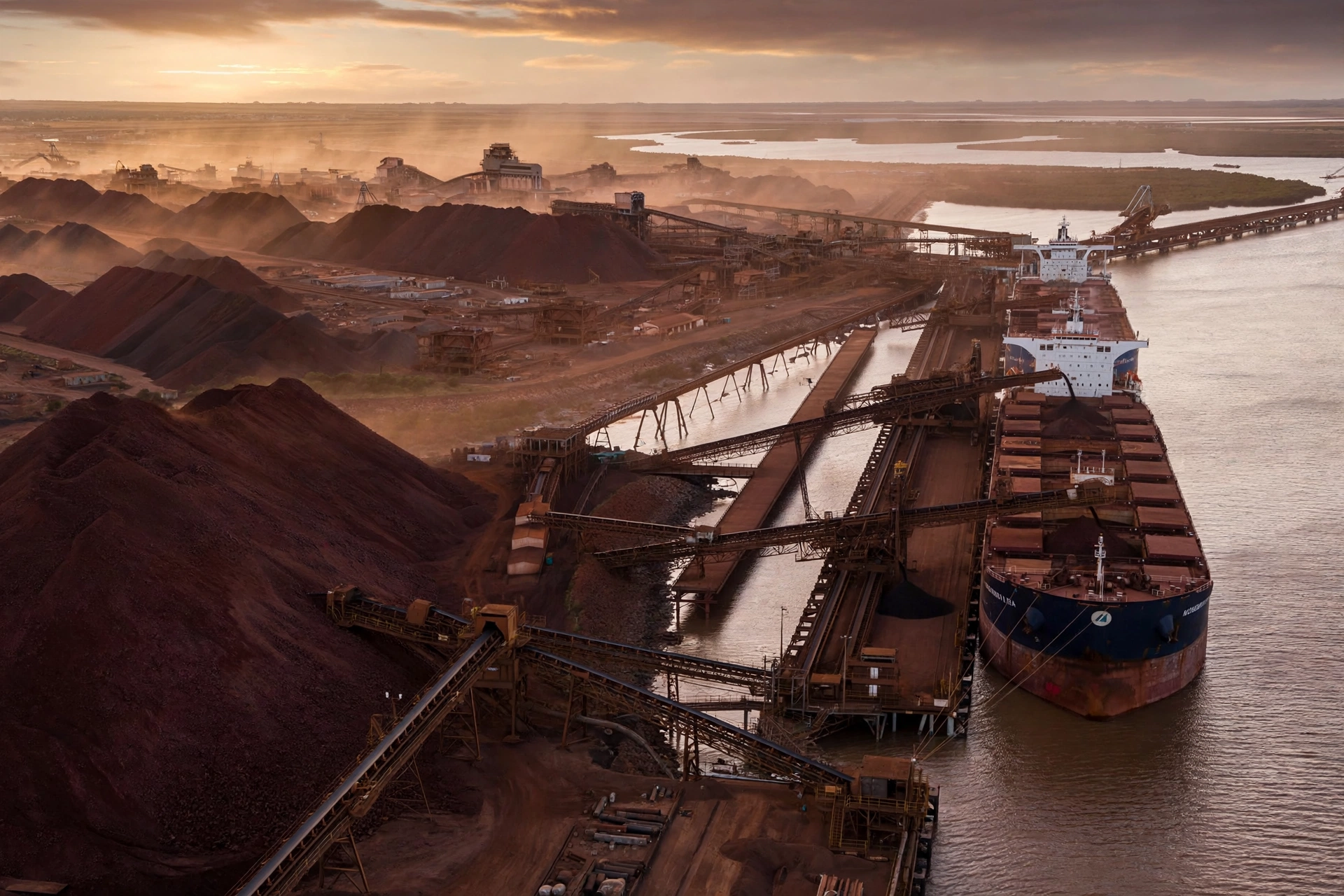
There was no memo. No letter, no filing, nothing on any exchange. Earlier this year, word simply went around some of China‘s steel mills: don’t take delivery of Fortescue‘s flagship ore while the annual supply talks are on.
Reuters reported the instruction at the time. It was verbal — as these things tend to be when the buyer is China Mineral Resources Group, the state-backed company Beijing set up in 2022 to negotiate as one for all of China’s steelmakers. No paper means no paper trail. The mills got the message anyway.
The freeze worked the way freezes do. Fortescue kept mining and kept shipping, 46.8 million tonnes in the three months to September 30, but it could only sell 42.9 million. The 3.9 million tonnes in between didn’t vanish. It piled up at ports, unsold, while the company told investors to expect the stockpile to keep growing through October. At the quarter’s realised price of US$79.79 a tonne, that’s roughly US$311 million of revenue sitting in inventory instead of landing in the bank.


That’s the number behind Thursday’s warning. Fortescue said its full-year guidance — 197 to 207 million tonnes shipped, unit costs, capital spending — stands, but it is “subject to” the CMRG talks. And then the line that moved the story past routine quarterly noise: “If negotiations with CMRG are not concluded by calendar year-end, operations may be affected, potentially including adjustments to production.” The shares fell more than 4%, to their lowest since June 2025.
The cash is already draining. Fortescue ended September with US$3.2 billion in the bank, down 37% in a quarter, while net debt more than tripled to US$2.8 billion after a US$1 billion dividend and US$0.9 billion of capital spending. Some of that is the dividend calendar, not the freeze. But operating cash flow was, in the company’s own accounting, squeezed by working capital tied up in product inventory — ore that was mined, shipped, and then had nowhere to go.
In August, the same verbal channel was aimed at Rio Tinto: CMRG directed some mills to halt negotiations for September shipments. In September, Bloomberg reported that CMRG had told mills to hold off buying Rio’s Pilbara Blend as those talks hit a critical point. On Wednesday of this week, the channel carried different news: CMRG told mills it had reached a new supply deal with Rio Tinto (Bloomberg reports a multiyear agreement running from November 2026 to May 2028) and would start collecting each mill’s volume requirements on Thursday.
So Rio is out of the cold.
BHP got there too, after a standoff that lasted months and ended with a one-year deal through June 2027 priced partly in yuan — a concession with its own symbolism. That leaves Fortescue, the fourth-largest miner by output, alone at the table with a buyer whose negotiating tactic is, functionally, to stop buying.
In March, executive chairman Andrew Forrest went on Bloomberg Television from the Boao Forum in Hainan and accused CMRG of trying to “create a cartel,” warning it shouldn’t “poke a bear” — meaning, he made clear, Australia‘s economy. “I’d say to the CMRG, step away from that gun fight, it isn’t one worth having,” he said. “Forming a cartel to force down the iron ore price will impact an economy completely. When you threaten someone who has nothing to lose, you can get any kind of response, and all I’m saying is the iron ore price is critical to Australia’s economy.”
Four months later, at the Boao Forum in Perth, the tone had shifted to entreaty: China and Australia should “always bargain fairly,” he said, adding that “bilateral trade has supported Australian businesses, public services and jobs. It also provided China with a reliable and secure supply of iron ore that drove its extraordinary industrial growth.”
Around the same time Forrest was accusing CMRG of cartel behavior on television, Fortescue was signing for a ¥14.2 billion loan (about US$2 billion) from major Chinese lenders, and ordering a fleet of Chinese-built electric mining machinery for its Pilbara operations. The adversary across the negotiating table is also the financier. Holding out against your own lender’s state buyer is a particular kind of leverage problem.
The pie is shrinking too. The iron ore benchmark has fallen about 15% this year and dropped below US$90 a tonne in Singapore; Fortescue’s realised price, at 82% of the Platts index, was US$79.79 a tonne, down from US$89 the quarter before. China’s steelmakers — the mills CMRG buys for — are running on thin margins against weak domestic demand. The freeze costs Fortescue cash; it costs the mills nothing they weren’t already prepared to wait out.
December 31 is the hinge. The annual supply-talks cycle is what gives the freeze its power — outside the negotiation window, there is nothing to freeze. Fortescue’s warning is best read as a calendar reading: the company has about ten weeks to reach terms, and its own forecasts now depend on an outcome it does not control. What “adjustments to production” would look like — fewer shifts at the Pilbara mines, deferred volumes, something else — the company hasn’t said. The buyers, presumably, already know.