For Five Months, a Russian Military Satellite Has Been Hunting a Private Company’s Radar Spacecraft
Six Russian inspector satellites launched in April. By May, four had slid into the orbital plane of ICEYE-X36 — a US-registered commercial radar satellite feeding Ukraine's war effort. The October encounter the US protested at the UN was the end of the campaign, not the start.
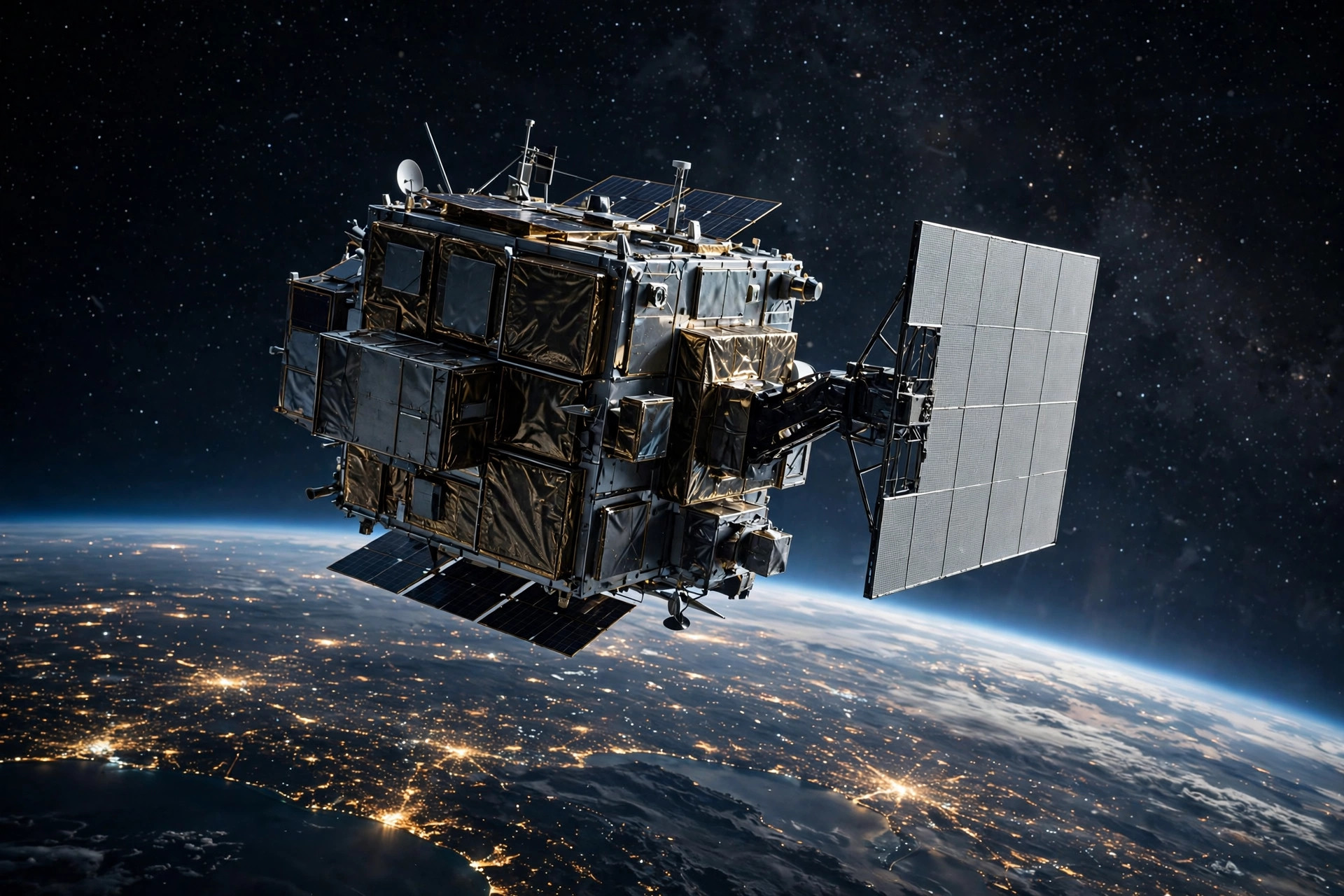
On the evening of October 17, Marco Langbroek was watching two dots of data closing on each other the way other people watch a storm front. The Dutch satellite tracker, who teaches space situational awareness at Delft University of Technology, had been following Russia’s Kosmos 2612 for weeks. That night the orbital elements said the two spacecraft were 1 to 2 kilometers apart, and still closing.
How close it actually got is still genuinely unsettled, and the spread of answers tells its own story about how this kind of watching works. LeoLabs, whose radars tracked the whole approach and published an event report on October 19, put the closest pass at about 500 meters, after a deliberate series of maneuvers that closed from hundreds of kilometers away, held station 2 to 3 kilometers off, then slid ahead of and behind the commercial satellite again and again; at times the firm’s radars struggled to tell the two spacecraft apart. Langbroek’s data suggested 1 to 2 kilometers on October 17. Some public models put the minimum under 100 meters. Fox News reported 100 feet. Adam Marsh, a LeoLabs vice president, told Ars Technica the pair were “likely quite a bit closer” than 500 meters, which is as far as anyone outside the two operators has been willing to go.
Langbroek had not started out convinced there was a target at all. “Initially I was skeptic whether #ICEYEX36 really was an intentional target,” he wrote on X on October 17, “but a series of manoeuvers by #Kosmos2612 starting on Sept 30, were clearly designed to bring the two objects very close and synchronise their orbital periods, orbital altitude and eccentricity.” More burns followed on October 12, 15 and 16, dialing the two spacecraft onto the same altitude, the same period, the same shape of orbit. “This is an #RPO without consent,” he added. By October 20 the Russian satellite was backing away at roughly 10 miles an hour relative to its quarry.


The burns that convinced him were the expensive kind. Kosmos 2612 is one of six Russian military satellites, Kosmos 2609 through 2614, that rode a single Soyuz-2.1b into orbit in April; their exact job is unconfirmed, though they look like inspector types, spacecraft built to sidle up to other objects in space. In May, four of the six fired their engines and changed orbital planes to match ICEYE-X36’s. A plane change is among the costliest maneuvers a satellite can make, measured in the fuel that is also its working life. The US Space Force noticed as early as May, calling out Russian satellites positioned close to a Western commercial radar satellite used by Ukraine for imagery intelligence, and Kyiv had been briefed too — a Ukrainian official told Axios the military had known about similar maneuvers in the spring and summer. So by the time LeoLabs published its report, the tracking community had been watching some version of this for five months.
ICEYE-X36 is a radar satellite: it pings the ground with microwaves and reads the echo, so it sees through cloud cover and darkness. The Finnish company behind it runs the world’s largest commercial radar constellation, and since August 2022 it has given Ukraine access to its imagery; this January it expanded that arrangement with a customer inside Ukraine’s defense ministry. Whether X36 itself feeds the Ukrainian war effort, ICEYE has never said.
Two days after the satellite began backing away, the United States made it official. At the UN’s First Committee, Under Secretary of State Thomas DiNanno said Kosmos 2612 had been “exhibiting threatening behavior by intentionally maneuvering dangerously close to a commercial satellite, behaviors consistent with on-orbit weapons operations.” The accusation landed the same day US envoy Steve Witkoff sat down with Vladimir Putin in St. Petersburg. Jonathan McDowell, the astrophysicist who has tracked launches for decades, wrote on X that to his knowledge “this is the first LEO rendezvous of two active satellites where the owner of one of the sats did not give approval.” Close passes have happened before, he added, “but not I think rendezvous (matching velocity vector).” Russia has done the close-approach part to American spy satellites — Kosmos 2543 sidled to about 30 kilometers of USA 245 in 2020, Kosmos 2558 got within about 70 kilometers of USA 326 in 2022 — and both of those targets were classified military spacecraft, owned by a state that could answer in kind.
A company answers differently, and mostly it hasn’t. Michael Traut, who heads Germany’s Space Command, said the Russian satellite was “chasing” its quarry and warned that maneuvers like these force a satellite to spend fuel adjusting its orbit — fuel that comes straight out of its working life. ICEYE’s public response, in full, is that it is “aware of the situation and tracking it closely,” and that its “constellation architecture is designed for continuity and resilience.” It hasn’t said whether ICEYE-X36 moved, burned fuel, or was damaged, or which of its customers use the spacecraft. The law it is operating under is the 1967 Outer Space Treaty, which gives the country that registers a satellite jurisdiction over it — X36 is US-registered through ICEYE’s American arm in Irvine, California — but sets no minimum distance between spacecraft. The only applicable rule is “due regard.” Analysts note that even physical interference wouldn’t automatically count as an armed attack on American territory, and NATO has said only that hostile acts in space could trigger collective defense “depending on the circumstances.”
Five of Kosmos 2612’s siblings are still up there, most of them already parked in the orbital plane where the West’s commercial radar satellites fly.