BNY Mellon Subsidiary and German Banks Join EU Crypto Registry as MiCA Approvals Pass 300
ESMA adds 15 new crypto service providers including BNY Mellon's Belgian arm and three German banking institutions.
The central database maintained by the European Securities and Markets Authority (ESMA) has reached 309 licensed crypto-asset service providers (CASPs) following its third update since the European Union’s transitional deadline on July 1.
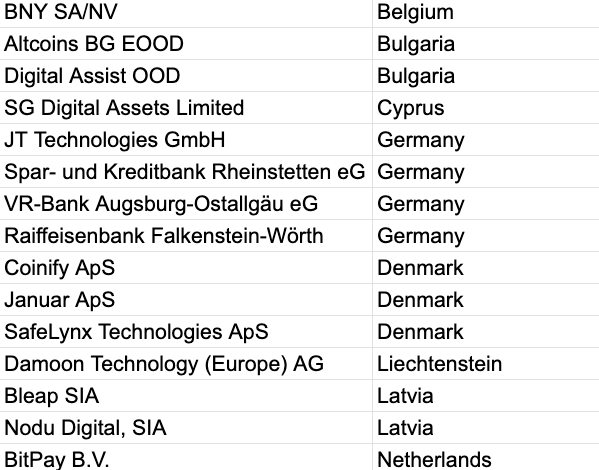
Fifteen new firms were added to the interim Markets in Crypto-Assets (MiCA) register, highlighted by the inclusion of BNY SA/NV, the Belgian subsidiary of American banking institution BNY Mellon. The registration signals growing involvement from traditional legacy financial institutions seeking compliant infrastructure under the European Union’s unified regulatory architecture.
Three cooperative banking entities from Germany also joined the public registry: Spar-und Kreditbank Rheinstetten, VR-Bank Augsburg-Ostallgäu, and Raiffeisenbank Falkenstein-Wörth. Digital asset native companies, including payment processors BitPay and Coinify alongside digital platform Bleap, were registered in the same batch.
Geographically, Germany and Denmark recorded the highest number of new registrants in the update, with three providers each. Among the Danish entries were payment infrastructure provider Januar and technology company SafeLynx Technologies. Bulgaria and Latvia added two entities each—Bulgaria registering Altcoins BG and Digital Assist, while Latvia added Bleap and Nodu Digital. Individual authorizations were finalized across Belgium, Cyprus, Liechtenstein, and the Netherlands.
The MiCA framework was created to establish a harmonized regulatory environment across all 27 EU member states, replacing individual country regulatory regimes with a single set of operational requirements. Under this system, licensed entities receive passporting rights, enabling them to market and execute digital asset services across the entire European Economic Area under one national license.
ESMA’s latest registrations build on previous post-July updates, which included 14 service providers such as Ripple Payments Europe. While the main service provider register continues to expand, ESMA reported no changes to secondary MiCA registers covering authorized issuers of asset-referenced tokens (ARTs), e-money tokens (EMTs), standard crypto-assets, or designated non-compliant entities.
The cost and complexity of adhering to MiCA standards have sparked debate regarding market concentration. High overhead costs associated with ongoing regulatory reporting, risk governance, and capital reserves could create significant barriers for early-stage firms. Industry leaders, including Gate Europe Chief Executive Officer Giovanni Cunti, have noted that smaller operators may face operational strain trying to maintain the required compliance resources over the long term.