CME Revives Single-Stock Futures as Alternative to Equity Options for Retail and Institutional Traders
The Chicago exchange is introducing cash-settled contracts on over 50 top U.S. companies, offering 23-hour leveraged trading without options complexity.
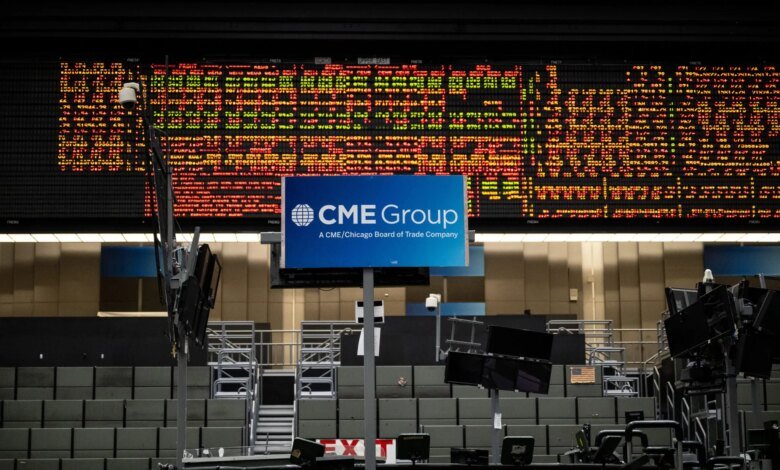
CME Group Inc. is launching single-stock futures on Monday, bringing back a leveraged derivative product that previously stalled in the United States to give traders a straightforward alternative to stock options for betting on major companies like Nvidia Corp. and SpaceX.
The cash-settled quarterly contracts will cover more than 50 prominent U.S. equities and trade 23 hours a day, five days a week, offering market access well beyond standard U.S. cash market trading hours of 9:30 a.m. to 4:00 p.m. Eastern Time. CME is introducing two distinct contract sizes: 55 standard contracts representing 100 shares each and 22 micro contracts representing 10 shares. The smaller micro lineup features key technology leaders among the Magnificent Seven alongside major corporations such as Micron Technology Inc., Pfizer Inc., and Walmart Inc.
Unlike equity options, which require traders to account for complex pricing variables known as the Greeks—such as delta, theta, and implied volatility—single-stock futures track underlying stock price movements directly while providing leverage. This direct structure is designed to appeal to retail investors seeking capital efficiency as well as institutional asset managers looking to hedge concentrated risk or gain synthetic long or short exposure when share allocations are constrained, as often occurs during high-demand initial public offerings. CME has lined up more than 35 retail brokerages and intermediaries to facilitate access for individual traders.
The debut represents a major attempt to revive an asset class with a troubled domestic history. Federal authorities originally banned single-stock futures for nearly two decades before the landmark Commodity Futures Modernization Act of 2000 established a joint regulatory framework under the Securities and Exchange Commission and the Commodity Futures Trading Commission. Although trading officially began in late 2002, the contracts struggled to maintain trading volume and liquidity, leading to the eventual shutdown of the last operating exchange, OneChicago, in 2020. Regulators later reduced margin requirements to help stimulate market interest, clearing the path for CME’s dual-agency approval. Speaking on a July 22 earnings call, CME Chairman and Chief Executive Officer Terry Duffy acknowledged the failure of the initial launch two decades ago, emphasizing that market structures and trading behavior have since evolved.
In international markets, single-stock futures have long maintained a substantial footprint. In India, robust single-stock derivative volumes underpin cash-futures arbitrage strategies and power specialized arbitrage funds while serving as a primary tool for retail directional trading. Across European exchanges, institutional asset managers routinely utilize single-stock futures for balance sheet optimization around regulatory reporting periods, as well as for managing dividend exposures and hedging net equity risk, noted Jeremy Cohen, global head of Stellar Securities.
Despite the operational simplicity compared to options, trading single-stock futures carries distinct financial considerations. Mat Cashman, principal for investor education at the Options Clearing Corp., cautioned that extended 23-hour trading windows can expose retail investors to erratic price swings during earnings announcements and off-hours events when liquidity is limited. Additionally, while retail stock and options trading frequently benefit from zero-commission structures financed through payment for order flow, futures transactions generally incur direct broker trading fees.
Market analysts note that widespread adoption will largely depend on broker distribution. Stuart Kaiser, head of U.S. equity-trading strategy at Citigroup, observed that retail investors currently rely heavily on call options and leveraged exchange-traded funds for leverage, meaning discount brokerages will need to actively promote single-stock futures for the product to gain meaningful market share. The product launch also comes during a competitive period for Chicago-based CME, which faces growing activity from offshore decentralized venues such as Hyperliquid, event-driven prediction platforms like Kalshi and Polymarket, and rival exchanges in key energy complexes.