Pentagon Reclassifies Recent American Combat Casualties in Middle East Escalation
Slain U.S. troops moved to separate database category as official casualty accounting faces scrutiny amid renewed conflict.
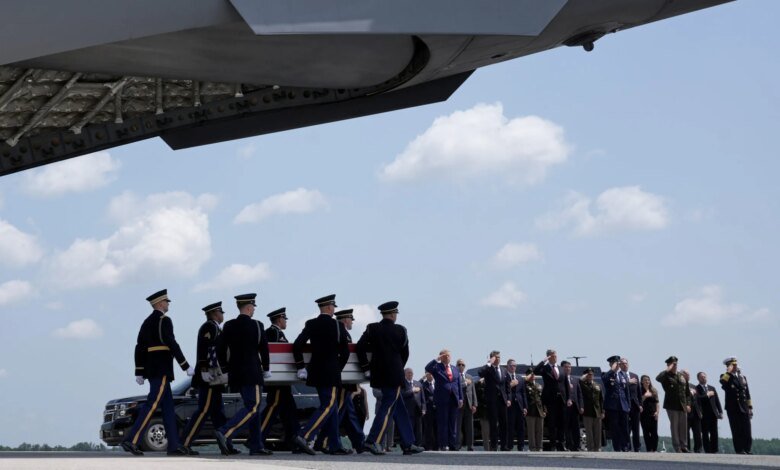
The U.S. Department of Defense has altered its public tracking of combat casualties from recent military engagements with Iran, reassigning four slain American soldiers and more than 200 wounded service members from its main conflict tally into a newly created generic category.
The Defense Casualty Analysis System, long cited by military officials as the primary public repository for wartime casualties, updated its database to introduce an “Overseas Operations” classification. This revision removed four Army soldiers killed in July, along with dozens of injured personnel, from the official Iran conflict death toll.
The database adjustment effectively lowered the listed death toll for the direct Iran campaign from 18 back down to 14, creating a divergence between official records and public statements made by President Donald Trump, who acknowledged on social media that 18 American lives had been lost in the confrontation.
The Strait of Hormuz serves as a vital maritime transit corridor handling approximately 20 percent of global petroleum shipments. Tensions in the region reignited on July 7 after Iranian forces targeted three commercial vessels near Oman, prompting retaliatory U.S. air strikes and the collapse of a tentative ceasefire signed in June.
The four fatalities occurred shortly after hostilities resumed. On July 17, an Iranian ballistic missile and drone strike on a base in Jordan killed three U.S. soldiers. A day later, a fourth soldier died in Iraq during a controlled detonation of a downed Iranian drone. When initially announcing the casualties, military officials characterized the Jordan deaths as supporting anti-ISIS operations, while the Iraq casualty was attributed broadly to overseas support missions.
Under the new website structure, the “Overseas Operations” designation specifically aggregates casualties sustained on or after July 7. The section records four deaths by name alongside 207 wounded personnel, though military documentation does not clarify whether all listed injuries stem exclusively from the Iran-related exchanges.
A U.S. official speaking anonymously indicated that the actual number of wounded service members across the broader conflict exceeds 500, a figure considerably higher than the 420 listed in the primary Iran conflict counter following the update.
Senior Defense Department spokespersons rejected suggestions that the administrative shifts were intended to obscure the human cost of the escalating operations. Pentagon Press Secretary Joel Valdez described the sudden drop in public casualty numbers as a result of temporary “anomalies” and data disruptions undergoing technical resolution. Top spokesman Sean Parnell similarly characterized the system changes as administrative glitches rather than policy shifts.
Historically, major military operations involve regular press briefings to account for operational progress and troop welfare. However, the Department of Defense has not held a formal press briefing regarding the Iran campaign since early May, while U.S. Central Command has ceased distributing routine casualty summaries directly to news organizations.
The initial stage of the war, launched jointly by U.S. and Israeli forces on Feb. 28, resulted in 14 American fatalities before a temporary cessation of hostilities was negotiated in April and formalized in mid-June. Subsequent nocturnal strike exchanges across the Gulf region have continued, though direct bombardments paused briefly as diplomatic intermediaries sought to negotiate a new truce.